

Procrastination is a silent productivity killer for entrepreneurs. It often stems from fear of failure, perfectionism, overwhelm, unclear goals, and distractions. These behaviors can cost businesses time, money, and momentum. For example, procrastinating three hours daily can lead to nearly $15,000 in lost productivity annually for someone earning $40,000 per year.
Here’s a breakdown of why procrastination happens and how to overcome it:
- Fear of Failure and Perfectionism: Fear can lead to avoidance, while perfectionism creates analysis paralysis. Solution: Treat failure as a learning opportunity, set achievable goals, and limit revisions.
- Overwhelm and Too Many Tasks: Juggling multiple roles often leads to burnout. Solution: Prioritize high-impact tasks, break them into smaller steps, and set clear work boundaries.
- Lack of Motivation and Unclear Goals: Vague objectives reduce drive and lead to busywork. Solution: Define specific goals, track progress, and use accountability tools.
- Distractions and Poor Work Environment: Notifications, clutter, and interruptions derail focus. Solution: Eliminate distractions, declutter your workspace, and create a focused routine.
The key to beating procrastination is starting small, staying consistent, and building momentum. Use strategies like the “One-Minute Rule” or “Eat the Frog” to tackle tough tasks, and watch your productivity soar.
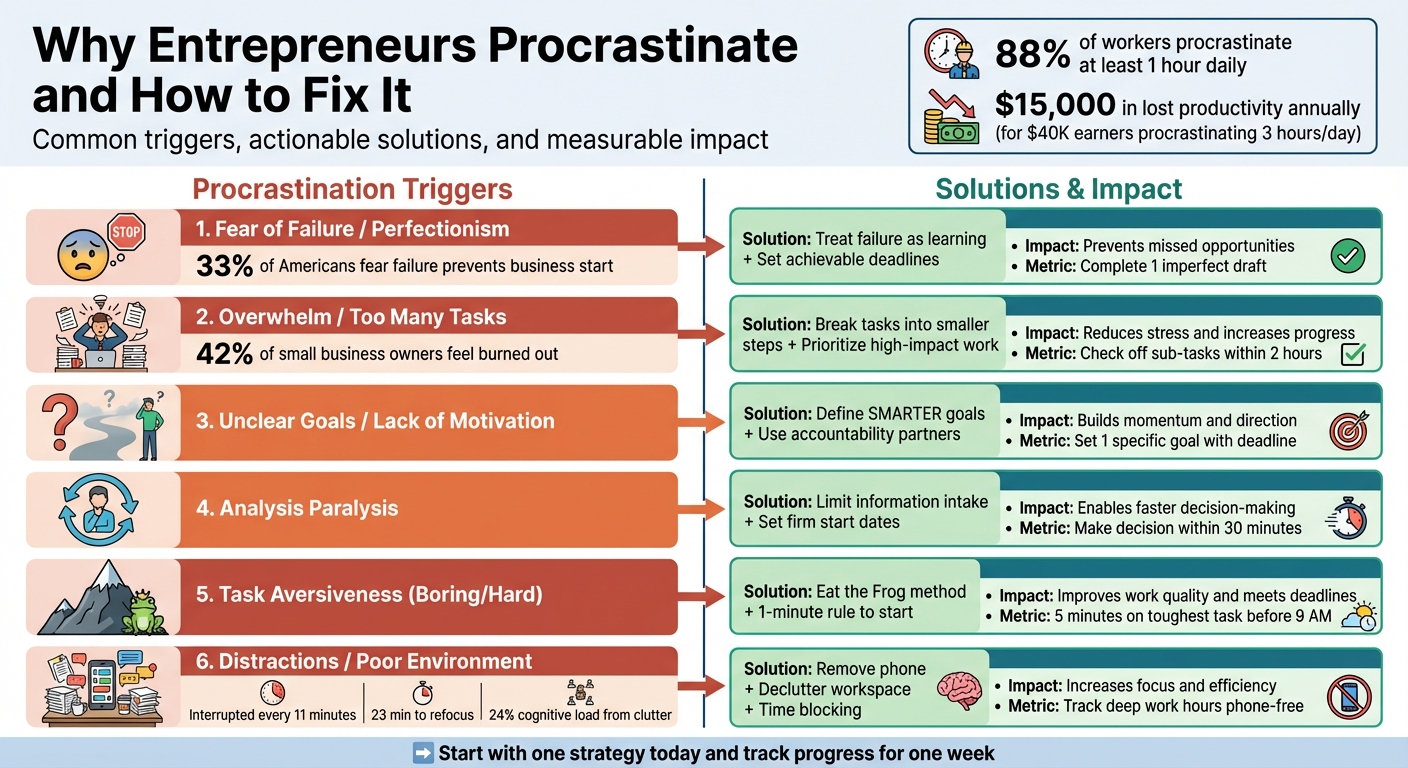
Procrastination Triggers and Solutions for Entrepreneurs
Reason 1: Fear of Failure and Perfectionism
Why Fear of Failure Stops Entrepreneurs
The statistics are striking: 33% of Americans admit that fear of failure keeps them from starting a business. But this fear doesn’t just hold back aspiring entrepreneurs – it can also paralyze those already running businesses, stopping them from taking necessary steps to grow or adapt.
Here’s why: your brain treats professional risks as threats. When faced with high-stakes tasks – like making a critical sales call, hiring your first employee, or launching a new product – your mind confuses discomfort with danger. This often triggers avoidance behaviors, leading to what experts call productive procrastination. Instead of tackling the tough tasks, you might find yourself redesigning your logo, rewriting email copy, or reorganizing your workspace. These activities feel like progress but don’t actually move the needle. By avoiding the real challenges, you keep alive the comforting illusion that success is still possible – if only you tried.
"Not-starting IS the reward. As long as you delay, you get to keep the story: ‘I could do it perfectly if I really tried.’ The moment you start, that story is at risk." – Dr. Jud Brewer, MD, PhD
This fear of failure often pairs with perfectionism, creating a powerful barrier to action.
How Perfectionism Creates Analysis Paralysis
Research across 43 studies reveals a key distinction: "perfectionistic strivings" (the drive to excel) can reduce procrastination, while "perfectionistic concerns" (fear of mistakes and judgment) significantly increase it. One stems from ambition, the other from anxiety.
Take this example: an entrepreneur who founded a website-building company spent five years creating his own company website. Despite having the expertise, his fixation on perfection left him stuck with just a single landing page for half a decade. In another case from 2024, a business owner trying to sell his company delayed the process by overcomplicating every step – conducting endless broker interviews, demanding excessive revisions, and expanding the buyer list from 200 to 1,000 names. These delays pushed the deal past its August 2024 target. By November, new tariff policies scared off buyers, and the deal collapsed, costing the owner millions.
The problem with perfection? It’s impossible to define, let alone achieve. You could spend one week producing A– work or a month chasing A+ work – but those extra weeks often mean lost opportunities and momentum. Research shows that fear of failure is the link between perfectionism and procrastination; remove the fear, and perfectionism loses its grip.
"Perfectionism doesn’t drive you forward. It keeps you stuck." – Dr. Jud Brewer, MD, PhD
These examples underscore how fear and unattainable ideals can derail progress, leaving entrepreneurs trapped in a cycle of inaction.
sbb-itb-fc951a8
Fix for Fear of Failure and Perfectionism
Treat Failure as a Learning Tool
The way you perceive failure can make all the difference. Instead of seeing it as a full stop, try to view it as a sign that you’re stepping into an opportunity to grow. When things don’t go as planned, take a moment to reflect and identify three key lessons you can take away from the experience.
This is where the Three-Lesson Rule comes in: after every misstep, jot down three specific insights you gained. Doing this shifts the narrative from failure to progress. And remember, your self-worth isn’t tied to your business outcomes. As scale coach Brent Lowe wisely says: "I am not my business". A failed product launch doesn’t define you – it simply provides valuable data on what doesn’t work.
Interestingly, research suggests that forgiving yourself for past procrastination can reduce the guilt and shame that often lead to more avoidance. By letting go of the idea that mistakes are personal judgments, you can break free from the cycle of self-doubt. Keep in mind: each success you achieve releases dopamine, reinforcing your confidence and helping you escape the shame spiral.
With this mindset, you’ll be better equipped to approach tasks directly and set realistic goals.
Set Achievable Goals and Deadlines
Perfectionism can be paralyzing because it’s impossible to pin down. But striving for excellence? That’s motivating and within reach. To get there, try the "Good, Better, Great" framework. Start with a “good” version of your project to create a solid base, then refine it into something “better,” and eventually aim for “great” as you go.
Another helpful approach is the Three-Change Rule: limit yourself to three revisions for any single piece of work before moving on. This keeps you from falling into the trap of endless tweaks. If starting feels like an insurmountable hurdle, try the One-Minute Start – commit to working on the task for just 60 seconds. Often, just beginning is the hardest part, but once you start, momentum tends to follow.
Break larger projects into smaller, manageable milestones and set realistic deadlines for each one. Even if the outcome isn’t flawless, meeting those deadlines builds progress and confidence. And if you find yourself behind schedule, focus on speeding up rather than stalling further.
Reason 2: Overwhelm from Too Many Tasks and Unclear Boundaries
The Difficulty of Balancing Business and Personal Life
When work spills into personal time, it can feel like you’re always "on." Handling business tasks late at night or during family time leaves little room to relax and recharge. Over time, this imbalance drains your energy and makes it harder to manage tasks effectively.
Without clear boundaries, this constant flexibility can lead straight to burnout. In fact, 42% of small business owners admit to feeling burned out and even resentful toward their businesses because they lack those boundaries. Burnout doesn’t just make you tired – it makes every task feel heavier, creating a vicious cycle of procrastination. The blurred lines between work and personal life, combined with an ever-growing list of tasks, can seriously impact your well-being and productivity.
The Problem with Overloaded To-Do Lists
A chaotic to-do list can be just as overwhelming. Entrepreneurs often juggle multiple roles, which makes it hard to focus on what’s truly important. Add constant interruptions to the mix, and staying on track becomes nearly impossible.
When tasks aren’t prioritized or properly documented, decision fatigue kicks in. You find yourself jumping from one thing to another without completing anything. The numbers tell a stark story: 88% of workers admit to procrastinating for at least an hour every day. If you’re earning $40,000 a year and procrastinate three hours daily, that’s nearly $15,000 in lost productivity annually. Mike Clark, a wealth manager, puts it perfectly:
"Overwhelm signals the need to pause, reassess, and set firm boundaries".
Fix for Overwhelm from Too Many Tasks and Unclear Boundaries
Prioritize and Break Tasks into Smaller Steps
Feeling overwhelmed by your workload? Start by evaluating your tasks based on their impact on revenue. Give each task a score from 1 to 10, where higher numbers represent a greater impact. Focus your energy on tasks scoring 9 or 10 – things like sales calls, launching products, or onboarding clients. For tasks scoring below a 5, consider delegating, automating, or even cutting them out entirely. Here’s a surprising fact: 73% of tasks entrepreneurs handle daily score below a 5 on revenue impact. That’s a lot of time spent on things that might not be moving your business forward.
Once you’ve pinpointed your high-priority tasks, break them down into smaller, actionable steps. Work backward from your goal and map out each step clearly. For instance, instead of writing "work on website", try something like "install theme" or "upload three product images." This kind of clarity makes it easier to know when a task is done, helping you move forward without second-guessing.
Another effective method is tackling "low-hanging fruit." Knock out any task that takes less than 30 minutes. This not only shortens your to-do list but also builds momentum. On the flip side, if there’s a big, anxiety-inducing task hanging over your head, try the "eat the frog" strategy: tackle it first thing in the morning. For maximum productivity, schedule your top three high-impact tasks during your peak energy hours – typically between 9:00 a.m. and 11:00 a.m. – and fiercely protect that time.
Once your tasks are under control, it’s time to focus on protecting your personal time.
Set Clear Boundaries and Work Schedules
Setting boundaries is crucial for avoiding burnout and staying productive. Start by defining your work hours and treating them as non-negotiable. Decide on a clear start and end time for your day, and make sure to communicate this to clients, team members, and even family. Without these boundaries, work can easily spill into personal time, and that’s a fast track to burnout – something 42% of small business owners report experiencing.
To safeguard your personal time, disconnect digitally when you’re off the clock. Turn off work notifications during family time and remove work-related apps from personal devices. Auto-responders can also help manage client expectations by letting them know when they can expect a reply. If clients make extra requests, explain how these could affect your timeline or budget. This way, you maintain professionalism while ensuring your boundaries aren’t compromised.
Reason 3: Lack of Motivation and Unclear Goals
How Unclear Goals Reduce Motivation
When your business objectives lack precision, your brain struggles to find a clear direction. For instance, "Start an online business" is just an idea – it’s not a specific or measurable goal. Without clear, actionable targets, tracking progress becomes nearly impossible, and any initial motivation can quickly fizzle out. The problem worsens when there’s no defined first step. Even the most inspiring long-term vision can feel paralyzing without a clear "Step 1" to get started. This often leads entrepreneurs to fall into the trap of "busy-ness" – spending time on low-priority tasks like organizing files or perfecting a logo. While these activities feel productive, they delay the meaningful work that drives real progress.
"Procrastination occurs when present costs are unduly salient in comparison with future costs, leading individuals to postpone tasks until tomorrow without foreseeing that when tomorrow comes, the required action will be delayed again." – George A. Akerlof, Nobel Prize Winner in Economics
Without clear goals, not only does motivation take a hit, but the mental load of decision-making becomes even more exhausting.
How Decision Fatigue and Stress Drain Energy
Entrepreneurs face a constant stream of decisions every day – everything from setting priorities to managing budgets. This endless decision-making creates mental pressure, making even simple tasks feel overwhelming. Adding to this, many tie their self-worth to outcomes, which raises the stakes and can lead to avoiding difficult but necessary tasks.
Decision fatigue is a major energy drain. Research shows that most workers delay tasks daily, which only worsens the effects of decision fatigue. Compounding this, the brain naturally leans toward instant rewards – like checking social media or tackling easy tasks – over the delayed gratification that long-term goals require. This tendency makes the immediate effort feel heavier than the future payoff, creating a cycle of procrastination. These mental challenges are a critical factor in why so many entrepreneurs struggle to maintain momentum.
Next, we’ll dive into actionable ways to overcome these challenges and reignite your motivation.
Fix for Lack of Motivation and Unclear Goals
Define Your Vision and Personal Purpose
Start by identifying the core reason behind launching your business. This driving "why" becomes your compass, helping you stay focused even when motivation wanes. Once you’ve nailed down your purpose, break it into SMARTER goals: Specific, Measurable, Achievable, Relevant, Time-bound, Evaluated, and Re-adjusted. For instance, instead of saying, "I want to start an online business", you could set actionable steps like "choose a website theme by Friday" or "finalize product pricing by March 31, 2026."
Take Foundr as an example. In 2020, they tripled their growth by breaking their big goals into smaller, manageable actions. They used a traffic light reporting system to track progress, which helped them stay accountable and avoid self-doubt.
To bring your vision to life, reverse-engineer it. Connect your daily to-dos to your ultimate goal. Even the tasks you dread can feel more meaningful when you view them as stepping stones toward success. Use tools like dashboards or spreadsheets to track progress, giving every task a clear purpose and sidestepping procrastination.
Use Accountability Tools and Partners
Once your goals are clear, external accountability can help you stick to them. An accountability partner – someone who checks in regularly – can make a big difference. Ideally, team up with someone whose skills complement yours. For extra support, look into online communities like Facebook groups, Reddit forums (e.g., r/entrepreneur), or local business masterminds.
Leverage digital tools too. Set reminders on your phone or computer, and experiment with techniques like the one-minute timer or tackling your hardest task first. These small actions can help you push past inertia. And if you fall behind, don’t beat yourself up. Forgive yourself, reset, and keep moving forward – it’s the best way to break the cycle of procrastination.
Reason 4: Distractions and Poor Work Environment
Common Distractions That Affect Entrepreneurs
A buzzing phone, endless email notifications, or an unplanned interruption – these are the silent productivity killers. Digital distractions like constant alerts, social media scrolling, and compulsive email checks can derail even the most focused individual. Did you know office workers are interrupted every 11 minutes on average? Even worse, it takes about 23 minutes and 15 seconds to regain focus after just one interruption. And surprisingly, even a tiny 2.8-second distraction can double the error rate on cognitive tasks.
Entrepreneurs often face another challenge: impulsive project hopping. Jumping from task to task might feel productive, but it often means avoiding the hard decisions that actually move the needle. As Entrepreneur.com highlights:
"Procrastination is not a time management problem. Every act of procrastination is an attempt to avoid a specific emotional experience."
When tasks feel daunting or failure looms large, distractions become an easy escape route. But it’s not just digital distractions at play – your physical environment can be equally disruptive.
How Your Environment Affects Productivity
While notifications steal your attention, your workspace can quietly drain your energy. A cluttered desk isn’t just messy; it increases cognitive load by 24%, leading to faster mental exhaustion. That pile of papers or scattered items? They’re not just eyesores – they’re productivity traps.
Temperature matters too. If your workspace is too cold – below 68°F – errors jump by 44% and output drops by 50%. The sweet spot for peak performance is between 71°F and 77°F. And here’s a surprising fact: even a silent, face-down smartphone on your desk can lower your working memory capacity by 10–12%.
For entrepreneurs working from home, the challenges multiply. The boundaries between personal and professional life blur, making it tough to focus. As writer Brenda Barron puts it:
"The line between your personal and professional life can easily blur. This can make it difficult to prioritize tasks and focus on your business, as household chores or other personal tasks might keep distracting you."
The financial impact of these distractions is no small matter. If someone earning $40,000 annually procrastinates for just three hours a day, they could lose nearly $15,000 in productivity. Your workspace isn’t just about aesthetics – it’s a direct contributor to your efficiency and success. Addressing workspace issues is just as important as tackling the emotional and mental hurdles of procrastination.
Fix for Distractions and Poor Work Environment
Remove Distractions and Set Boundaries
Tackling distractions requires deliberate actions to regain focus. A simple first step? Move your phone to another room. Research shows that even a silent smartphone nearby can reduce your working memory capacity by 10–12% – mental energy you need for critical thinking and decision-making.
Next, turn off unnecessary notifications. The average entrepreneur deals with 46 push notifications daily, each one breaking concentration. To combat this, disable non-emergency alerts and limit email checks to three times a day. Apps like Hold can help you curb phone usage, while tools such as Marinara Timer encourage focused work sessions (25 minutes on, 5 minutes off).
Consider creating a "Not-To-Do" list. Write down activities you’ll avoid during work hours – no scrolling through social media, no reading the news, no texting. As content writer Jenny Rose Spaudo aptly puts it:
"Distraction is often the path of least resistance because it tends to be passive, mindless, and comfortable".
This approach helps you establish clear boundaries, training your brain to stay on track.
Time blocking is another powerful method. Dedicate 2–4 hours for high-priority tasks and communicate your unavailability to family, friends, and colleagues during these periods. When others respect your focused time, interruptions decrease, giving you the space to tackle your most important work.
Improve Your Work Environment
Your workspace has a direct impact on your ability to concentrate. Start by decluttering your desk – keep only the essentials. Research suggests that reducing visual clutter can lower cognitive load by 24%. Use closed storage like cabinets or drawers for non-essential items, and try implementing the 5S methodology: Sort, Set in order, Shine, Standardize, and Sustain. These changes not only simplify your physical space but also complement your efforts to manage digital distractions.
Temperature matters, too. Aim to keep your workspace between 71°F and 77°F for peak performance. If you can’t adjust the thermostat, layer your clothing or use a small space heater to stay comfortable.
Noise is another critical factor. Invest in noise-canceling headphones rated at -25 to -30 dB. Background chatter or TV noise can slash cognitive performance by up to 50%. For added focus, try playing pink noise through your headphones to mask distractions.
Lastly, bring some nature into your workspace. Adding a small plant to your desk or positioning yourself near a window can make a noticeable difference. Studies show that office plants can increase productivity by 15% and reduce stress by 37%. This "soft fascination" from greenery provides a mental break, helping your mind recharge and stay sharp.
How To Stop Procrastinating In Business (Complete System)
Procrastination Triggers vs. Solutions Comparison Table
Here’s a handy table that matches common procrastination triggers with solutions you can apply right away. It also highlights the potential impact on your business and offers measurable ways to track progress.
| Procrastination Trigger | Actionable Solution | Impact on Business | Immediate Measurement |
|---|---|---|---|
| Fear of Failure / Perfectionism | Shift your mindset: treat fear as a sign of growth and set achievable deadlines | Missed chances and wasted time on less important tasks | Complete one "imperfect" draft or prototype |
| Overwhelm / Complexity | Break tasks into smaller, manageable steps; use SMART goals | Slower progress, added stress, and team frustration | Check off several sub-tasks within 2 hours |
| Analysis Paralysis | Reduce information intake and set a firm start date | Stalled innovation and difficulty staying competitive | Make a decision within 30 minutes |
| Task Aversiveness (Boring/Hard) | Tackle the hardest task first (“Eat the Frog”); try the 1-minute rule to get started | Rushed work, lower quality, and missed deadlines leading to financial setbacks | Spend 5 minutes on the toughest task before 9:00 AM |
| Distractions / Environment | Eliminate digital distractions and establish clear work boundaries | Loss of focus and inefficient time use | Track "Deep Work" hours without using your phone |
| Lack of Accountability | Partner with an accountability buddy or join a mastermind group | Damaged reputation and unmet commitments to collaborators | Schedule and attend a weekly check-in meeting |
This table highlights how procrastination affects your business and provides actionable steps to overcome it. Pinpoint your primary trigger, apply the suggested solution, and monitor the quick-win metric for a week. Regularly revisit these strategies to refine your approach and maintain steady progress.
Conclusion
Procrastination often arises from fear, perfectionism, and feeling overwhelmed. It’s a common issue – 88% of workers admit to procrastinating daily, which can cost a $40K earner nearly $15,000 annually in lost productivity. As Stacey Davis, Founder and Consultant, aptly states:
"Procrastination is the silent killer of dreams. It stops more businesses from starting than a lack of funding, a bad economy, or even self-doubt".
To combat procrastination, start by changing your mindset. Break tasks into smaller, manageable steps and eliminate distractions. Use fear as a motivator to take action, not as a reason to stop. Begin your day by tackling the most challenging task (also known as "eating the frog"), minimize interruptions, set clear boundaries, and create accountability through partnerships or mastermind groups.
Momentum is a key factor that separates successful entrepreneurs from those who never launch. For example, in 2020, Foundr, a media company, introduced a visual "traffic light reporting system" to objectively track progress. This simple yet effective approach helped them triple their business growth in just one year.
A practical way to get started is by using the one-minute rule: commit to working on your toughest task for just 60 seconds. Often, the hardest part is starting, and once you do, momentum takes over. Forgiving yourself for past procrastination also helps break the guilt cycle, making it easier to avoid repeating the pattern. As Davis wisely points out:
"The best way to get it right is to get it started".
Take action now. Choose one strategy from this article and put it into practice today – your future self, and your business, will thank you.
For more practical tips to overcome procrastination and fuel your entrepreneurial success, visit Legendary Life Media (https://legendarylifemedia.com).
FAQs
How do I find my main procrastination trigger?
Identifying what causes your procrastination starts with reflecting on the emotions and thoughts you experience when you put off tasks. Some common culprits include fear of failure, anxiety, perfectionism, or simply feeling overwhelmed. Take a moment to analyze your behavior. Are you sidestepping tasks because you’re afraid of not meeting expectations? Are distractions pulling your focus, or are you doubting your ability to succeed?
By recognizing these patterns, you can uncover the deeper reasons behind your procrastination and take meaningful steps to tackle it.
What should I do when perfectionism keeps me from starting?
Perfectionism can often act as a sneaky form of procrastination, keeping you stuck in place. Instead of striving for perfection, try focusing on progress. Begin with small, manageable goals and remind yourself that your initial efforts don’t have to be flawless – they just need to get you moving. Adopting this perspective can help you escape the perfectionism trap and take action, even if the outcome isn’t ideal.
How can I stay focused when distractions keep pulling me away?
To tackle procrastination effectively, it’s important to understand what’s causing it. Often, fear of failure or perfectionism can be at the heart of the issue. Start by setting clear work boundaries and cutting out distractions – this helps create an environment where you can focus. Instead of aiming for perfection, shift your mindset to prioritize progress.
Breaking tasks into smaller, manageable steps can also make a big difference. Aim for "good enough" rather than getting stuck overanalyzing every detail. These approaches can keep you productive and on track, even when life throws interruptions your way.
Related Blog Posts
- 5 Habits That Kill Your Creative Flow
- Why Entrepreneurs Need Accountability Systems
- Entrepreneurs vs. Pressure: Decision-Making Tactics
- SMART Goals for Entrepreneurs: Step-by-Step Guide
About The Author