

The Pareto Principle, or the 80/20 rule, is a simple concept: 80% of outcomes often come from just 20% of efforts. This idea helps you focus on tasks that truly matter, saving time and boosting results. Originating from economist Vilfredo Pareto‘s observation in 1896, it has since been applied in productivity, business, and personal growth. For example, Microsoft once found fixing 20% of bugs resolved 80% of crashes.
Here’s how you can apply it:
- List Tasks: Write down everything you need to do.
- Evaluate Impact: Identify which tasks contribute most to your goals.
- Prioritize: Focus on the top 20% of tasks that lead to 80% of results.
- Use Tools: Apps like Asana or Life Planner can help track and prioritize tasks.
- Review Regularly: Adjust your focus weekly to stay aligned with your goals.
How Pareto Principle Can Boost Your Productivity
sbb-itb-fc951a8
Benefits of Using the 80/20 Rule
Applying the 80/20 rule can help you zero in on what truly matters while simplifying your workflow. The Pareto Principle often leads to noticeable improvements in both work and personal life.
Higher Productivity
When you focus on tasks that have the biggest impact, you’re not just working harder – you’re working smarter. Studies suggest that peak productivity typically lasts about three hours a day, yet workers spend roughly 58% of their time on "work about work" (like meetings, emails, and admin tasks). That leaves only 33% of the day for meaningful, high-impact work. By prioritizing the tasks that truly count, you can maximize those valuable productive hours. Tools like time tracking can help you stay focused on what’s most important.
Improved Time Management
The 80/20 rule can bring order to a cluttered schedule. By identifying the 20% of tasks that deliver the most value, you can allocate your time more effectively. This means dedicating your peak focus hours – around three hours when your energy is highest – to your most critical work. Instead of letting meetings or emails disrupt this time, you can use it for tasks that matter most. Additionally, recognizing low-value activities makes it easier to decide what to delegate, automate, or eliminate. This frees up time not only for productive work but also for personal priorities, whether that’s spending time with family, focusing on your health, or pursuing hobbies.
Concentrated Effort on Important Activities
With better time management comes the ability to focus deeply on essential tasks, leading to higher-quality results. As Ron Ashkenas aptly puts it:
If everything is called a priority, then nothing is.
By channeling your energy into the most important work during your peak hours, you can achieve better outcomes. Instead of juggling low-impact tasks, you’ll stay focused on projects that align with your long-term goals. Geoffrey James, a Contributing Editor at Inc.com, offers a valuable reminder:
Plenty of important things take so much effort that, in the end, they’re not worth actually doing.
The Pareto Principle helps you separate true priorities from tasks that only feel urgent, ensuring your effort goes where it counts the most.
How to Apply the Pareto Principle: A Step-by-Step Guide
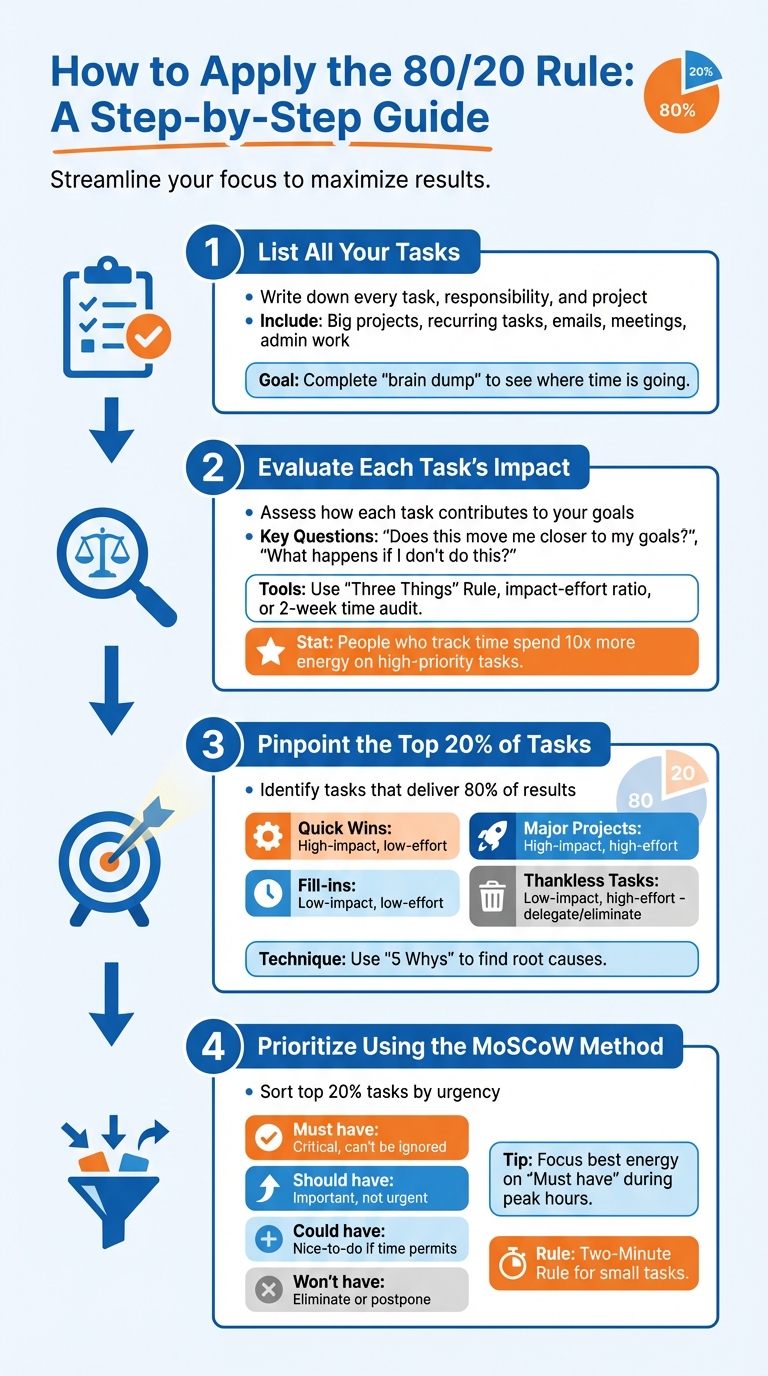
4-Step Guide to Applying the Pareto Principle for Task Prioritization
You don’t need fancy tools or complex strategies to put the 80/20 rule into action. All it takes is a clear process to figure out which tasks are worth your time and which ones are just distractions. Here’s how you can start applying it right away.
Step 1: List All Your Tasks
Begin by jotting down every single task, responsibility, and project on your plate. Include everything – big projects, recurring tasks like answering emails, attending meetings, or handling admin work. Don’t overthink it; just get it all out of your head and onto paper. This “brain dump” helps you see where your time is going and sets the stage for the next step.
Once you’ve got your list, it’s time to figure out which tasks actually matter.
Step 2: Evaluate Each Task’s Impact
Take a close look at how each task contributes to your goals. Ask yourself: Does this task move me closer to what I want to achieve? Or, If I didn’t do this, what would happen? Tasks that don’t directly impact your goals are likely just busywork.
A helpful trick is the "Three Things" Rule: if you could only get three things done today, what would they be? Those are your high-impact tasks. You can also use an impact-effort ratio to rank tasks – tasks with a high impact but low effort should take priority. Another option is a two-week time audit. Track everything you do and its results. Studies show that people who monitor their time spend up to 10 times more energy on high-priority tasks compared to those who don’t.
Step 3: Pinpoint the Top 20% of Tasks
Now, identify the small percentage of tasks that account for the majority of your results – the 20% that align with the Pareto Principle. Using your impact rankings, focus on the tasks that deliver the most value. These are your high-impact activities, the ones driving 80% of your outcomes.
To dig deeper, try the "5 Whys" technique. Ask “why” five times to uncover the root cause of an issue – solving one root problem can often eliminate several smaller ones. Once you’ve identified your high-impact tasks, group them into these categories:
- Quick Wins: High-impact, low-effort tasks you can knock out right away.
- Major Projects: High-impact, high-effort tasks that need to be broken into smaller steps and scheduled during your most productive hours.
- Fill-ins: Low-impact, low-effort tasks you can tackle during downtime.
- Thankless Tasks: Low-impact, high-effort tasks that should be delegated or eliminated.
With this clarity, it’s time to fine-tune your priorities.
Step 4: Prioritize Using the MoSCoW Method
Even within your top 20%, not all tasks carry the same weight. The MoSCoW method helps you sort them into four groups:
- Must have: Absolutely critical tasks that can’t be ignored.
- Should have: Important tasks that aren’t as urgent.
- Could have: Nice-to-do tasks if you have extra time.
- Won’t have: Tasks to eliminate or push to the back burner.
Focus your best energy on the “Must have” tasks during your peak productivity hours. Schedule “Should have” tasks around those, and handle admin work in fixed blocks outside of your prime hours. For small tasks that pop up, use the Two-Minute Rule: if it takes less than two minutes, do it right away so you can stay focused on what really matters.
Using the Pareto Principle in Your Daily Routine
Once you’ve pinpointed the 20% of tasks that yield the most results, the next step is integrating them into your daily routine. Recognizing these tasks is just the beginning; the real challenge lies in building your day around them. The Pareto Principle works best when it becomes a regular part of your workflow, not just a one-time experiment. Here’s how you can make the 80/20 rule a lasting habit.
Use Productivity Tools
Productivity tools can help you identify and focus on tasks that truly matter while filtering out time-wasters. Apps like malife include features such as "Impact/Effort" tagging and "Today & Next" workflows, giving you a clear view of your most important 20%. For team settings, Asana connects daily tasks to broader goals, ensuring your efforts align with what drives progress. On a personal level, tools like Life Planner offer habit tracking and journaling, helping you reflect on what’s working and what needs adjustment.
Using these tools, you can score tasks based on their impact versus effort, allowing data to guide your decisions. Research even shows that people who actively track their time spend up to 10 times more time on high-priority tasks compared to those who don’t.
Review and Adjust Your Priorities Regularly
Your priorities will shift over time, so it’s important to reassess them frequently. What feels urgent today might not be relevant tomorrow. To stay on track, schedule a weekly tactical review – perhaps on Friday or Sunday. During this review, list out your tasks, identify the top 20% for the upcoming week, and consciously de-prioritize tasks that no longer align with your objectives.
A helpful technique during these reviews is the "Swapping Method": when a new high-impact task arises, remove or delegate an existing one to make room. Think of your schedule as a limited resource, and prioritize only what drives meaningful results.
Delegate and Outsource Low-Priority Tasks
You don’t have to handle everything yourself. Once you’ve evaluated each task’s importance, low-impact tasks are perfect candidates for delegation. What feels like busywork to you might be highly productive for someone else. The key is distinguishing between tasks only you can manage and those that can be handed off.
Focus on your "Thankless Tasks" – those high-effort, low-impact items that drain your energy without contributing much progress. Delegate these to team members, automate them, or eliminate them altogether. Before delegating, ensure you’re not creating bottlenecks. Check for collaboration dependencies, where others may be waiting on you to complete certain tasks. For routine tasks like data entry or simple emails, automation tools can often handle the job more efficiently.
As Sara London, a writer at Hive, puts it:
The least productive part of your day might end up being the most productive part of someone else’s if you just share the labor.
Real Examples of the Pareto Principle at Work
The 80/20 rule isn’t just a concept – it plays out in real-world scenarios across business, project management, and even personal growth. Let’s look at how this principle drives results in sales, project workflows, and self-improvement.
Sales and Revenue Management
In many businesses, 80% of revenue often comes from just 20% of customers, and a similar percentage of total sales stems from 20% of a company’s product lineup. Retailers use this insight to focus on best-sellers, cutting down on slower-moving inventory to improve cash flow and profits.
Additionally, 20% of salespeople frequently generate 80% of total sales. Top-performing sales reps are often assigned to manage the most critical accounts, while their winning strategies – whether it’s their communication style, relationship-building skills, or techniques – are analyzed and shared with the rest of the team. When prospecting, targeting customers who resemble the top 20% of current clients can lead to better results. This focus on high-impact contributors also extends to project management.
Project Management
In project management, the Pareto Principle helps teams zero in on the most impactful tasks. For example, 80% of software crashes are often caused by just 20% of reported bugs. Developers can significantly improve a system’s stability by addressing those key issues first. Similarly, 80% of manufacturing defects typically stem from 20% of production activities.
Project managers use this principle to identify the 20% of tasks that drive 80% of progress. They then allocate their best resources to those tasks. The same applies to stakeholders: focusing on the 20% of decision-makers and influencers who have the greatest impact can make or break a project’s success. Addressing bottlenecks that cause the majority of delays allows teams to stay on track. As Sarah Laoyan from Asana puts it:
A small percentage of inputs creates the majority of results. Understanding this imbalance helps you identify which initiatives to prioritize for maximum impact.
Personal Development
The 80/20 rule isn’t just for businesses – individuals can use it to improve their personal lives and growth. Instead of trying to fix everything, focus on the 20% of habits or skills that bring about 80% of the desired results. For example, when working on health, prioritizing consistent sleep and regular exercise can often have a bigger impact than obsessing over every tiny dietary detail.
Track your time for a week to see which activities lead to your best outcomes. Once you identify those high-impact habits, double down on them and eliminate less important tasks. This approach not only boosts efficiency but also helps you avoid burnout, paving the way for steady, long-term progress.
Conclusion
The Pareto Principle provides a simple yet effective way to cut through distractions and zero in on what truly matters. By focusing on the 20% of tasks that drive 80% of your results, you can ditch the busywork and make meaningful strides toward your goals. This guide equips you with practical tools – like task evaluation and the MoSCoW method – to help you prioritize and make the most of your productive hours.
Now, it’s time to take action. Start small – try time-blocking your most productive hours for two weeks. Keep track of your results and adjust as needed. The goal isn’t to be perfect but to consistently channel your energy into the tasks that truly matter.
Whether you’re tackling business challenges or working on personal growth, this principle can reshape your outcomes. It’s a strategy that works everywhere – from improving sales and managing projects to achieving personal milestones. By focusing on the tasks that count, you’ll accomplish more, feel less stressed, and avoid burnout. The secret isn’t doing it all – it’s doing the right things.
For more tips and inspiration to help you live boldly, check out Legendary Life Media (https://legendarylifemedia.com).
FAQs
How do I find my true top 20% tasks?
Start by listing all your tasks to get a clear picture of where your time is going. Look for patterns and pinpoint which tasks have the biggest impact on your goals. Ask yourself questions like: "If I could only complete three tasks today, which ones would make the most difference?" and "What are the consequences if I skip this?"
Make it a habit to regularly review and tweak your priorities. Focus on the critical 20% of tasks that contribute to 80% of your outcomes – this is where your energy will have the greatest payoff.
What if urgent tasks crowd out high-impact work?
When you’re swamped with urgent tasks, it’s crucial to step back and focus on the small percentage of efforts that deliver the biggest outcomes – this is the essence of the 80/20 rule. Take time to regularly review your to-do list and distinguish between tasks that feel urgent but have minimal impact and those that truly move the needle.
For less critical tasks, consider delegating them to others or removing them altogether. Tools like the Eisenhower Matrix can help you weigh urgency against importance, ensuring your energy is directed toward what genuinely matters most.
How often should I review and reset priorities?
Take time to regularly evaluate your priorities to ensure they align with your goals. By focusing on tasks that have the greatest impact, you can make sure you’re dedicating your energy to what truly matters. This habit not only keeps you on track but also helps you make the most of your time.
Related Blog Posts
- Best Productivity Apps for Entrepreneurs
- 5 Habits That Kill Your Creative Flow
- SMART Goals for Entrepreneurs: Step-by-Step Guide
- Why Entrepreneurs Procrastinate and How to Fix It
About The Author