

Social media engagement is more than just likes and shares – it’s about creating connections that grow your business. Here’s what you need to know:
- Engaged audiences convert better: They’re 3x more likely to act, and prompt responses can increase spending by 20–40%.
- Platforms prioritize interaction: High-engagement posts can reach up to 6.4x more people.
- Trust builds through active engagement: 92% of consumers trust recommendations from online communities.
To succeed, focus on these steps:
- Define your brand voice and audience: A conversational tone boosts trust by 22%.
- Choose the right platforms: Start with one primary and one secondary platform (e.g., LinkedIn for B2B, Instagram for product discovery).
- Set measurable goals: Use SMART goals, like increasing comments by a specific percentage in 90 days.
- Create engaging content: Use videos, polls, and behind-the-scenes posts to spark interaction.
- Engage actively: Reply to comments within hours and use social listening tools for insights.
Focus on meaningful interactions like comments, shares, and saves, rather than vanity metrics like follower count. Remember, building a loyal, engaged community can lead to 156% higher conversions and stronger customer retention.
Social Media Engagement Statistics and ROI for Entrepreneurs 2025
how to get people to OBSESSIVELY ENGAGE with your content online
sbb-itb-fc951a8
Building Your Social Media Strategy
Crafting a social media strategy starts with defining who you are and who you’re speaking to.
Identifying Your Brand Voice and Target Audience
Your brand voice is the personality that shines through in every post, comment, and caption. It’s not just what you say, but how you say it. Research shows that a conversational tone can increase factual knowledge retention by 18% and boost trust scores by 22% compared to stiff, corporate language. On the flip side, overly formal communication can reduce purchase intent by nearly 20%.
Before you nail down your voice, you need to know your audience. Platform analytics are your best friend here – they reveal demographics, peak activity times, and content preferences. With 81% of consumers using social media to discover products, understanding how your audience communicates helps you connect with them more effectively. Remember, while your brand voice remains consistent, your tone can shift depending on the situation – celebratory for good news, empathetic when addressing complaints. Consistency across all platforms isn’t just a good habit; it can increase revenue by up to 33%.
Once your voice and audience are clear, it’s time to focus on the platforms that make the most sense for your business.
Selecting the Right Platforms for Your Business
Not every platform will work for every business, so focus your efforts wisely. The 1+1 Rule is a smart way to start: pick one primary platform to build strong connections and one secondary platform for repurposing content. This approach prevents burnout while maximizing your reach.
The choice of platform depends on where your audience spends time and the kind of content you’re best at creating. For example:
- LinkedIn is a powerhouse for B2B, generating 80% of all B2B social media leads.
- Instagram excels at product discovery, with 61% of users browsing it for shopping.
- TikTok leads in engagement, boasting an average rate of 2.5%, making it ideal for viral and visual content.
- Facebook remains invaluable for local businesses, with 3.07 billion monthly users.
To test the waters, run a 30-day experiment on your chosen platform. Post 4–7 times a week and track key metrics like email sign-ups or direct messages. Always aim to drive traffic back to assets you own, like your website or email list.
Setting Measurable Engagement Goals
With your platforms selected, it’s time to set clear, actionable goals.
Use SMART goals – Specific, Measurable, Achievable, Relevant, and Time-bound. For instance, instead of a vague goal like “improve engagement,” aim for something like “Increase Instagram comment rate from 2% to 3.5% within 90 days.” Marketers with documented strategies are 414% more likely to succeed than those without.
Focus on metrics that matter. Engagement rate, response time, and saves often tell a more meaningful story than likes. Shares and saves show that your content resonates on a deeper level. Businesses with high engagement see 73% higher customer retention and are 6x more likely to convert social traffic into sales.
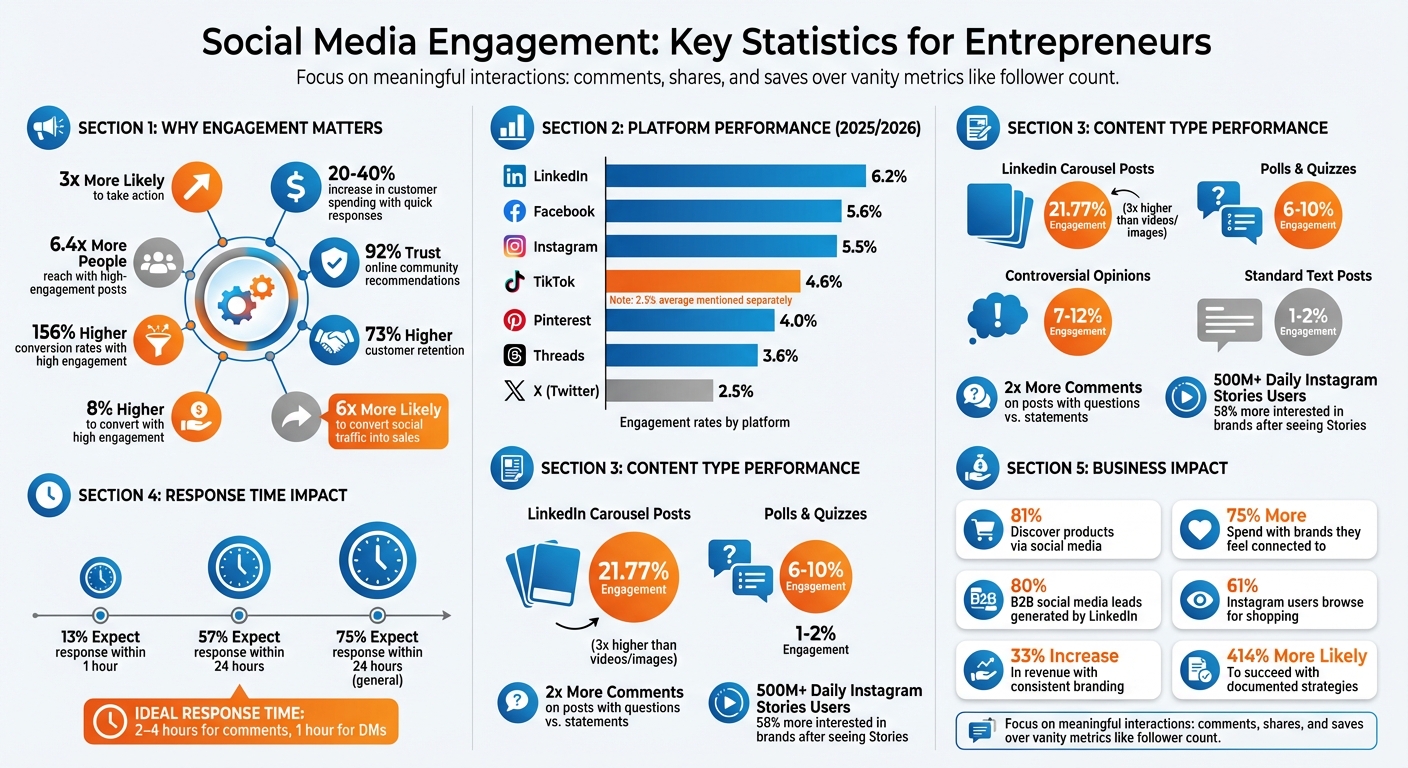
Timely responses also matter. Aim to reply to comments within 2–4 hours and direct messages within 1 hour. This is crucial since 75% of consumers expect a response within 24 hours.
Creating Content That Generates Engagement
Once your strategy is set, the real challenge begins: crafting content that grabs attention, sparks interaction, and builds lasting customer connections.
Using Video and Interactive Content
Video and interactive formats are king when it comes to grabbing attention and encouraging participation. Platforms like Instagram Reels and TikTok prioritize short-form videos that entertain rather than just sell products. The secret? Use “surprise elements” – think unexpected visuals or statements that make people pause – and ask “opinion-based questions” to spark conversations.
Simple, low-effort formats like polls, “this or that” questions, and fill-in-the-blank prompts perform exceptionally well. Engagement rates for polls and quizzes hover around 6–10%, while posts featuring controversial opinions can climb to 7–12%. Compare that to the 1–2% engagement typical of standard text posts. Even better, posts with questions generate double the comments compared to plain statements. Consider this: over 500 million users interact with Instagram Stories daily, and 58% say they become more interested in a brand after seeing it featured in a Story.
For entrepreneurs, the most meaningful engagement signals include DMs, saves, and shares – these often indicate a strong intent to purchase or refer. Use “DM triggers” to turn public interaction into private conversations. For instance, prompt users to comment a specific keyword (like “TUTORIAL”) to receive a resource or link, which can lead to sales. To encourage participation, share your own answer to polls or questions first – it sets an example and lowers the bar for others to join in. Also, replying to comments promptly (ideally within the first hour) signals activity to platform algorithms and boosts visibility. Beyond these tactics, showing your authentic process can deepen trust and engagement.
Sharing Behind-the-Scenes Content
Pulling back the curtain can be more impactful than any polished ad. Sharing personal stories or the reasons behind your business helps transform your brand from a faceless entity to a relatable individual. And people connect with people. In today’s crowded market, behind-the-scenes content acts as a “credibility signal” – especially in an era where AI-generated material is everywhere.
“Showing your process and imperfections signals genuine human craftsmanship.” – Jon Bjarnason, Author and Speed Reading Master Trainer
This type of content also helps justify your pricing by highlighting the effort and care behind your product or service. It’s simple to create: set up your phone on a tripod, record your workflow, and turn the footage into a 15-second timelapse with a short caption. Don’t shy away from showing the “mess” – whether it’s a cluttered desk, a post-workout snapshot, or a failed project. These moments build trust by proving you’re human.
“Audiences easily distinguish between ‘unprofessionalism’ and ‘authenticity.’ While your final product should be highly polished, your audience understands that the process of creating it is messy. Showing that mess builds trust.” – Jon Bjarnason, Author and Speed Reading Master Trainer
Featuring User-Generated Content and Testimonials
While videos and behind-the-scenes content grab attention, customer-driven content solidifies trust. Highlighting what your customers share about your brand – like unboxings, before-and-after results, or “day-in-the-life” clips – can be far more effective than overly polished ads. With 74% of consumers saying there are too many ads in their feeds, user-generated content (UGC) feels more authentic and relatable.
To keep things consistent, request clear and concise submissions from customers. Instead of generic testimonials, focus on “customer decision stories” that explain the problem they faced and why they chose your product. Always credit contributors and consider creating incentives, like a “creator hall of fame” or early access to new products, to encourage repeat participation.
Repost standout customer clips to your Stories or Reels 3–5 times a week to keep the momentum going. You can also group multiple submissions into themed carousels, such as “30-Day Results” or “Travel Hacks”, to provide a variety of perspectives. Just make sure to get permission first – send a simple rights request via DM or email – and clearly disclose any gifted or paid content using tags like #ad to comply with FTC guidelines.
Interacting With Your Audience
Creating great content is just the beginning. To truly connect, you need to engage actively. Social media isn’t just about broadcasting – it’s about being part of a conversation. Your audience wants to see you listening, responding, and participating.
Responding to Comments, Messages, and Mentions
Did you know 13% of consumers expect a response within an hour, and 57% expect one within 24 hours? Meeting these expectations pays off – customers spend 20–40% more with brands that respond to service requests on social media. Plus, Buffer’s data shows that replying to comments can boost engagement by 42% on Threads, 30% on LinkedIn, and 21% on Instagram.
“If you want engagement, do engagement.”
- Suzanne Kelly and Carolyn Kopprasch, Buffer
Personalized replies go a long way in building trust. Even when faced with negative feedback, don’t ignore or dismiss it. Instead, show empathy, apologize if necessary, and offer a solution. It’s worth the effort – 45% of consumers are more likely to visit businesses that respond to negative reviews. If you can’t stay online around the clock, set clear expectations by listing your active hours in your profile.
Comments can also be a goldmine for insights. Use them to ask for reviews, share resources, and gather feedback for future improvements. Beyond direct replies, keeping an eye on broader conversations can deepen your engagement strategy.
Using Social Listening Tools
Social listening goes beyond just tracking mentions – it helps you understand the emotions and needs behind the words. Over 60% of businesses now use social listening to shape their strategies.
Set up alerts for your brand name, competitor products, relevant industry terms, trending hashtags, and even common misspellings. Don’t stop at social media – explore review sites like Yelp or forums like Reddit and Quora for unfiltered opinions. Tools like Semrush’s Brand Monitoring (starting at $59/month) or Reddit’s Trend Analytics ($10/month) make this easier.
Sentiment analysis is another powerful tool, letting you categorize mentions as positive, negative, or neutral. For example, if customers repeatedly mention a frustration, you can address it in your next product update or create content that solves their problem. These insights not only improve immediate interactions but also guide your broader content strategy.
Hosting Live Q&A Sessions and Community Events
Live sessions take engagement to the next level, turning passive followers into active participants. Audiences spend three times longer watching live streams compared to pre-recorded videos, and brands that stream regularly report 345% higher engagement and 67% more conversions.
Before hosting, review FAQs and support tickets to identify common questions. Promote your event with countdowns and teasers to build anticipation. During the session, keep the energy up by interacting every 2–3 minutes – this could be through polls, shout-outs, or answering questions. Reserve 10–15% of your session for a dedicated Q&A segment (e.g., 10 minutes in a 60-minute session). If you can’t answer a question on the spot, be upfront and promise to follow up later – honesty strengthens your credibility.
After the session, keep the momentum going by addressing any unanswered questions in a follow-up post. And here’s a tip: prioritize investing in a quality microphone before upgrading your camera. Great audio makes a bigger impact on viewer retention than video quality.
Measuring Results and Improving Your Approach
To refine your content strategy, it’s essential to measure engagement and identify what resonates with your audience. Focus on metrics that align with your business goals.
Tracking Key Engagement Metrics
Start by calculating your engagement rate (ER) – the percentage of people interacting with your content compared to those who see it. The formula is straightforward: divide total engagements (likes, comments, shares, saves) by reach, then multiply by 100.
Engagement rates vary across platforms in 2025/2026: LinkedIn leads at 6.2%, followed by Facebook (5.6%), Instagram (5.5%), TikTok (4.6%), Pinterest (4.0%), Threads (3.6%), and X (Twitter) at 2.5%. A “good” engagement rate on one platform might not translate to another, so adjust expectations accordingly.
For a more detailed picture, assign different weights to interactions. For example, a share significantly amplifies your reach, while saves indicate high-value content that can drive conversions 40% better than likes. Posts exceeding a 3% engagement rate often receive a 40% boost from algorithms.
When analyzing video content, focus on completion rates and average watch duration. These metrics show how well your content holds attention and fosters meaningful engagement. On LinkedIn, carousel posts (PDFs or documents) perform exceptionally well, with a median engagement rate of 21.77%, nearly triple that of videos or images.
Use these insights to guide adjustments in your content strategy and improve overall performance.
Testing and Adjusting Based on Data
Regularly review your analytics – every 90 days is a good benchmark – to identify top-performing content and refine your approach. For instance, if behind-the-scenes videos consistently outperform product announcements, focus on creating more of that type of content.
Experiment with posting times based on your platform’s native analytics instead of relying on generic advice. Your audience’s habits may differ from industry norms. Similarly, test variations in calls-to-action over short timeframes (e.g., 48 hours) to see which prompts generate more meaningful engagement.
A great example comes from Sofia, a fitness creator who pivoted her strategy in early 2026. By shifting from generic workout routines to behind-the-scenes content and engaging with every comment quickly, she boosted her engagement rate from 0.9% to 4.2% in six months. Though her follower count dropped slightly to 7,200, the higher engagement quality led to brand partnerships, earning her between $3,500 and $5,000 monthly.
Pay attention to the sentiment behind comments, not just the volume. Comments with more than two words often indicate a deeper connection.
Prioritizing Community Over Vanity Metrics
Many businesses focus on vanity metrics like follower counts, but these numbers mean little without genuine engagement. Building a community is far more impactful. Nearly 90% of consumers buy from businesses they follow on social media, spending about 75% more with those they feel connected to.
“One thoughtful comment is worth 100 drive-by likes.”
- Meta‘s 2024 Algorithm Update Documentation
High-quality engagement fosters trust and drives conversions. Customers spend 20% to 40% more with companies that respond to their social media inquiries. Moreover, high engagement rates are linked to 156% higher conversion rates and 67% better brand loyalty.
Focus on meaningful actions like link clicks, email signups, saves, and shares with commentary. These interactions bring users closer to becoming customers. To quantify engagement, consider using an Engagement Quality Score (EQS): (Shares × 10) + (Saves × 8) + (Comments × 5) + (Link Clicks × 15) + (Likes × 1). A score above 10% is considered excellent.
Conclusion
Achieving success on social media as an entrepreneur isn’t about obsessing over follower counts or endlessly posting content. It’s about fostering genuine relationships that lead to real business outcomes. For example, higher engagement rates can result in 89% more interaction, 67% stronger brand loyalty, and 156% higher conversion rates. These numbers highlight the power of a thoughtful approach to social media.
Instead of trying to dominate every platform, focus on one or two networks where your audience is most active. This strategy avoids spreading your efforts too thin and helps you build a stronger, more engaged community. As Gary Vaynerchuk wisely said:
“Social media requires that business leaders start thinking like small-town shop owners. This means taking the long view and avoiding short-term benchmarks to gauge progress”.
A great way to maintain balance is by following the 80/20 rule: dedicate 80% of your content to providing value and only 20% to promotion. Pair this with the 5x5x5 rule, where you spend just 5 minutes a day liking 5 posts, leaving 5 thoughtful comments, and responding to your audience within 2–4 hours. These small, consistent actions add up. In fact, creators who post consistently – 20 or more weeks out of 26 – experience about 450% more engagement per post than those who post sporadically.
Remember, engagement beats numbers. A thousand loyal followers who trust your brand are far more impactful than 10,000 passive ones. Prioritize meaningful interactions like shares with commentary, thoughtful comments, and direct messages. With 92% of consumers trusting recommendations from engaged communities over traditional ads, building trust through authentic engagement can deliver returns far beyond any advertising campaign.
Related Blog Posts
- How to Network When You’re an Introvert
- Ultimate Guide to Personal Branding Online
- Entrepreneurs vs. Pressure: Decision-Making Tactics
- SMART Goals for Entrepreneurs: Step-by-Step Guide
About The Author