Why it matters:
- 97% of review readers also read responses.
- 41% of customers are more likely to engage with businesses that respond.
- Ignoring criticism? Nearly 47% of customers avoid businesses that stay silent.
What to Do:
- Respond quickly: Aim for 24 hours or less. Timely replies show attentiveness.
- Personalize your response: Address the reviewer by name and refer to their specific concerns.
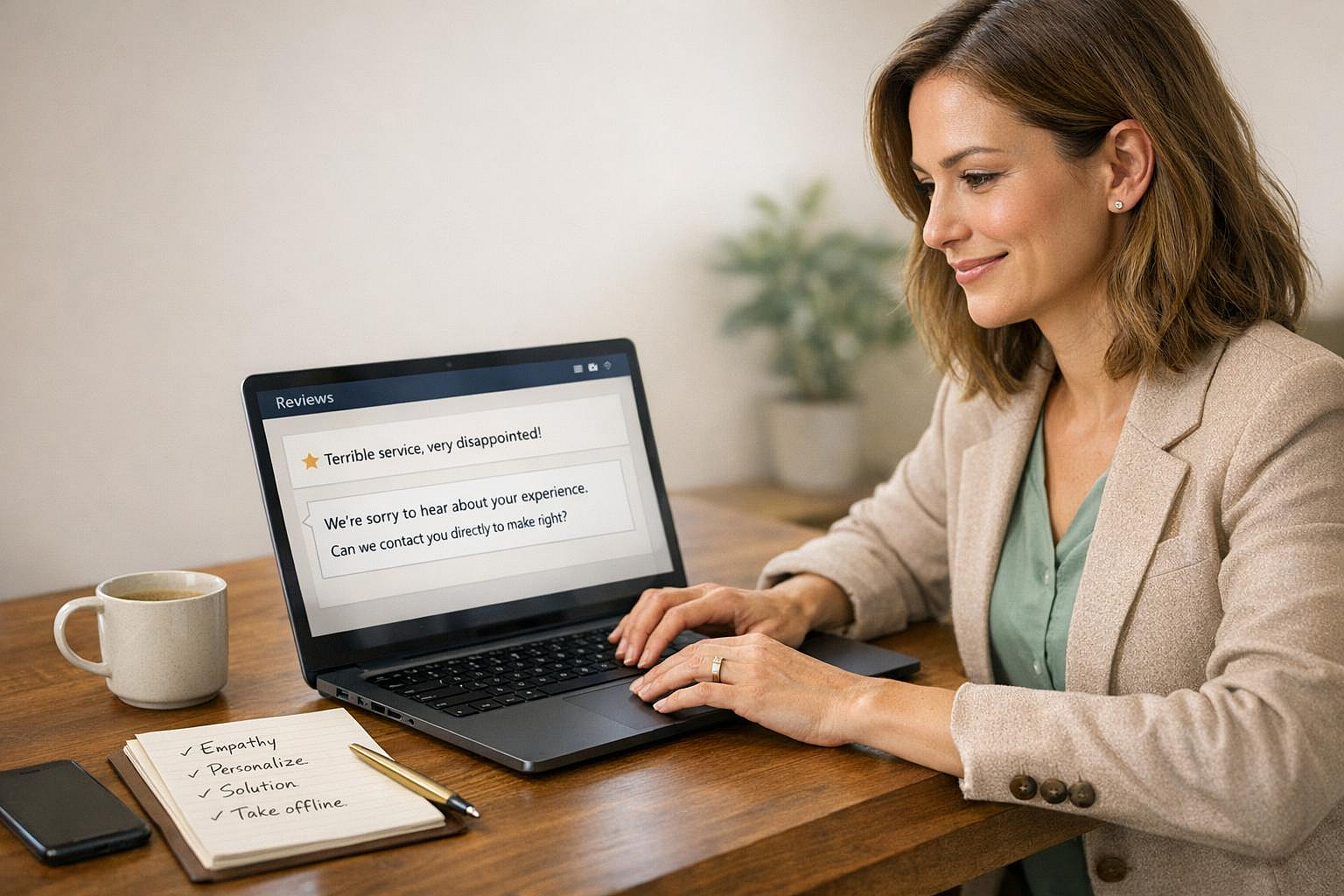
- Show empathy: Acknowledge their feelings and apologize sincerely.
- Offer solutions: Provide clear steps to resolve the issue and move the conversation offline.
- End on a positive note: Thank the reviewer and highlight your commitment to improvement.
Common Mistakes to Avoid:
- Delayed or defensive responses.
- Using generic, copy-paste replies.
- Public arguments or failing to follow up.
Bottom line: Every negative review is an opportunity. Responding with care and professionalism can not only repair relationships but also attract new customers.
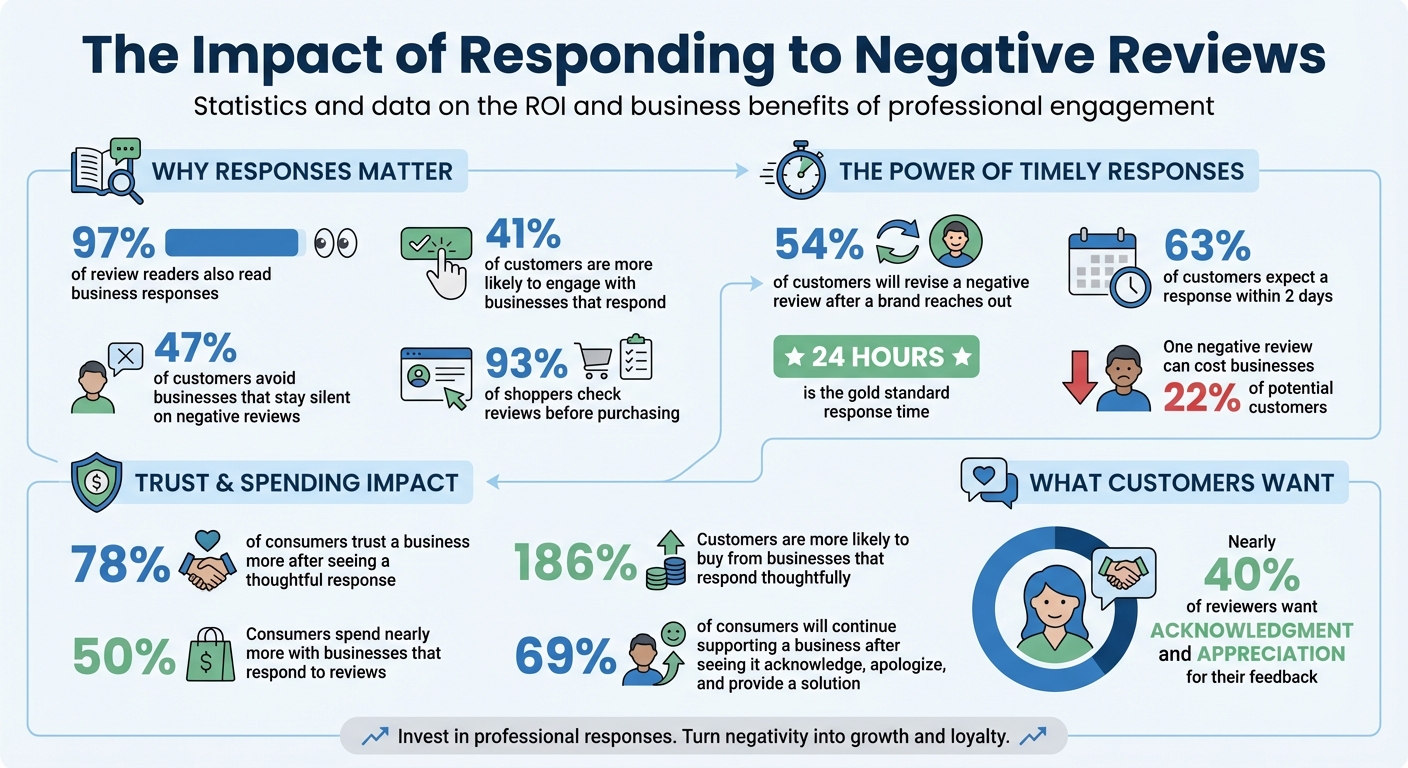
Key Statistics on Responding to Negative Reviews: Impact on Customer Trust and Business Growth
How to Respond to Negative Google Reviews (with Examples)
sbb-itb-fc951a8
Respond Quickly to Negative Reviews
Managing your online reputation effectively starts with a quick response. Timing is everything when it comes to addressing negative reviews. Responding within 24 hours is the gold standard. This shows customers that your brand is attentive and values their experience. On the flip side, delays can lead to frustration and a loss of trust.
How Delayed Responses Damage Your Brand
Leaving a negative review unanswered – even for a short time – can harm your business. The longer it sits there, the more it influences potential customers who are reading reviews to decide if they can trust your brand. As Padrig Jones explains:
"The longer you leave a bad comment sitting without a response, the more time it has to negatively sway potential customers and erode trust in your brand".
Silence can send the wrong message. It might suggest that you’re indifferent or not paying attention, which could alienate nearly half of your potential customers. Quick responses aren’t just about damage control – they’re about resolution. In fact, 54% of customers will revise a negative review after a brand reaches out. Consider the stakes: on October 25, 2025, Ryanair received 850 negative reviews in just one day, reaching over 5 million users. When negativity spreads that fast, delays can turn a manageable situation into a full-blown crisis.
This illustrates why timely, thoughtful responses are essential to protecting your reputation.
How to Write a Fast but Thoughtful Response
Responding quickly doesn’t mean rushing or being careless. Aim to address standard negative reviews within 24 hours, balancing speed with professionalism. For reviews that go viral or involve serious concerns, respond within hours, not days.
For more complex issues, use a two-step approach. Start with a quick acknowledgment within 24 hours to thank the reviewer and let them know you’re looking into the matter. This initial response gives you time to investigate without leaving the customer in the dark. Anthony Will, CEO of Reputation Resolutions, explains:
"The ideal response time to a negative review is within 24 hours. This will show your customers your dedication to addressing any issues while mitigating the negative review’s damage".
Before hitting send, double-check your tone. It should be professional, caring, and never defensive. Tools like Google Alerts or Brand24 can help you monitor reviews in real time, so you can prioritize high-impact situations – like those involving influencers or users with large audiences. Act quickly to gather the facts, but always stay within the 24-hour window.
| Review Situation | Response Time | Objective |
|---|---|---|
| Standard negative review | Within 24 hours | Show attentiveness and accountability |
| Review gaining viral traction | Within a few hours | Contain narrative and reduce escalation |
| Safety or legal allegations | Immediate acknowledgment | Signal seriousness and protect trust |
| Complex issue | Acknowledge in <24 hours; follow up later | Manage expectations during investigation |
Personalize Your Response
Why Personalization Builds Trust
Generic replies can come across as cold and insincere. When you take the time to personalize a response, you turn what could feel like a routine interaction into a meaningful conversation. Most consumers pay close attention to how businesses handle feedback – especially negative reviews – so your audience is likely evaluating your tone and approach. A personalized reply shows that you’re actively listening rather than just going through the motions.
Using the reviewer’s name and addressing their specific issue shows that you’ve taken the time to understand their concerns. This small acknowledgment can go a long way in easing tension and rebuilding trust. As Valentin Hinov, CEO & Founder of Thankbox, emphasizes:
"Negative review replies are for the benefit of your future customers, not the reviewer."
By addressing the reviewer directly and referring to their specific complaint – whether it’s about a delayed shipment or a faulty product – you demonstrate accountability. It’s worth noting that consumers are willing to spend nearly 50% more with businesses that respond to their reviews. Below are some actionable tips to make your responses feel genuine and human.
How to Personalize Your Responses
Start by addressing the reviewer by name. A simple greeting like "Hi Sarah" or "Thank you for your feedback, Michael" immediately signals that a real person is behind the response. Next, refer directly to the issue they mentioned. For example, if someone mentions a long wait time at your restaurant, acknowledge it specifically. If they struggled with a product feature, name that feature in your reply.
Len Berkowitz, Owner of Men’s Health Clinic, shares his strategy:
"I always mention something specific from their review. It proves you’re not copy-pasting corporate garbage."
End your response with your actual name and title – something like "Best regards, Jennifer, Store Manager" feels much more personal and accountable than signing off as "The Team." If the reviewer included something positive in their feedback, make sure to acknowledge it. This shows you’ve read their entire review and aren’t just focusing on the negative. Finally, avoid using identical phrasing in multiple replies. Even small tweaks can make your responses feel fresh and sincere. This thoughtful approach not only helps de-escalate issues but also strengthens your brand’s authenticity.
Show Empathy and Apologize
How to Show Empathy in Your Response
The first step to showing empathy is acknowledging the customer’s feelings. Pinpoint their emotion – whether it’s frustration, disappointment, or anger – and address it directly. A phrase like "I understand how frustrating this must have been" demonstrates that you’re actively listening and responding to them as a person, not just defending your business.
Arsh Sanwarwala, Founder of ThrillX, sums it up perfectly:
"Start by naming the emotion, not defending the problem. People aren’t judging your systems. They’re judging your humanity."
Avoid cookie-cutter responses that feel robotic. Instead, refer to the specific issue the customer mentioned – be it a late delivery, a product defect, or a service mishap. This shows you’ve genuinely read their feedback. Always respond with patience and composure. The goal here is to resolve the issue, not to prove you’re right. When you start with empathy, you pave the way for a meaningful apology that takes full responsibility.
Why a Genuine Apology Matters
Once you’ve shown empathy, the next step is offering a genuine apology. A heartfelt apology not only mends relationships but also protects your reputation. The key is to avoid "non-apologies" that shift blame onto the customer. Phrases like "We’re sorry you had this experience" or "We apologize for any inconvenience this may have caused" can come across as dismissive.
Instead, take full ownership of the situation with statements like "We didn’t get it right this time, and we’re working to fix it" or "We take your feedback seriously and regret that your experience was disappointing". Jeff Tilley, Founder of Muncly, highlights the importance of honesty:
"If you failed, you failed. Own it. A clear, honest reply builds more trust than a page of perfect five-star reviews."
In fact, research shows that 78% of consumers are more likely to trust a business after seeing a thoughtful response to a negative review. Remember, your apology isn’t just for the person who left the review – it’s for everyone who reads it.
How to Take Responsibility Without Being Defensive
After showing empathy and apologizing sincerely, the next step is taking responsibility without deflecting blame. Avoid defensive language like "this issue hasn’t come up with other users" or "that’s not typically how our service works," as these can make customers feel dismissed.
Geremy Yamamoto, Founder of Eazy House Sale, advises:
"Forget about the reviewer and write for your future customers. Thousands of leads are going to read your response and watch how you handle a confrontation."
When taking responsibility, outline the steps you’re taking to ensure the issue doesn’t happen again. Mention specific actions like staff retraining, updates to policies, or quality control improvements – this shows your words are backed by action. For more complex situations, provide your direct contact information to continue the conversation offline. And if a review stings emotionally, take a moment to pause before replying. This ensures your response remains professional and composed.
Offer Solutions and Move the Conversation Offline
When addressing negative reviews, it’s critical to not only take responsibility but also provide actionable solutions and shift the conversation to a private channel.
Suggest Specific Solutions
Addressing complaints with clear, actionable solutions is key. Avoid vague promises and instead offer something concrete. For instance:
- Refunds, replacements, store credit, or discounts for product-based issues.
- Complimentary follow-ups, account upgrades, or extended subscriptions for service-related concerns.
Take the example of Zero Bounce in 2024. After receiving a 2-star review about unclear pricing, the team, led by PR Manager Corina Leslie, immediately updated their platform’s copy for better transparency. They also reached out to the customer directly to share the changes. The result? The customer revised their rating to 5 stars and continued using the service. This shows that even internal improvements, like updating website content or fixing reservation systems, can transform dissatisfied customers into loyal advocates.
Why Private Communication Works Better
Once you’ve proposed a solution, take the next step by inviting the reviewer to continue the conversation privately. This approach helps avoid public back-and-forth exchanges, which can spiral into further reputational damage. It also allows you to address sensitive details discreetly.
Why does this matter? Because 97% of people reading reviews also pay attention to how businesses respond. A well-handled response signals professionalism and accountability to potential customers.
"Be helpful publicly, say what you’ve done, and only then offer a call or email."
- Daniel Kroytor, CEO of TailoredPay.
This approach demonstrates transparency while showing your willingness to resolve issues. Plus, businesses that respond to reviews see customers spending 50% more on their services.
Provide Clear Contact Information
When asking to move the conversation offline, make it easy for the reviewer to reach the right person. Instead of directing them to a generic "Contact Us" page, share a specific email (e.g., manager@yourbusiness.com) or a dedicated phone number. Include the name of the person handling their case.
"Including a direct name and number shows you want resolution, not a public spat."
- Amanda New, Founder of Cash For Houses Girl.
Additionally, request relevant details like an order number, account ID, or visit date to expedite the investigation. This level of care shows you’re serious about resolving their issue. And here’s the kicker: potential customers are 186% more likely to buy from businesses that thoughtfully respond to negative reviews. A direct, detailed approach not only resolves complaints but also strengthens trust with future customers.
End Your Response on a Positive Note
Once you’ve addressed the issue publicly and taken steps offline, your closing remarks can leave a lasting impression. The way you end your response is just as important as how you begin. A thoughtful conclusion reassures both the reviewer and future readers that you’re committed to growth. In fact, 69% of consumers are willing to continue supporting a business after seeing it acknowledge a poor review, apologize, and provide a solution. With the right approach, you can turn a negative moment into an opportunity to showcase your brand’s integrity.
Remind Them of Your Brand Values
Rather than coming across as promotional, use your brand values to highlight the standards you aim to uphold – while admitting where you fell short. Phrases like "We set high standards for ourselves, and we regret we didn’t meet them in your case" are effective because they acknowledge accountability while reinforcing your commitment to quality. This strikes a balance between humility and professionalism.
Take, for example, a real-world scenario from October 2025: Greenwoods, a restaurant, received a 1-star review from a customer named Bryan, who praised the food but was upset about card payment issues. The owner, Veronica, responded by addressing Bryan by name, apologizing sincerely, and emphasizing the restaurant’s dedication to "high quality, professional customer service, and customer satisfaction." She also offered Bryan a replacement meal or drink on his next visit. This response not only addressed the issue but also reflected the restaurant’s core values, turning a negative review into a chance to demonstrate their dedication.
Whenever possible, tie your values to specific actions you’re taking. For instance, if you’re rolling out staff training or updating policies based on feedback, mention it briefly. This transparency shows you’re not just making promises – you’re actively working to improve. End with a personal sign-off, such as "Chris, Customer Service Manager", to add a human touch. A personal, thoughtful close reinforces your commitment to customer satisfaction and leaves a positive impression.
Thank Them for Their Feedback
Always wrap up with genuine gratitude. For many reviewers, an apology is only part of what they’re looking for – nearly 40% want acknowledgment and appreciation for their feedback. Thanking them shows you value their input and see it as a tool for growth. Personalize your thanks by addressing the reviewer by name and framing their feedback as a vital contribution to your business’s improvement. Phrases like "Thank you for bringing this to our attention" or "Your insights help us enhance our services" work well. This not only validates their concerns but also shifts the narrative toward building a better relationship in the future.
"Bad reviews are always helpful even when they hurt because each one is an opportunity to learn and grow."
- Brooke Webber, Head of Marketing, Ninja Patches
Common Mistakes to Avoid
Avoiding common mistakes is just as important as implementing the right strategies when managing reviews. Why? Because the stakes are high – 93% of shoppers check reviews before purchasing, and a single negative review can cost businesses around 22% of potential customers. Missteps in handling feedback can seriously damage trust in your brand.
One major mistake is ignoring reviews or delaying your response. When negative feedback goes unanswered, it sends the message that customer satisfaction isn’t a priority, leaving the criticism unchecked. Quick responses are key. Another misstep is reacting defensively or arguing with the reviewer. For example, saying something like, "You’re wrong. Our service is great, and you’re the only one with a problem", makes your business look unprofessional and unwilling to listen. Even subtle defensiveness, such as "This hasn’t come up with other users", can invalidate the customer’s experience and hurt your credibility.
Using generic, templated replies is another common pitfall. Phrases like "We apologize for any inconvenience" come across as insincere, showing a lack of genuine engagement with the issue. On the flip side, thoughtful responses make a big difference – customers are 186% more likely to buy from businesses that handle reviews thoughtfully. Sharing private customer information publicly or engaging in heated debates on review platforms can also backfire, potentially turning a small issue into a viral PR nightmare. Lastly, failing to follow up with a reviewer after promising to help can lead to further dissatisfaction and even more negative feedback. These mistakes directly conflict with best practices, showing how small errors can have big consequences for your reputation.
Effective vs. Ineffective Response Examples
Here are some examples that highlight the difference between poor and professional responses:
| Mistake (Ineffective) | Professional Alternative (Effective) |
|---|---|
| Defensive: "You’re wrong. Our service is great, and you’re the only one with a problem." | Empathetic: "We’re sorry to hear about your experience. We’re reviewing this issue internally and will reach out to resolve it." |
| Dismissive Apology: "We acknowledge our mistake and are committed to making improvements." | Accountable Apology: "We didn’t handle this situation as we should have, and we’re taking immediate steps to address it." |
| Generic: "Thank you for your feedback. We will look into this." | Personalized: "Thank you, [Name], for sharing your thoughts about our [Specific Service]. We’re sorry to hear about [Specific Detail]." |
| Public Confrontation: Continuing the argument on the review platform. | Offline Transition: "We’d like to discuss this further to ensure your satisfaction. Please contact us at [Contact Info]." |
The contrast is striking. Effective responses demonstrate empathy, accountability, and a willingness to resolve issues, while ineffective ones come off as dismissive or combative. By avoiding these common mistakes, you show your dedication to professionalism and a commitment to improving customer experiences.
Conclusion
Responding professionally to negative reviews isn’t just damage control – it’s a chance to build trust. When you approach criticism with empathy, accountability, and real solutions, you’re sending a clear message to potential customers: you genuinely care about their experience. In fact, 97% of readers check responses, and 78% trust a thoughtful reply.
"If we respond swiftly to negative reviews and find an adequate solution, that says far more about our brand’s values and priorities than anything we could write in an ad."
– Rex Huxford, Director of Demand Generation, MD Clarity
Your replies don’t just matter to the reviewer – they influence thousands of potential customers. Studies show that actively responding to reviews can boost customer attraction by 41% and increase spending by nearly 50%. Plus, with 63% of customers expecting a response within two days, timely replies prevent frustration and demonstrate attentiveness.
FAQs
What should I say if the negative review is false?
If you come across a false negative review, it’s important to stay calm and address it with facts. Politely correct any inaccurate details in your response. If it feels appropriate, offer to continue the conversation privately to resolve the matter. This not only demonstrates your professionalism but also shows your willingness to clear up any misunderstandings. Steer clear of confrontational language to protect your credibility.
How do I reply without admitting legal fault?
To respond professionally while steering clear of admitting legal fault, focus on being empathetic and solution-oriented. Start by acknowledging the reviewer’s concerns and expressing gratitude for their feedback. Keep the tone respectful and invite them to resolve the matter privately. Avoid including specific details or sensitive information in your response.
For example: "Thank you for bringing this to our attention. We value your feedback and would like to address your concerns further. Please reach out to us directly so we can assist you."
When should I ask to take the conversation offline?
When dealing with issues that involve personalized or sensitive matters – like complex complaints or private information – it’s best to take the conversation offline. This not only helps avoid public escalation but also shows a genuine commitment to handling the situation professionally and with care.
Related Blog Posts
- Ultimate Guide to Personal Branding Online
- Authenticity vs. Perfection in Storytelling
- How To Build A Personal Advisory Board
- Storytelling in Leadership: Resolving Team Conflicts
About The Author