

If your focus drops, your energy crashes after meals, or your thinking feels foggy, poor insulin sensitivity may be part of the problem. The short version: regular exercise helps your body handle glucose better, and that can support memory, focus, and day-to-day mental stamina.
Here’s what I’d take from this:
- Your brain runs on glucose and uses about 20% of the body’s supply despite being only about 2% of body weight.
- When insulin signaling slips, you may feel brain fog, low energy, weaker focus, and slower thinking.
- Walking, strength training, and short hard intervals can all help insulin sensitivity.
- Even one workout can help for hours, and steady exercise may start shifting brain-related changes in about 12 weeks.
- Small habits matter too: walking breaks every 20 minutes or 10 squats every 45 minutes can help blood sugar control during the workday.
I’d keep it simple: move most days, lift a couple of times per week, and break up long sitting blocks. That gives you a clear path toward steadier energy, better blood sugar control, and sharper thinking without needing an extreme plan.
The rest of the piece explains how insulin resistance affects the brain, what kinds of exercise help most, and how to turn the research into a weekly routine you can stick with.
How to Exercise to Improve Insulin Sensitivity With Joseph Houmard, PhD
sbb-itb-fc951a8
The problem: How insulin resistance weakens memory, focus, and mental resilience
Peripheral insulin resistance happens when muscles and other tissues stop responding well to insulin. As a result, glucose stays in the bloodstream instead of being used for energy. Insulin resistance in the brain is a separate but related issue. It means the brain itself has a harder time using glucose well.
Both problems can build up quietly. And over time, they can chip away at mental performance. If your work depends on steady attention, strong memory, and fast judgment, that matters a lot.
Long periods of sitting lower BDNF (Brain-Derived Neurotrophic Factor), a protein that helps brain cells stay connected. Visceral fat makes things worse. It releases inflammatory signals that interfere with brain-cell communication, memory, attention, and learning. Metabolic syndrome and type 2 diabetes push the risk even higher.
What happens in the brain when insulin signaling drops
The hippocampus, which helps create new memories, is one of the first areas to take a hit. When insulin signaling gets weaker, the hippocampus can atrophy. At the same time, synaptic plasticity – the brain’s ability to strengthen connections through learning – starts to decline.
That shows up in simple but frustrating ways: learning feels slower, and holding onto new information gets harder.
The prefrontal cortex is also affected. This part of the brain helps manage self-control, inhibition, and task focus. When insulin signaling drops here, the brain has a harder time staying on task and filtering distractions. Chronic brain insulin resistance is also linked to mild cognitive impairment and Alzheimer’s disease.
Why poor insulin sensitivity hits entrepreneurs and creators hard
This hits entrepreneurs and creators especially hard because so much of their work depends on strong executive function. If insulin signaling weakens in the prefrontal cortex, focus and task control start to slip. Deep work gets harder. Complex problem-solving can feel like you’re trying to run through mud, and creative output can drop too.
Stress handling also gets worse. When the prefrontal cortex is weaker, the amygdala – the brain’s fear center – becomes more reactive. In plain English, pressure feels heavier, and clear thinking is harder to hold onto when you need it most.
Aerobic exercise helps on both fronts. It improves creative output and problem-solving, which makes it especially useful for work that puts a heavy load on the brain. It also helps restore insulin sensitivity and support the brain systems behind focus and resilience.
How exercise improves insulin sensitivity and supports the brain
Exercise helps the brain in two main ways: through metabolism and through direct effects on the nervous system. When your muscles work, they pull in glucose for fuel. That can lower blood sugar during activity and make insulin signaling work better across muscle, liver, and fat tissue.
And this isn’t just a while-you’re-exercising thing. A single workout can improve insulin response for hours, and in some cases, even days afterward.
Brain insulin, BDNF, and stronger neural communication
Exercise also increases BDNF, a protein that helps with neuroplasticity, neuron growth, and memory. This matters a lot for the hippocampus, the part of the brain most tied to forming new memories. It tends to respond strongly to BDNF.
Some research suggests that brain changes linked to a sedentary lifestyle can start to improve within 12 weeks of steady behavior change. That’s a big deal. It means the brain isn’t stuck where it is.
The key is consistency. Regular movement tends to have a stronger effect than the once-in-a-while workout.
Why regular movement beats sitting all day
Long periods of sitting keep insulin resistance and low-grade inflammation going. In plain terms, too much sitting can push the body in the wrong direction for both blood sugar control and brain health.
Even small breaks help. Short walking breaks every 20 minutes can lower blood sugar and insulin levels. That may sound almost too simple, but it adds up. Regular movement also helps the brain use glucose more efficiently, which can support steadier energy across the day.
Normal brain insulin signaling vs. brain insulin resistance: a side-by-side look
Here’s the contrast in plain English:
- Normal insulin signaling helps the brain use glucose well, supports stronger BDNF activity, and is linked to better memory and executive function.
- Brain insulin resistance is tied to poorer fuel use, less plasticity, brain fog, and weaker mental control.
Training style can shape these effects, so it helps to look at which kinds of exercise do the most work here.
What the evidence says and which exercise types help most
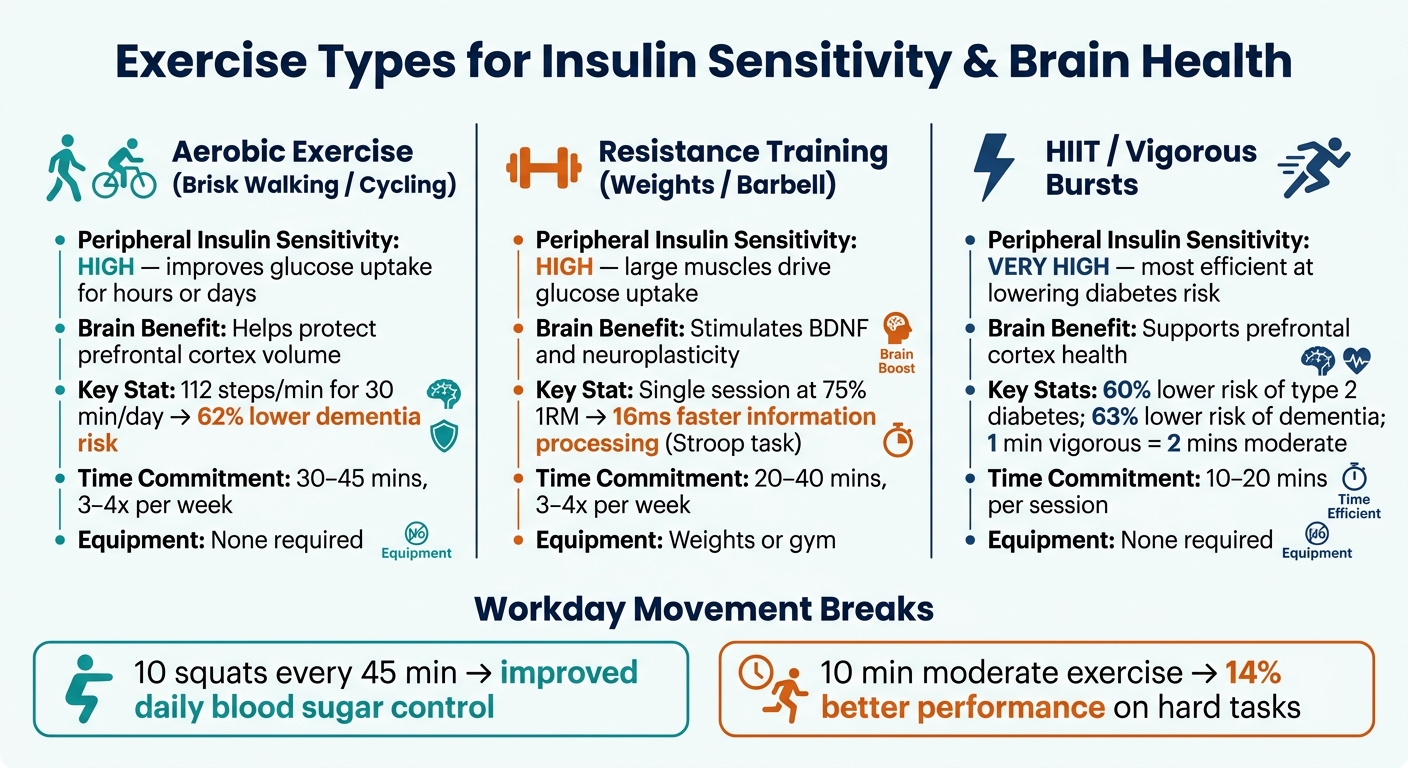
Exercise Types for Insulin Sensitivity & Brain Health: A Quick Comparison
Once you understand the brain-insulin link, the next step is pretty simple: which kind of exercise helps the most?
The short answer: regular exercise is linked to better insulin sensitivity, along with stronger executive function, memory, and mental flexibility.
One of the clearest examples comes from the EXERT clinical trial. Researchers enrolled sedentary older adults and followed them for 12 to 18 months. The result? Exercise preserved cognition and reduced shrinkage in the prefrontal cortex, which lines up with better insulin signaling.
Intensity also seems to matter. In a large UK Biobank study of 78,500 adults, brisk walking at 112 steps per minute for 30 minutes a day was linked to a 62% lower risk of dementia. The key point here is important: the researchers found that stepping intensity mattered beyond total volume. So it wasn’t just about moving more. Moving with more purpose mattered too.
Aerobic exercise, resistance training, and HIIT: what each one does
Aerobic exercise like brisk walking or cycling helps improve insulin receptor response and makes it easier for muscles to pull in glucose for hours after a session. It’s also been linked to better memory and less brain fog. That’s one reason a simple walk can do more than people expect.
Resistance training works a bit differently. It targets large muscle groups, especially the legs, which use a lot of glucose. In one study, a single barbell session at 75% of 1RM improved information processing speed by an average of 16 milliseconds on the Stroop task. That supports both metabolic health and mental performance.
HIIT and vigorous exercise stand out for one reason: they save time. People with the highest levels of vigorous activity had a 60% lower risk of developing type 2 diabetes and a 63% lower risk of dementia. Researchers also noted that one minute of vigorous effort is roughly equal to two minutes of moderate activity. If your calendar is packed, short hard intervals can make a lot of sense.
Which exercise type fits a busy schedule best
Each type has a different upside. Here’s how they compare for insulin sensitivity and brain health:
| Exercise Type | Peripheral Insulin Sensitivity | Emerging Brain Benefits | Time Commitment | Equipment Needed |
|---|---|---|---|---|
| Aerobic (Brisk Walking/Cycling) | High; improves glucose uptake for hours or days | Helps protect prefrontal cortex volume | 30–45 mins, 3–4x/week | None |
| Resistance (Weights/Barbell) | High; large muscles drive glucose uptake | Stimulates BDNF and neuroplasticity | 20–40 mins, 3–4x/week | Weights or gym |
| HIIT / Vigorous Bursts | Very high; most efficient at lowering diabetes risk | Supports prefrontal cortex health | 10–20 mins per session | None required |
There isn’t one perfect option for every goal. For entrepreneurs and creators, the best setup is usually the one you can stick with week after week. A repeatable mix tends to beat the “ideal” plan you never do.
A practical weekly plan for better insulin sensitivity and brain health
You don’t need an extreme training plan to help insulin sensitivity and brain function. A simple mix of aerobic exercise, strength work, and short high-intensity efforts is enough to get started.
Standard U.S. guidance recommends at least 150 minutes of moderate aerobic activity per week, plus strength training 2 to 3 days per week. The template below gives you a simple way to put that into practice. Adjust the volume and intensity to match your current fitness level.
This kind of setup helps turn the research into something you can actually do week after week, with a clear payoff: better focus, steadier energy, and better blood sugar control.
A simple weekly workout template for focus, energy, and metabolic health
| Day | Exercise Type | Intensity | Duration (Min) | Main Target |
|---|---|---|---|---|
| Monday | Brisk Walking | Moderate | 30 | Aerobic capacity & blood sugar |
| Tuesday | Strength Training (Squats, Push-ups) | Moderate/High | 30 | Muscle glucose uptake & BDNF |
| Wednesday | Brisk Walking or Cycling | Moderate | 30 | Insulin sensitivity & mental clarity |
| Thursday | Strength Training (Core, Deadlifts) | Moderate/High | 30 | Muscle glucose use and brain signaling |
| Friday | HIIT or Brisk Walking | High/Moderate | 30 | Cardio fitness and blood sugar control |
| Saturday | Brisk Walking or Swimming | Moderate | 30 | Steady endurance and glucose control |
| Sunday | Light mobility | Low | 10–20 | Stress reduction & mobility |
When you do strength training, put extra attention on squats, step-ups, and lunges. Those big lower-body muscles do a lot of the work when it comes to glucose uptake. If you’re new to exercise, chair squats are a solid place to start. If you’ve trained for a while, weighted goblet squats or deadlifts work the same major muscle groups with more load.
All in, this adds up to about three focused hours per week, which can support both fitness and cognition.
How to use short movement breaks during the workday
Your weekly workouts matter more when you also stop long stretches of sitting. That’s where short movement breaks can help.
One study found that doing 10 bodyweight squats every 45 minutes can improve daily blood sugar control. That makes these breaks easy to slot into a normal workday – between meetings, after a call, or at the end of a deep-work block.
A simple setup works well:
- Set a timer for every 45 minutes
- When it goes off, do 10 squats, climb a flight of stairs, or take a brisk walk
This might sound small, but it adds up. Even 10 minutes of moderate exercise can improve performance on hard tasks by 14%. So these short breaks aren’t just a nice wellness habit. They’re a practical way to support both energy and mental sharpness during the day.
Conclusion: What to take away for long-term brain performance
Poor insulin sensitivity affects more than blood sugar. Over time, it can wear down memory, focus, and mental resilience. The good news is that steady exercise helps improve insulin signaling in both the body and the brain.
Aerobic exercise, resistance training, and short high-intensity intervals each help in different ways. Put them together across the week, and you get a broad set of effects instead of relying on just one type of workout.
The main idea is simple: steady movement habits support long-term cognitive function and metabolic health. With consistency, brain health can improve within weeks. That makes regular exercise one of the most direct ways to support sharper focus and steadier energy.
FAQs
How quickly can exercise improve insulin sensitivity?
Exercise can improve insulin sensitivity fast. It does this in two main ways: it makes your muscles more hungry for glucose, and it helps insulin receptors work better.
And the effect doesn’t end when the workout does. Those changes can stick around for hours, and sometimes even days, after you finish.
The good news? You don’t need long gym sessions to help blood sugar. Small, steady bits of movement can do the job. For example, doing 10 bodyweight squats every 45 minutes can help support blood sugar health.
Which workout is best for brain fog and focus?
Aerobic exercise works well for clearing brain fog and sharpening focus. Even a short 10- to 20-minute burst of moderate-to-vigorous movement, like a quick jog or bike ride, can give your brain an immediate boost.
Short on time? Try doing 10 bodyweight squats every 45 minutes. It’s a simple way to support mental clarity without changing your whole day.
The main thing is consistency. Pick an activity you like, and you’ll be much more likely to stick with it.
Can short movement breaks really help blood sugar?
Yes. Brief, frequent movement breaks can help blunt post-meal blood sugar spikes.
A 10- to 15-minute walk after a meal is a simple example. So is doing 10 bodyweight squats every 45 minutes. Small bits of movement like these give your muscles a reason to pull more glucose out of the bloodstream.
That matters because active muscles absorb glucose more effectively. Over time, that can improve insulin sensitivity and support metabolic health across the day.
Related Blog Posts
- 5 Habits That Kill Your Creative Flow
- Checklist for Building a Positive Stress Mindset
- Top Biohacks To Control Cortisol Levels
- Entrepreneur Stress: Research-Backed Solutions
About The Author