

If you run a business, your mood can shape your decisions fast. A short journaling habit can help you slow down, sort out stress, and respond with a clearer head. That matters when 72% of entrepreneurs report mental health concerns and 54% say mental health is still taboo in business.
Here’s the short version:
- Use journaling to pause before reacting
- Match the writing style to the problem
- Keep it short: 5 to 15 minutes is enough
- Review your notes weekly to spot patterns
- Start small when you feel stuck
I’d break it down like this:
- Expressive writing for hard moments like a failed pitch or team tension
- Morning pages for mental clutter and anxiety before work
- Reflective journaling for end-of-day review and better judgment
- Prompt-based writing when I need to move from emotion to one next step
A simple journaling routine does not need much time or money. It just needs to be easy enough to repeat. Below, I’ll sum up the main ideas so you can start without overthinking it.
The main point: I’d use journaling as a small daily reset that helps me think more clearly under pressure, protect team morale, and make better calls when things feel shaky.
- Why it helps: writing puts space between emotion and reaction
- What to do: pick one format based on the problem
- How long: start with 5 minutes, or go up to 15 minutes
- When to do it: before email, after a setback, or at the end of the day
- How to keep it useful: review entries once a week for repeat triggers
Quick comparison
| Method | Best for | What I’d do |
|---|---|---|
| Expressive writing | Stress after a hard event | Write freely about what happened and what I feel |
| Morning pages | Anxiety and mental noise | Write unfiltered thoughts first thing in the morning |
| Reflective journaling | Better judgment | Review what happened, what I chose, and what I learned |
| Prompt-based journaling | A clear problem | Answer fixed questions and end with one next step |
Bottom line: if I want steadier leadership, journaling is one of the simplest ways to keep emotions from running the business.
My 5 Minute Journaling Trick for Anxiety & Overwhelm (from a therapist)
sbb-itb-fc951a8
How Journaling Helps Entrepreneurs Manage Emotions Under Pressure
When a tough email hits your inbox or a deal falls apart, the first impulse is often to fire back fast. Journaling gives you a buffer between the trigger and your reply, so your mood doesn’t run the whole show. Putting thoughts on paper slows snap judgments and helps you figure out what’s actually wrong. That makes it easier to deal with the cause, not just the emotion. And not every kind of pressure needs the same kind of writing.
Expressive Writing, Mindfulness Journaling, and Reflective Journaling Explained
The best format depends on the feeling you’re trying to work through.
| Journaling Method | What It Does | Best Used For |
|---|---|---|
| Expressive Writing | Processes difficult emotions by writing freely about a stressful event | After failed funding rounds, team conflicts, or major setbacks |
| Mindfulness Journaling | Clears mental clutter through stream-of-consciousness writing | Reducing morning anxiety before the workday begins |
| Reflective Journaling | Reviews past events to spot patterns and build perspective | End-of-day debrief and strategic self-assessment |
Expressive writing is the most direct way to process emotion. You write freely about a hard experience – no editing, no structure – and that can reduce its emotional intensity while helping you see it with more distance.
Mindfulness journaling takes a different route. Often done as morning pages, it means writing three longhand pages of whatever is in your mind right after you wake up. The goal is to clear mental clutter before the day’s demands start piling up.
Reflective journaling fits best at the end of the day. It creates a record of your choices that you can check against your original intent. Over time, that can help you catch faulty thinking, like sunk cost reasoning or confirmation bias, before it shapes your next move.
What 15 Minutes of Writing Can Actually Change
A brief daily session can go a long way. Writing for 15 minutes a day can cut decision fatigue and improve emotional regulation. In day-to-day terms, that can mean less rumination after a rough meeting and a private place to admit imposter syndrome or fear without letting it spill into team morale.
This works best when it becomes a habit. Different kinds of pressure call for different formats, which is why the next step is choosing the method that fits the problem.
Journaling Methods Matched to Specific Emotional Problems
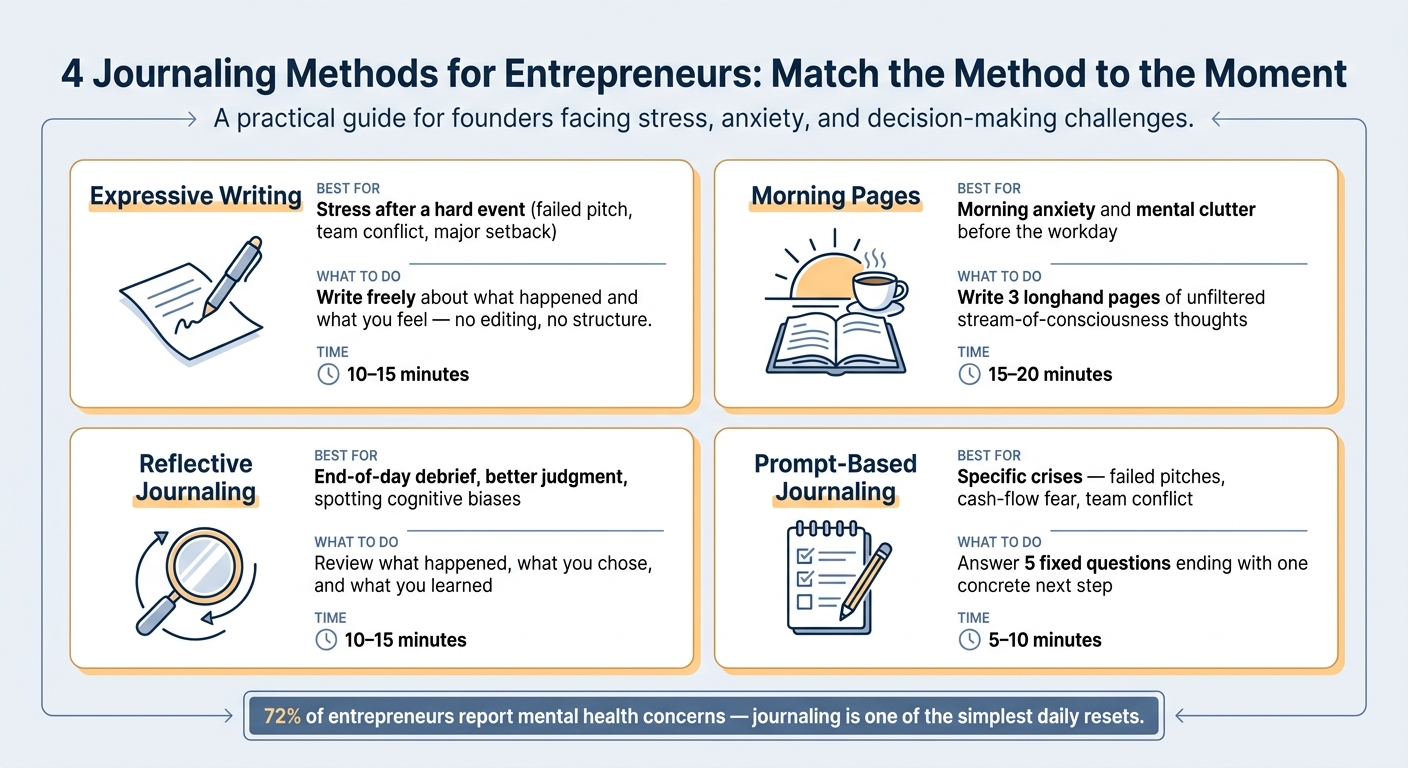
4 Journaling Methods for Entrepreneurs: Match the Method to the Moment
Once you know the main journaling options, the next step is simple: match the method to the problem in front of you. Not every emotional hit needs the same kind of writing. If you pick the wrong format, journaling can feel like busywork. If you pick the right one, it helps you slow down, think straight, and respond instead of react.
For founders, that difference matters.
Evening Emotional Check-In for Stress, Tension, and Perspective
A short end-of-day check-in can stop work stress from following you into bed. Write down one win, one source of stress, and one point of gratitude. This three-part check-in takes about 5 minutes and helps create emotional closure at the end of the day.
Each part does a different job. The win keeps your brain from ending the day locked onto what went wrong. The stress entry puts a name to what’s bothering you, which often makes it feel less slippery. The gratitude line adds balance without pushing fake positivity.
That kind of shutdown routine can help you leave stress at the desk instead of dragging it into the next call, the next decision, or the next morning. Over time, it can also help you spot repeat stress patterns before they pile up.
Morning Pages and Reflective Journaling for Mental Clutter and Anxiety
Use morning pages when your head feels crowded. Use reflective journaling when you need space after a setback.
Morning pages mean writing three longhand pages of unfiltered, stream-of-consciousness thoughts with no structure, no editing, and no goal beyond getting the noise out of your head and onto the page. It’s messy on purpose. That’s the point.
Reflective journaling works better after something rough happens and you need to look at it without spiraling. Use it after a setback to review what happened without panic.
One method clears the fog. The other helps you step back and see the hit for what it is.
Problem-Focused Prompts for Failed Pitches, Team Conflict, and Cash-Flow Fear
When the problem is specific, your writing should move toward a decision, not just circle the feeling.
A failed pitch. A tense team issue. Cash-flow fear at 11:30 p.m. Those moments can send your thoughts in loops. Structured writing helps keep the page from turning into rumination. A five-step framework works well here:
- What happened? Facts only.
- What did I feel? Name the raw emotional response.
- What story am I telling myself? Identify the internal narrative.
- What else could explain this? Look for other explanations or outside factors.
- What is the next step? Write one concrete next move.
The point isn’t to relive the problem. It’s to turn emotion into action.
For team conflict, prompts like "What conversation am I putting off?" or "Am I leading the way I want to be led?" can bring blind spots to the surface instead of replaying the same argument.
For cash-flow fear, questions like "Am I making financial decisions from abundance or fear?" and "What is the worst-case scenario if I make this decision today?" help turn vague dread into something you can actually look at.
This is what keeps journaling useful when the pressure feels close and personal: pick the method that fits the moment. Use a quick check-in for stress, morning pages for mental clutter, and prompts when you’re dealing with a clear crisis.
How to Build a Journaling Routine That Fits a Busy Schedule
Once you know which method fits the moment, the next step is making it repeatable. The goal isn’t to write more. It’s to catch emotion before it starts steering a decision.
Pick a Time, Format, and Session Length You Can Repeat
Consistency matters more than length. A routine you can stick with creates a little space between pressure and reaction. And that space is often where better decisions happen.
One simple way to make journaling stick is to pair it with something you already do. Write while your coffee brews, right after a workout, or as part of your evening shutdown ritual. That anchor habit does most of the work. You don’t have to build a whole new system from scratch.
Format matters too, but only because friction matters. Paper cuts distractions and can help you think more deeply. Digital is faster and easier to search later. Go with the one that’s easier to start. If you need a prompt to begin, keep your journal somewhere visible so it’s right in front of you.
Before you open email, write down:
- today’s top outcome
- the decision you’re avoiding
- how you want to show up
Keep it under 5 minutes.
How to Review Past Entries Without Turning It Into Busywork
A daily journal becomes useful when you scan it for repeated triggers. Writing things down helps, sure. But the review is where patterns start to show.
Once a week, spend 15 minutes looking back through the past week’s entries. You’re looking for signals: What drained my energy this week? What decision am I avoiding? What patterns am I seeing in my results? At month-end, group recurring stressors – sales stress, leadership friction, cash-flow anxiety – and turn them into one action plan.
Review for repeated triggers, decisions, and outcomes. That’s the part that shifts journaling from a wellness habit into a business tool.
Once the routine is in place, the next challenge is getting started on low-energy days. That’s when resistance tends to show up first.
Common Obstacles and How to Get Started Anyway
What to Do When You Do Not Know What to Write or Avoid Facing Your Feelings
Even with a simple routine, starting can feel like the hardest part. The blank page is often the first wall. You sit down, open your notebook, and either nothing comes out or you just do not want to look too closely at what is going on.
A good way through it is to make the first step tiny. Set a 5-minute timer and write whatever is in your head – no grammar, no structure, no polish – just write. That takes the pressure off. You are not trying to produce anything polished. You are just getting words on the page.
If your mind goes blank, do not wait for inspiration to show up. Use a fixed prompt. One simple 4-question check-in can help:
- How am I feeling right now?
- What am I doing to care for myself?
- Is it having the impact I want?
- What do I need to do about that?
When hard emotions are the blocker, it helps to think of the page as a diagnostic check. Feeling overwhelmed is like a check-engine light. It does not mean you have failed. It means something needs attention. At that point, go back to the same tools that already work: short check-ins, brain dumps, or prompts.
Perfectionism can kill the habit just as fast. If that shows up, treat the session like a reset, not a test. One missed day does not mean the routine is broken.
Conclusion: Start Small, Stay Honest, and Use Journaling to Protect Your Edge
Journaling works best when it stays small, honest, and easy to repeat. A morning intention, an evening check-in, or a quick brain dump during a brutal week can create just enough space between feeling and reacting to think with more clarity.
Start with 5 minutes. Be honest. Come back the next day, even if you missed one.
FAQs
Which journaling method should I start with?
Start with a method that fits your routine and feels easy to keep up with. For busy entrepreneurs, structured micro-journaling works well because it takes less than 10 minutes and gives you clear prompts.
You could try the five-minute journal, freewriting, or bullet journaling. What matters most is consistency, not length.
Can journaling help if I hate writing?
Yes. You can still benefit from journaling even if you dislike writing.
Try voice memos, voice-to-text, or a guided journal with prompts. If writing feels like a lot, start small. Even one sentence can make the habit feel easier.
How do I know if journaling is actually working?
You’ll know journaling is working when it starts to show up in daily life, not just on the page.
A few signs tend to stand out. You can name what you’re feeling within 60 seconds instead of sitting in a fog. You bounce back from stress or setbacks faster. And you begin to notice behavior patterns that used to run the show without you even seeing them.
Your old entries can tell the story too. When you look back, you should be able to spot growth over time and see a shift from automatic reactions to calmer, more intentional choices.
Related Blog Posts
- Checklist for Building a Positive Stress Mindset
- Why Entrepreneurs Need Accountability Systems
- Entrepreneurs vs. Pressure: Decision-Making Tactics
- Why Entrepreneurs Procrastinate and How to Fix It
About The Author