

When pressure hits, I make better calls by pausing, checking the facts, calming my emotions, and choosing based on my values instead of panic.
This guide breaks that into 6 simple steps I can use for big business choices like funding, hiring, expansion, or a major tech purchase. It also shows why stress bends judgment: the brain shifts into fight-or-flight, bias gets louder, and even sleep loss can hurt risk judgment. One stat stands out: getting 6 hours of sleep instead of 8 can cut risk assessment accuracy by 38%.
Here’s the full process in plain English:
- Pause for 3 to 5 minutes before reacting
- Define the decision in one sentence
- List the stakes and constraints, like cash runway, time, and team bandwidth
- Check the facts and watch for bias like confirmation bias, sunk cost fallacy, overconfidence, and urgency bias
- Settle emotion first, even with 60 seconds of slow breathing
- Compare options with a weighted scorecard
- Make the call, log why I chose it, and assign one next step with a deadline
- Review decisions each quarter to spot patterns
The main idea is simple: I do not need perfect information. I need a clear process I can use the same way each time.
This is most useful for hard-to-reverse decisions where a rushed move can cost time, money, or trust. The rest of the article shows how to turn that short pause into a repeatable habit.
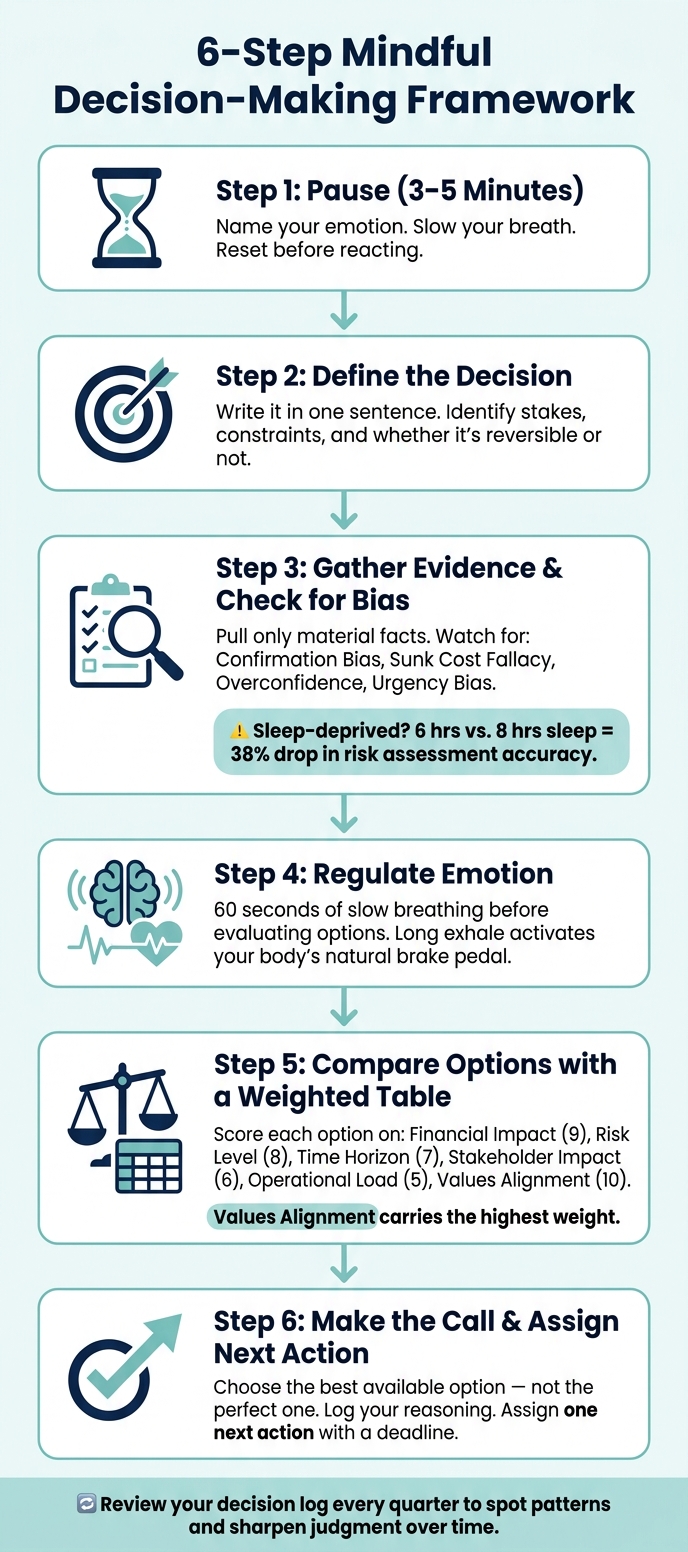
6-Step Mindful Decision-Making Framework for Entrepreneurs
6 Principles For Focus and Mindfulness in Entrepreneurship
sbb-itb-fc951a8
Steps 1–3: Pause, Define the Decision, and Gather the Right Facts
The first three steps of this framework are about slowing down just enough to think straight.
Step 1: Pause for 3 to 5 Minutes Before Responding
Before an investor call or negotiation, take 3 to 5 minutes. Slow your breathing, notice where you’re holding tension, and name the emotion. Are you anxious? Defensive? Rushed? Putting a label on the feeling takes some of the heat out of it. Notice the urge to react, then bring your attention back to your breath.
If a pause feels awkward in a live conversation, script it ahead of time. A line like “I need three minutes to review these facts against our key constraints before we proceed” signals control, not hesitation. That short reset helps you move from reaction to choice. Then, before the pressure starts climbing again, get clear on the decision itself.
Step 2: Define the Decision, Stakes, and Constraints
Once you’ve made a little mental room, write the decision in one sentence. Then check whether that sentence lines up with your priorities. This clears out the noise and forces you to get specific about what you’re deciding.
Next, spell out what’s on the line and what boxes you in. Think about cash runway and mental bandwidth. It also helps to ask, “What would make this decision fail?” That kind of inversion thinking can surface traps early, before you’re knee-deep in them.
You should also sort the decision into one of two buckets:
- A hard-to-reverse decision, like changing your business model
- An easy-to-reverse decision, like testing an email headline or changing a meeting schedule
That distinction tells you how much time the decision deserves. Once the frame is clear and the limits are on paper, move to the facts that matter.
Step 3: Gather Evidence and Check for Bias
Now pull only the facts that materially affect the outcome. More data isn’t always better. Sometimes it just muddies the water. Pay close attention to the story you want to believe, not just the evidence in front of you.
At the same time, check your thinking for bias. A few usual suspects show up again and again:
| Bias | What It Looks Like | How to Counter It |
|---|---|---|
| Confirmation Bias | Only seeking data that supports what you already want to do | Seek contradicting evidence |
| Sunk Cost Fallacy | Staying the course because of past investment, not future value | Ask whether you’d still choose this fresh |
| Overconfidence | Assuming the best-case scenario is the likely one | Run a worst-case scenario |
| Urgency Bias | Treating a deadline as a reason to skip due diligence | Verify whether the deadline is real or artificial |
One more thing: if you’re sleep-deprived, treat that as a constraint too. Getting 6 hours instead of 8 can reduce risk assessment accuracy by 38%. After you’ve filtered the facts, the next move is to steady emotion before weighing options.
Steps 4–6: Regulate Emotion, Compare Options, and Choose with Values
Step 4: Regulate Emotion Before Evaluating Options
Once the facts are clear, steady your emotions before you rank the options.
Stress can still distort how you read the facts, so calm your body before you start comparing. Under pressure, your brain can fire off a fast reaction before judgment has time to catch up. That short space between stimulus and response is where choice lives.
Use a slow exhale that lasts longer than your inhale. It turns on the body’s natural “brake pedal”, which can lower heart rate and ease cortisol. Even 60 seconds of mindful breathing before a high-pressure choice can reduce reactivity and improve decision clarity.
Next, name the feeling and ask yourself: What am I feeling, what outcome matters most, and who will this affect long term? That simple pause helps shift you from reaction mode to analysis.
Once your response is steadier, compare the options against what matters most.
Step 5: Compare Options with a Decision Table
A weighted decision table puts tradeoffs in plain view. Before you score anything, give each criterion a weight from 1 to 10 based on how much it affects your long-term goals. Then score each option against those criteria. The math gives you a guardrail so emotion doesn’t quietly tip the scales.
Here’s a practical framework to use:
| Criterion | Weight (1–10) | What to Evaluate |
|---|---|---|
| Financial Impact | 9 | Cost or first-year return |
| Time Horizon | 7 | Time to results or reversal |
| Risk Level | 8 | Failure odds and downside |
| Stakeholder Impact | 6 | Effect on team and clients |
| Operational Load | 5 | Time and energy required |
| Values Alignment | 10 | Fit with vision and ethics |
Notice that values alignment carries the highest weight. That keeps the table tied to what matters most over the long run.
After scoring, pick the best option and assign the next action.
Step 6: Make the Call and Assign the Next Action
Choose the best available option, not the perfect one.
Write down why you picked it. Keep a short decision log with the option you chose, your reasoning, the expected outcome, and your emotional state at the time. This gives you a record to review later.
Then assign one concrete next action with a clear deadline. For example: “Schedule the vendor call by Jul 17, 2026.” Then act.
Apply the Framework to Common Entrepreneurial Decisions
Here’s what the six steps look like in the decisions founders deal with most.
Funding, Hiring, and Expansion Decisions
Use Step 2 to define what’s at stake, Step 3 to test your assumptions, and Step 5 to weigh tradeoffs.
The six-step framework helps most with high-stakes calls founders make all the time. Funding and senior hires are hard to undo. Expansion calls often need the same kind of care.
When you’re weighing funding, think one move ahead. Ask, “And then what?” That helps you trace the long-term effects of each path (Step 3). After that, use a decision matrix to score each option against your core values and long-term goals, not just the cash in front of you right now (Step 5).
For leadership hires, flip the usual approach. Instead of starting with who seems like the best fit, start with failure (Step 3). Ask what kind of hire could hurt the project or the team dynamic, then screen candidates against those failure modes. Defining the downside first tends to make the review sharper and faster.
For expansion decisions, use a short observe-orient-decide-act cycle: pause for 10 to 15 seconds, gather the key facts, then respond (Step 1). A mindful expansion choice protects long-term resilience, not just short-term momentum.
Mindful vs. Reactive Choices in a High-Pressure Scenario
When pressure spikes, even a short pause can change the call you make. The table below shows what that looks like in practice.
| Dimension | Mindful Approach | Reactive Approach |
|---|---|---|
| Speed | Deliberate; uses micro-pauses to ensure clarity | Rushed; driven by perceived urgency |
| Emotional State | Regulated; calm focus despite pressure | Anxious, fatigued, or impulsive |
| Financial Risk | Calculated; uses second-order thinking to cap downside | High; focused on immediate short-term relief |
| Stakeholder Impact | Aligned with long-term values and team trust | Often results in strained relations or collateral damage |
| Long-Term Resilience | High; builds repeatable systems and insights | Low; leads to decision fatigue and burnout |
Reactive choices often feel urgent in the moment. But that short pause gives you room to choose instead of just react. The founders who scale tend to be the ones who put a process in place before impulse takes over.
Conclusion: Build a Repeatable System for Better Decisions
Better decisions don’t come from waiting for perfect information. They come from using the same process each time: pause, weigh your options against your values, and look back at the result afterward. This works because it’s consistent, not because it’s flawless. A decision log helps you see when stress or pressure shifts your judgment.
A lot of the upside shows up after the decision. Keep a short log with the choice, your reasoning, and the outcome you expected. Note the step you used, the decision you made, and what happened next. Review it every quarter, and patterns start to show – where your judgment is solid and where it needs more work.
To make this stick, build a few small habits into your routine. A pre-decision planning routine or a simple pre-decision checklist can make mindful decision-making feel more automatic over time. Research shows that just 8 weeks of consistent mindfulness practice can make the pause easier to use under pressure.
That way of thinking lives in small, repeatable routines. The goal is decision discipline: standardize small choices so you can stay clear on high-stakes ones. When low-stakes decisions don’t eat up your mental energy, you have more room for the choices that matter most.
FAQs
When should I use this process?
Use this process when the stakes are high, the pressure is intense, or the choice in front of you could change your life.
It helps most when your mind feels crowded, your first reaction is to act on impulse, or you’re running low on mental energy after too many decisions. These mindful strategies can help you stay grounded, think more clearly, and make choices that fit your long-term goals.
How do I know if stress is affecting my judgment?
Stress can quietly throw off your judgment. Sometimes your body tells you first: tight muscles, a racing heart, or shallow breathing. Those signals can point to a fight-flight-freeze response.
Your mind can give it away too. You might rush a decision, freeze up, get tunnel vision, bend on your values, or mistake anxiety for intuition.
That’s why a 30-second pause can make such a difference. It gives you a moment to notice what’s happening before you react, so you can move toward a more mindful choice.
What should I include in a decision log?
Include the decision you’re facing, your reasoning, and what you expect to happen. A decision log is a clear, honest record of your thinking before you commit.
When you write it down, you give yourself something solid to look back on later. That makes it easier to compare your expectations with what actually happened and spot patterns that can sharpen your judgment over time.
Related Blog Posts
- Checklist for Building a Positive Stress Mindset
- Entrepreneurs vs. Pressure: Decision-Making Tactics
- Why Entrepreneurs Procrastinate and How to Fix It
- Journaling for Entrepreneurs: Emotional Balance Tips
About The Author