
Most loyalty programs fail for one simple reason: they treat every customer the same.
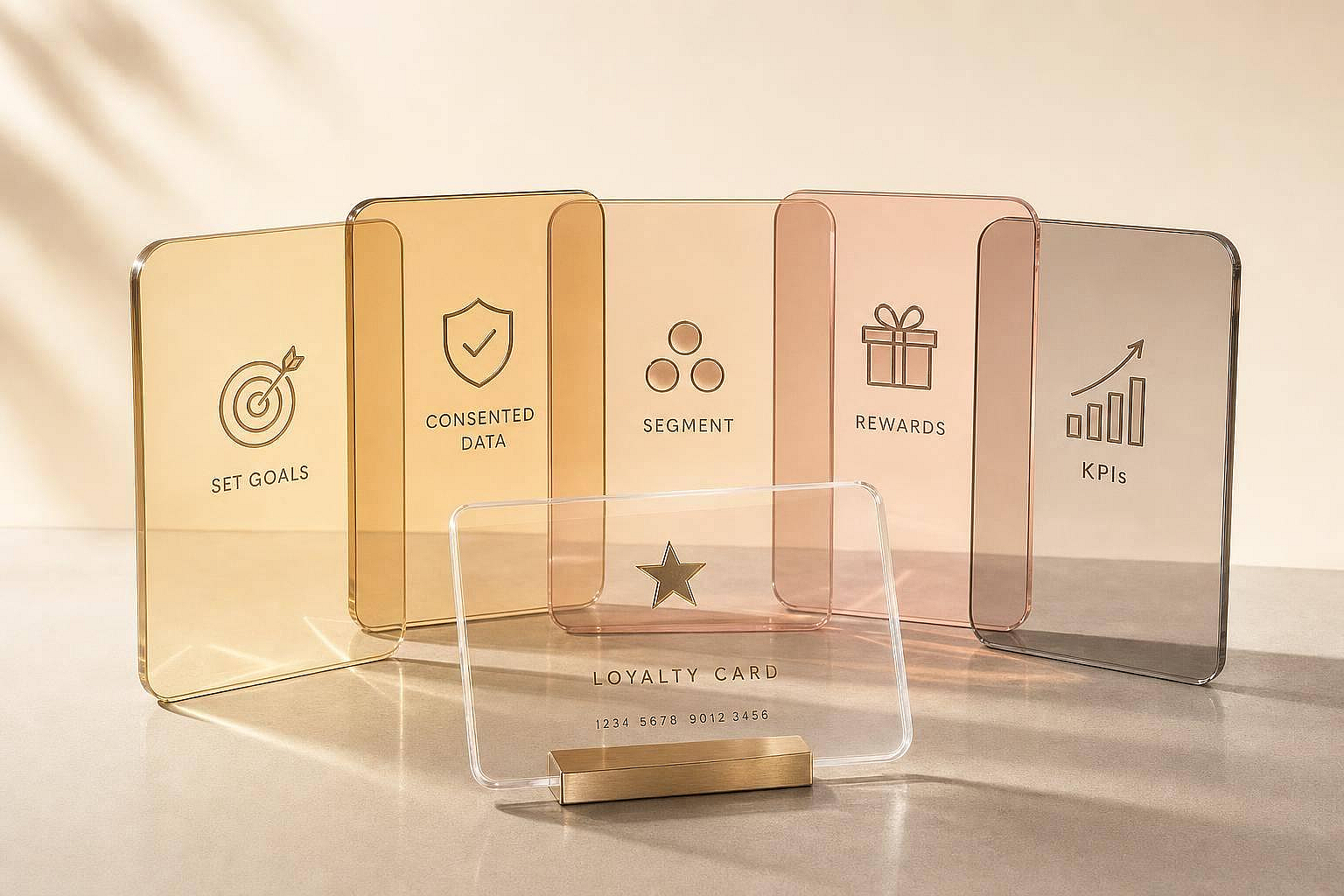
If I want a loyalty program to drive repeat sales in 2026, I need to do five things well: set revenue and retention goals, collect customer data with clear consent, group customers by behavior, pick a simple reward setup, and track results after launch. That matters because returning customers spend 67% more than new ones, and even a 5% lift in retention can add 25% or more in profit.
Here’s the short version:
- Start with numbers: track churn, repeat purchase rate, AOV, CLV, enrollment, and redemption.
- Use customer data well: combine purchase history with details customers share, like birthdays or product likes.
- Segment customers: new, loyal, at-risk, and lapsed customers should not get the same offers.
- Choose a simple program model: points, tiers, paid membership, or a mix.
- Mix reward types: don’t rely only on discounts; early access, surprise perks, and member-only experiences can work better.
- Match the message to the channel: email for progress updates, SMS/push for time-sensitive offers, and on-site prompts for live actions.
- Launch in steps: test first, fix errors, then roll out to everyone.
- Keep improving: a redemption rate above 60% is a strong target, and small changes can improve results by 15% to 30% over time.
A few stats stand out. The average U.S. shopper belongs to about 18 loyalty programs but uses only about half. Also, 74% of U.S. consumers say they will share data for a better experience. That means the bar is not just getting sign-ups. It’s giving people a reason to stay active.
One lesson runs through the whole article: personalization is not just about points. It’s about sending the right reward, to the right person, at the right time, in a way that feels easy to use.
If I had to sum it up in one line, it would be this: keep the rules simple, make rewards feel worth it, and base every offer on customer behavior.
How to build a best-in-class loyalty program
Build the Foundation: Goals, Data, and Customer Segments
Start with measurable goals and the customer groups you want to retain.
Set goals tied to revenue and retention
Pick 2–3 goals tied to revenue and retention, and put a number on each one. Broad goals sound nice, but they don’t give your team anything clear to work toward.
For example, if your monthly churn rate is around 5.3% – a common benchmark for subscription businesses – a measurable target could be cutting it by 25% in the first year. You could also focus on increasing Average Order Value (AOV), growing wallet share, lifting Customer Lifetime Value (CLV) by 40%, or getting your redemption rate above 60%.
Track these KPIs from day one:
| KPI Category | Metric | What It Tells You |
|---|---|---|
| Revenue | Average Order Value (AOV) | Whether loyalty members spend more per transaction than non-members |
| Revenue | Customer Lifetime Value (CLV) | Total value a customer brings over the full relationship |
| Retention | Churn Rate | How many customers stop buying or cancel |
| Retention | Repeat Purchase Rate | How often customers return to buy again within a specific window |
| Engagement | Redemption Rate | Whether members find rewards worth using |
Set your baseline before launch. If you don’t know where you’re starting, you can’t show progress later. Those targets also shape the next step: what data you need to collect.
Collect first-party and zero-party data responsibly
First-party data is the information you already gather through normal customer activity, like purchase history, transaction frequency, website browsing behavior, email open and click rates, and app engagement. Zero-party data is what customers choose to tell you directly, such as their birthday, product preferences, preferred communication channel, or personal values.
You need both. And many customers are open to the trade-off: 74% of U.S. consumers will share data for a better experience. The key is to make that exchange plain. One simple move is to offer 100 bonus points when someone completes their profile or shares their birthdate during signup.
On the legal side, keep consent simple and transparent. Tell people what you’re collecting and why. Protect that data with encryption and multi-factor authentication. For most SMBs, it also makes sense to keep loyalty data inside your CRM so it doesn’t get scattered across tools.
That data should do more than fill out a profile. It should help you build useful segments.
Create segments that change the customer experience
Once the data is in place, group customers by behavior and value. A good starting point is lifecycle stage: new, active, loyal, at-risk, and lapsed. Then layer in RFM signals – recency, frequency, and spend – to spot at-risk, high-value, and lapsed customers. Someone who bought three times in 60 days should not get the same message as someone who has been inactive for 120 days.
This is where segmentation starts to pay off. Brands that deliver strong personalization earn customer loyalty at rates 1.5 times higher than those that don’t, and personalized marketing can capture 40% more revenue. For lapsed customers, send win-back emails after 90–180 days of inactivity and include the current point balance. For high-value customers, non-monetary perks can work well. The point is simple: match the offer to the segment.
Choose the Right Program Structure and Personalization Tactics
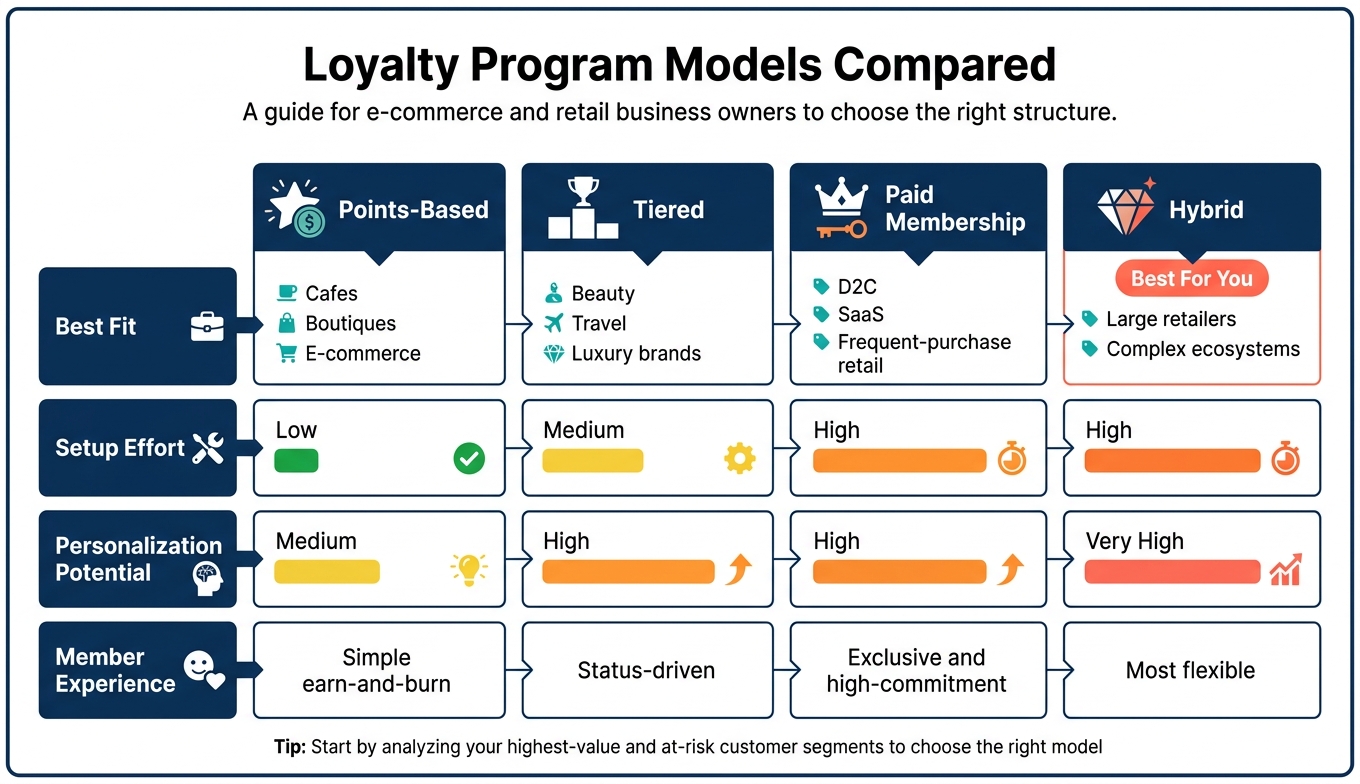
Loyalty Program Models Compared: Points, Tiers, Paid & Hybrid
Once your segments are set, pick the simplest program structure that fits your business and leaves room for personalization.
Points, tiers, and hybrid models compared
The model you choose affects almost everything: how customers earn rewards, what keeps them coming back, and how much room you have to tailor the experience.
| Program Type | Best Fit | Setup Effort | Personalization Potential | Member Experience |
|---|---|---|---|---|
| Points-Based | Cafes, boutiques, e-commerce | Low | Medium | Simple earn-and-burn |
| Tiered | Beauty, travel, luxury brands | Medium | High | Status-driven |
| Paid Membership | D2C, SaaS, frequent-purchase retail | High | High | Exclusive and high-commitment |
| Hybrid | Large retailers, complex ecosystems | High | Very High | Most flexible |
Points-based programs are the easiest to get live. They tend to work best for businesses with frequent, lower-value purchases.
Tiered programs make more sense when status and progression push repeat buying. That’s often the case in beauty, travel, and luxury.
Hybrid models blend points with tiers or subscriptions. They give you the most flexibility, which makes them a strong fit for large retailers and more complex ecosystems.
A simple way to choose: look at your highest-value and at-risk segments first. Those groups usually tell you where personalization matters most.
Once the structure is in place, reward design decides whether members stay active.
Rewards customers actually want
If you rely too much on discounts, customers can start waiting for the next sale. That can chip away at margins over time.
A better mix includes both monetary rewards and experiential rewards.
- Monetary rewards: cashback, free products
- Experiential rewards: exclusive access, member events, early product drops
Non-cash perks often do more than save someone a few dollars. They create the kind of emotional pull that keeps people engaged after a discount has lost its effect.
The data lines up with that idea. 67% of loyalty program members prefer surprise rewards over standard exclusive offers. And 70% of emotionally engaged consumers spend up to twice as much or more on brands they’re loyal to.
Personalization across email, SMS, app, and on-site experiences
Each channel should do one clear job. Email is best for progress. SMS and push work best for urgency. On-site and in-app prompts should react to behavior as it happens.
Email works well when you want to show progress in a way people can grasp at a glance. Put the customer’s current point balance in the header, then add a visual progress bar that shows how close they are to the next reward. For birthday offers, timing matters. Send them 5–7 days before the actual date, not on the day itself, so customers have time to use them.
SMS and push notifications are better when timing is tight. Use them for flash sales, restock alerts on favorite items, or geo-targeted offers when someone is near a store.
On-site and in-app personalization should react to what the customer is doing right now. If someone abandons a cart, trigger a reminder that shows their current point balance and what they’d earn by finishing the purchase. If someone is a top-tier member, show early-access banners before a public sale. The key is simple: match the message to the moment, and match the channel to the action.
These rules keep the program simple enough to launch without making the experience feel generic.
sbb-itb-fc951a8
Launch the Program Step by Step
Once your structure and personalization rules are locked in, launch turns into an execution job. The smartest way to do that is in phases. A phased rollout helps you catch mistakes before they hit your entire customer base.
Map the launch workflow from strategy to rollout
Most loyalty launches follow the same path. You set goals, build the reward system, set the rules, connect the tech, test it, run a small pilot, and then open it up to everyone. The table below lays that out in a simple way.
| Launch Phase | Purpose | Required Inputs |
|---|---|---|
| Strategy & Goals | Define KPIs and financial targets | Revenue targets, retention targets, CLV benchmarks |
| Reward Design | Select sustainable, high-value perks | Margin analysis, customer preference data |
| Earning & Redemption Rules | Set simple, visible logic | Points-to-dollar ratio, expiration rules |
| Technology Setup | Integrate loyalty software that connects to your CRM and POS | API keys, customer database, mobile app flow |
| Testing | Catch glitches before full rollout | Test accounts, QA checklists, edge-case scenarios |
| Soft Launch | Test with a small segment | Segmented email list, feedback surveys |
| Full Rollout | Drive broad awareness and enrollment | Marketing assets, email/SMS templates, support scripts |
One detail matters more than it may seem: make sure points post in real time across in-store, mobile, and web channels. If a customer buys something and their balance doesn’t update, trust can slip fast.
A soft launch gives you room to fix problems early. Testing with a small group first helps you spot friction in the sign-up flow, missing point credits, or redemption errors before they frustrate a larger audience. Test each customer segment so you can confirm balances, offers, and redemption paths display the way they should.
Set rules customers can understand quickly
Complicated rules can sink sign-ups. If someone can’t tell what their points are worth in under ten seconds, you’ve already made the program harder than it needs to be.
Keep the math simple. A ratio like 100 points = $1 makes the value easy to grasp right away. The earning side should be just as plain. Reward purchases, then add a few easy actions like leaving a review or creating an account.
Redemption should feel within reach, not like a long grind. Set a minimum threshold that feels doable. Put expiration rules where people can see them, and tell them well before points expire. Don’t hide that stuff in fine print. Tier qualification windows should also be spelled out clearly on the program page and in onboarding emails.
The point is simple: customers should feel like the program is easy to use, not like they need a calculator and a lawyer.
Prepare your team and support channels before launch day
Before launch day, marketing, customer support, operations, and finance need to be on the same page. If support finds out about the program when customers do, things can get messy fast.
Set up canned responses for common issues, including:
- Missing points
- Expired rewards
- Tier questions
- Redemption errors
Your support team should know how tier status works, how segment-based offers appear, and how personalized redemption rules affect the customer experience. Give them an internal dashboard with real-time redemption rates and enrollment numbers so they can keep an eye on performance without digging around. It also helps to assign clear ownership for point disputes and define turnaround time in advance.
Store staff and support reps should be able to answer basic questions on the spot. Short training sessions and support scripts usually cover the issues that come up most often.
Measure Performance, Fix Problems, and Improve Over Time
Track the KPIs that show real loyalty impact
Once your program is live, the job changes. Setup is done. Now it’s about watching performance and using the numbers to make better calls.
The table below covers the seven KPIs that matter most, what each one shows, and how often to review them.
| KPI | What It Measures | What It Reveals | Review Frequency |
|---|---|---|---|
| Retention Rate | % of customers who continue to purchase over time | Repeat purchases and long-term retention | Monthly / Quarterly |
| Customer Lifetime Value (CLV) | Total projected revenue from a single customer account | Long-term profitability of loyalty members vs. non-members | Quarterly / Annually |
| Average Order Value (AOV) | Average dollar amount spent per order | How well personalized offers drive higher spend | Monthly |
| Enrollment Rate | % of total customers who join the program | How well the offer converts customers | Monthly |
| Active Participation Rate | % of members who earn or redeem within 30–90 days | Active use vs. inactive accounts | Monthly |
| Redemption Rate | % of issued points or rewards actually used | Whether rewards feel valuable and reachable | Monthly |
| At-Risk Score | Likelihood a member will disengage | Where to focus win-back campaigns before revenue declines | Real-time / Weekly |
A good benchmark for redemption rate is above 60%. That number tells you whether rewards feel worth using or just sit there untouched.
Retention deserves close attention too. A 5% lift in retention can increase profit by 25% to 95%. That’s a big swing from what can look like a small change on paper.
Before launch, write down your baselines. If you skip that step, it’s hard to tell whether the program is helping or whether sales moved for some other reason.
Personalization mistakes that reduce results
Most loyalty programs don’t fall apart because the idea was bad. They slip because the targeting is off, the data is old, or the rules make people work too hard.
Weak segmentation is one of the biggest problems. Putting all frequent shoppers into one group sounds simple, but it misses what they care about. A sustainability-focused buyer and a price-driven buyer may want very different rewards. Send both the same offer, and one of them may ignore it.
Irrelevant rewards cause the same kind of drop-off. If the reward doesn’t line up with what a segment wants, members stop paying attention.
Then there’s over-reliance on discounts. If every reward is a percentage off, customers learn to wait for the next deal instead of buying at full price. That can chip away at margins and brand value over time. Mix in perks like early access to products, community events, or charitable donations.
Data silos can also wreck personalization behind the scenes. If in-store purchase data doesn’t sync with online profiles, your messaging can look clueless. For example, you might send a “we miss you” email to someone who bought in-store last week. Regular data audits help keep targeting tied to recent behavior.
And then there are the rules. Too many of them can kill momentum. Complicated earning systems, points that expire too fast, and reward ratios people have to stop and calculate all add friction. A/B tests can help here. Compare reward thresholds, discount levels, and message frequency before rolling changes out more broadly.
Conclusion: Core steps to build a loyalty program that keeps customers coming back
Use these signals to improve the next round of offers. Track the seven KPIs on a set schedule, review core numbers each month, and use A/B tests to fine-tune offers and thresholds. Watch At-Risk Scores closely so you can step in before members drift away. Small, steady changes can improve program results by 15% to 30% over time.
FAQs
How do I choose the right loyalty program model?
Choose a model that fits your business goals, customer expectations, and industry. Start by deciding what you want the program to do: increase purchase frequency, grow lifetime value, or build a stronger sense of connection with your community.
Common options include points-based programs for repeat purchases, tiered programs for higher spending, and paid subscriptions for members-only perks. The best move? Start simple. Map the customer journey, see where loyalty can make the biggest difference, and then fine-tune the program using metrics like redemption rates and churn.
What customer data should I collect first?
Start with the basics, like a customer’s name and email address, so you can stay in touch. It also helps to collect birthdates at signup. That gives you a simple way to send birthday or anniversary rewards that feel personal instead of generic.
From there, focus on first-party data such as purchase history and website behavior. That kind of data helps you see what people like, what they buy, and how much they tend to spend. Just make sure consent is clear and easy to understand. People should know exactly what data you collect and how you use it.
How long should I test before a full launch?
There’s no set testing window before a full launch. A loyalty program works best when you treat testing as an ongoing process, not a one-and-done trial.
Use A/B testing and regular performance reviews to fine-tune your approach, see how different segments respond, and spot the best timing. Then adjust rewards and communication based on your business goals and what your customers expect.
Related Blog Posts
- Ultimate Guide to Personal Branding Online
- SMART Goals for Entrepreneurs: Step-by-Step Guide
- Personal Stories vs. Data: What Builds More Trust?
- Q&A: Social Media Engagement for Entrepreneurs
About The Author