

Founder stress is common, measurable, and fixable. Research in this article shows that 87.7% of entrepreneurs report at least one mental health issue, founders are 2x more likely to face depression, and stress tends to hit hardest when money pressure, overload, isolation, and poor recovery pile up at the same time.
If I boil the article down, the message is simple: I lower founder stress with systems, not willpower. The strongest support in the research points to five moves: build psychological capital, use better coping habits, protect sleep and recovery, get peer support, and tighten cash and company systems.
Here’s the article in plain English:
- Stress hits founders differently because business results often feel tied to self-worth.
- The biggest triggers are cash pressure, too many roles, conflict, and nonstop task-switching.
- Not all stress is the same: some pressure can push action, but money strain and friction tend to wear judgment down.
- Psychological capital – hope, confidence, optimism, and resilience – links to better well-being and sticking power.
- The best coping tools are planning, delegation, boundaries, mindfulness, breathing, and reframing.
- The worst coping tools are overwork, avoidance, and alcohol.
- Recovery matters: sleep, clear stop times, and light aerobic exercise can lower strain.
- Support matters too: mentors, founder peers, and outside sounding boards can cut isolation.
- Business structure helps: documented processes, weekly review time, and backup plans reduce mental load.
- Money setup matters: cash reserves, burn-rate planning, and debt terms that fit uneven revenue can lower pressure.
- Tracking helps: resting heart rate, sleep quality, and weekly work hours can show when stress is building.
Bottom line: if I want to stay steady as a founder, I need to work on my habits, my support circle, my company systems, and my cash plan at the same time.
The Main Drivers of Entrepreneur Stress and Resilience
Workload, Conflict, and Financial Uncertainty
Money pressure and too many roles sit near the top of the stress list for founders. Financial worries drive anxiety for 39.2% of founders, and role overload keeps showing up as a major source of strain. A founder may handle strategy, sales, marketing, and operations all in the same week, sometimes all in the same day. That kind of constant switching comes at a cost. It can take about 23 minutes to get back into deep focus after changing tasks, which helps explain why so many days feel stuck in shallow work.
These pressures don’t just make work harder. They shape who bounces back and who hits the wall.
Some stress can push people forward. Challenge stressors can spark effort and momentum. But hindrance stressors – like financial instability and investor conflict – tend to drive burnout and weaken decision-making. That split matters because it points founders toward the right fixes instead of treating all stress like it works the same way.
| Mental Health Indicator | % of Entrepreneurs Affected |
|---|---|
| Anxiety | 50.2% |
| High stress | 45.8% |
| Burnout | 34.4% |
| Loneliness and isolation | 26.9% |
| Depression | 19.8% |
Source:
Why Resilience and Psychological Capital Matter
Founders with higher resilience and energy are linked to 2.2x better survival through early setbacks.
One useful way to think about this is through Psychological Capital (PsyCap). PsyCap brings together hope, optimism, resilience, and self-efficacy. Founders with higher PsyCap tend to report lower stress, stronger persistence, and better psychological well-being. And because PsyCap can be trained and measured, it gives teams and support systems a clear place to start when they want to help founders cope better and recover faster.
sbb-itb-fc951a8
Well-being of Entrepreneurs | Prof. Ute Stephan
Research-Backed Practices Entrepreneurs Can Use
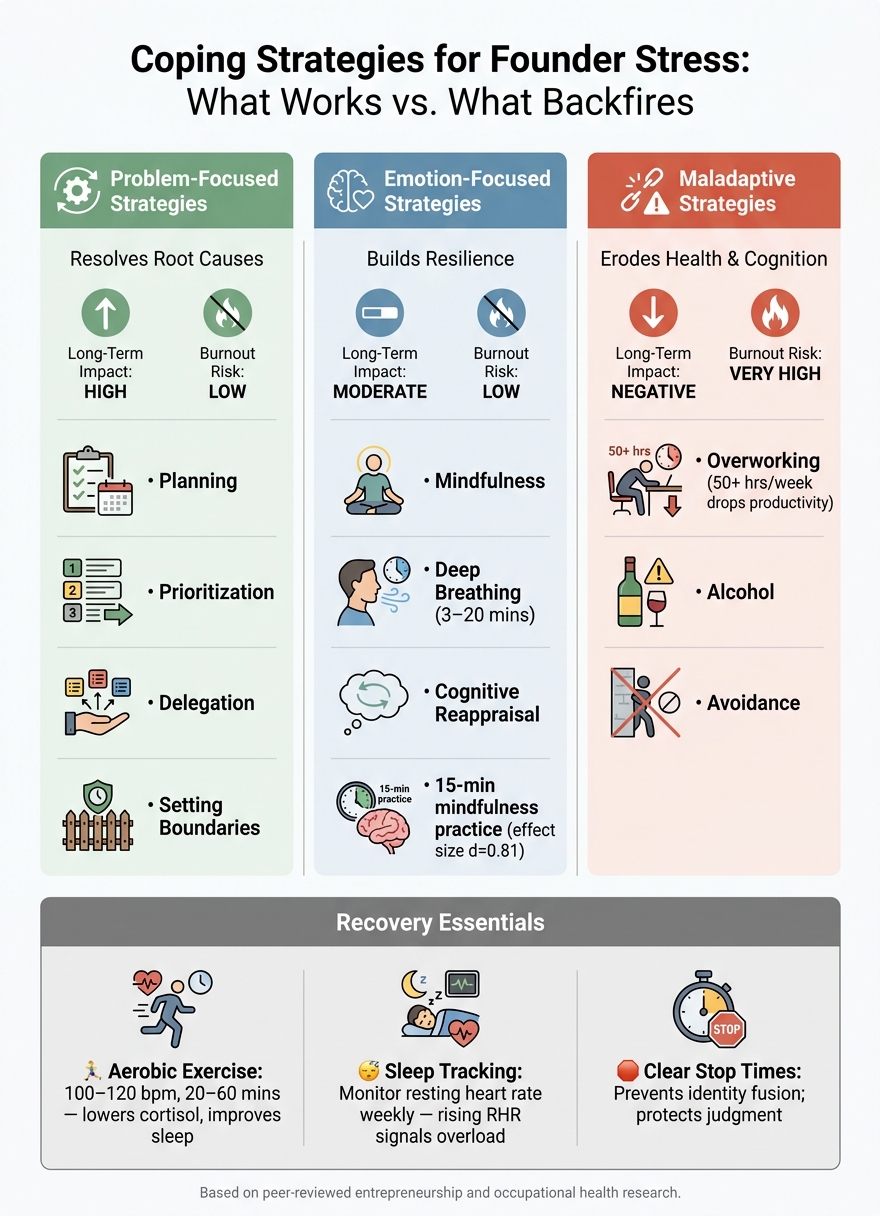
Entrepreneur Stress: Coping Strategies That Help vs. Hurt
Research points to three levers you can control: training, coping, and recovery.
Build Psychological Capital with Structured Training
Founders build PsyCap through active training, not motivation alone. That means using a set process, not just waiting to “feel ready.” Two methods stand out: mastery-based skill practice and cognitive reframing.
Pick challenges that push you a bit, but not so far that they crush your focus. When skill and challenge are in sync, concentration gets better. When they’re out of sync, stress climbs or boredom sets in.
Brief mindfulness can help too. A 15-minute mindfulness practice can reduce mental fatigue and restore self-control. One meta-analysis found a strong pooled effect on performance and psychological flexibility in high-pressure settings (d = 0.81).
Training helps most when it shows up in how you deal with pressure day to day.
Use Coping Strategies That Reduce Strain Instead of Hiding It
Problem-focused coping goes after the source of stress. That includes planning, prioritization, and delegation. Emotion-focused coping works on your response to stress. That includes mindfulness, deep breathing, and cognitive reappraisal.
Some habits can seem useful in the moment but backfire later. Overworking, alcohol, and avoidance may dull the pressure for a while, but they also push burnout risk up.
| Strategy Type | Long-Term Impact | Burnout Risk |
|---|---|---|
| Problem-Focused (planning, delegation, boundaries) | High – resolves root causes | Low |
| Emotion-Focused (mindfulness, deep breathing, reappraisal) | Moderate – builds resilience | Low |
| Maladaptive (alcohol, overwork, avoidance) | Negative – erodes health and cognition | Very High |
After coping, recovery keeps stress from piling up.
Protect Recovery Through Detachment and Sleep
Detaching after work helps buffer the strain that comes from heavy workloads and conflict. Clear stop times help too. They lower the odds of identity fusion, where self-worth gets wrapped up in business results.
The exercise advice here is pretty specific. Low-intensity aerobic activity at 100–120 bpm for 20–60 minutes lowers cortisol and improves sleep quality. High-intensity training can push stress hormones higher when you’re already under heavy strain.
Wearable data can help you spot the drift. If your resting heart rate starts to climb, that’s a sign to scale back and recover.
Recovery protects judgment, not just energy.
Social, Business, and Financial Buffers That Lower Stress
Personal habits matter. But founder stress doesn’t come from personal habits alone. It also comes from the people around you, how your company runs, and how your money is set up.
Mentors, Peer Groups, and Role Models Reduce Isolation
Stress drops when founders stop carrying every problem by themselves. Isolation makes things heavier because every hard call, every doubt, and every bad week lands on one person. Peer groups lighten that load and give you better feedback at the same time.
That matters even more now because the share of new startups led by a single founder climbed from 23.7% in 2019 to 36.3% by mid-2025. When more founders are building alone, outside support matters more.
A non-partner peer can be especially helpful. The best version of that person sits outside your equity and reporting structure. They’re close enough to get the pressure, but far enough away to speak plainly without the baggage of shared ownership.
Support helps most when the company itself isn’t in constant disorder.
Firm Resilience Starts with Systems and Cash Planning
Clear systems take pressure off your brain. Documented processes and simple decision rules cut cognitive load, which helps preserve resilience when things get tense. One simple habit helps here: set aside time each week to work on the business, not just in it. Otherwise, structure slips fast.
Money planning matters just as much. Keep a cash reserve and stress-test your monthly burn. You should know exactly how many months the business can keep running at its current rate if revenue drops. Founders who skip this tend to make reactive calls when pressure spikes.
A contingency plan helps too. If you become unavailable, someone should know who takes over operations and what happens next. That removes a quiet, constant layer of pressure.
How Funding Structure Can Ease Financial Stress
Funding structure shapes how much financial strain a founder feels day to day. Match repayment terms to the ups and downs of your revenue. If cash flow is uneven, fixed obligations can make each month feel tighter and more stressful.
The next step is to track which of these buffers actually lowers your stress. Once you can measure them, you can act on them.
A Practical Framework for Tracking and Improving Stress Resilience
A Four-Part Resilience Model for Founders
The research points to four levers: individual recovery, social support, business systems, and financial stability. Stress tends to ease when these four work together instead of operating in silos.
How to Track What Works
A simple way to do this is to use those same four levers as a scorecard. Try one change, watch the response, and keep the changes that lower strain. Think about stress management the same way you’d think about any business metric: test, measure, adjust.
Track both daily habits and body signals. That gives you a clearer picture of which changes are helping and which ones just sound good on paper.
| Strategy | Stressor Addressed | Effort | Research-backed outcome |
|---|---|---|---|
| Deep Breathing | Acute anxiety | Low (3–20 mins) | Immediate relaxation |
| Aerobic Exercise | Chronic stress / high blood pressure | Medium (20–60 mins) | Improved sleep; lower resting heart rate |
| Peer groups | Isolation / Decision Fatigue | High (Regular meetings) | Cognitive diversity; social buffering; accountability |
| Task automation | Skill Gap / Burnout | Medium (Setup phase) | Cuts repetitive work and context switching |
| Sleep Tracking | Resilience / Fatigue | Low (Passive) | Improved recovery decisions |
For body-based markers, track your resting heart rate and sleep quality each week with a wearable device. If your resting heart rate starts climbing, that can signal your nervous system is under too much strain.
Workload matters too. Research shows that productivity per hour drops significantly once you exceed 50 hours per week. So total hours worked isn’t just a calendar issue. It’s a stress metric.
Check these measures every month, not just once.
Conclusion: The Strategies Research Supports Most
Entrepreneur stress is real, measurable, and something you can lower with the right systems. The strongest evidence points to structured training, sleep and recovery, social support, business resilience, and financial stability. These are repeatable systems, not quick fixes. The goal isn’t to remove stress from founder life. It’s to keep stress from stacking up into burnout, poor judgment, and weak performance.
FAQs
How can I tell when founder stress becomes burnout?
Founder stress may be turning into burnout when work starts to feel far heavier and more draining than it normally does.
A few common signs tend to show up fast:
- Weak work-life boundaries
- Growing resentment toward your business
- Feeling stuck in a reactive, hyper-vigilant state
If your decision-making gets worse, or you feel worn out day after day despite doing your best, that’s a strong sign your mental reserves are running too low.
What should I track weekly to catch stress early?
Keep a weekly stress journal. Write down what set off the stress, what you felt in your body, and the thoughts that showed up in the moment.
Then look back at your entries each week. Patterns tend to pop up fast. You may notice the same stress points, the same kind of days, or the same people and tasks showing up again and again.
It also helps to track your own warning signs, like tense shoulders, a racing heart, or negative thoughts that won’t let go. Once you spot those signals early, it gets a lot easier to adjust your schedule and scale back commitments before things pile up.
Which stress fix should I start with?
Start with self-awareness. Notice what sets off your stress and how you tend to react. Maybe you rush a decision, shut down, or bend your values just to get through the moment.
Once you can spot those patterns, use the STOP technique: Stop, Take a breath, Observe, and Proceed. It gives you a short pause so you can respond with more care instead of running on autopilot.
It also helps to protect your sleep quality. Poor sleep and chronic work stress can feed each other, and that can take a toll on your health fast.
Related Blog Posts
- Checklist for Building a Positive Stress Mindset
- Why Entrepreneurs Need Accountability Systems
- Entrepreneurs vs. Pressure: Decision-Making Tactics
- Why Entrepreneurs Procrastinate and How to Fix It
About The Author