

Risk can create new openings – if I keep the downside small and the test clear.
Here’s the short version: I don’t need to bet everything to get growth. The article’s main idea is simple: protect the core, test with a small slice, learn from misses, and take social risks that cost little but may lead to big returns.
If I had to sum it up in four moves, it would be this:
- Take calculated risks, not reckless ones
- Put limits on time, money, and damage
- Look for bets with small loss and big upside
- Run small experiments first
- A 10% test / 90% protected split keeps me in the game
- Use a 30- or 90-day window to decide what happens next
- Treat failure like data
- Write down what failed, why, and what I’ll change
- Review it soon so the lesson sticks
- Take bold relationship risks
- Send the message, ask the question, start the talk
- The cost is often low, but one contact can change a career or business
A few numbers stand out:
- 90% of core resources stay protected
- 10% goes to tests
- Launch a rough test within 48 hours
- Use a 30-day or 90-day cutoff to scale, adjust, or stop
Calculated Courage: How to Take Risks the Smart Way
sbb-itb-fc951a8
Quick Comparison
| Approach | Main idea | Cost if wrong | Possible return |
|---|---|---|---|
| Calculated risk | Test with limits | Small to moderate | High |
| Reckless risk | Bet without limits | High | Unstable |
| Small experiment | Try before going big | Low | Proof, demand, cash |
| Relationship risk | Reach out and ask | Low | Mentors, deals, referrals |
So the takeaway is clear: I create more chances when I take small, controlled risks instead of one big blind leap.
Risk as a Path to Opportunity
Here’s the core rule: not all risk is the same. Opportunity almost always comes with uncertainty. The key difference is how you handle it.
Use that uncertainty on purpose. Calculated risk helps protect your core while still giving you room for upside.
A simple way to think about it: protect 90% of your core resources – capital, time, and stability – and use the other 10% for bold experiments. If the experiment fails, you’re still on your feet. If it works, you may open a new door. That matters because risk only turns into opportunity when there’s some structure behind it.
Sometimes that looks like direct, bold outreach. In 1994, Barnett Helzberg Jr. saw Warren Buffett standing on a street corner in New York and walked up to pitch his company. One year later, in 1995, he sold Helzberg Diamonds to Berkshire Hathaway.
1. Take Calculated Risks Instead of Reckless Ones
A calculated risk means you protect the core of your business while testing a bet that has real upside. Reckless risk is different. It usually skips the homework.
The key difference comes down to preparation. You make the move on purpose, with clear limits, instead of just hoping things work out.
Opportunity Upside
The best calculated risks offer big upside with limited downside. That’s the sweet spot.
Look for low-cost bets where being wrong won’t hurt much, but being right could pay off in a big way. Think of it like placing a small chip on a table where the payout could be many times higher than what you put in.
Limit the Downside
Before you commit, run a pre-mortem. Ask a simple question: Why could this fail?
That shift matters. It helps you spot weak points early, tighten the plan, and keep a bad test from turning into an expensive mistake.
Learning Speed
The goal isn’t perfect results on the first try. The goal is to learn fast.
Chase Jarvis learned from weak contracts and the wrong partners, then applied those lessons to build CreativeLive. A failed attempt can still pay off if it teaches you what to fix before the next bet.
Long-Term Leverage
When a calculated risk works, the payoff can last. You’re not just getting a short-term win. You may be setting up an edge that keeps helping you over time.
Once the downside is capped, the next move is to test the idea on a small scale.
2. Run Small Experiments Before Making Big Bets
Next, test the idea on a small scale. That lets you move ahead without putting everything on an idea that hasn’t proved itself yet. A simple way to do this is the 10/90 split: keep 90% of your core resources protected and use 10% to test the idea. The point isn’t commitment. The point is proof.
Opportunity Upside
Small experiments are built to look for big upside at a low cost. One small test can show demand, bring in cash, or pull in support. That’s the appeal: you’re not swinging for the fences with your whole budget. You’re checking whether the market gives you a reason to go bigger.
Downside Containment
Set a hard deadline before you start. A 90-day trial forces a clear decision: scale, adjust, or stop. That matters because ideas can drift if you let them. A fixed window keeps the test honest and stops a small trial from turning into a slow, expensive habit.
Learning Speed
Move fast. Run a small version of the idea within 48 hours so you can get real data. Not guesses. Not opinions. Actual signals from the people, market, or system you’re testing. Even a rough first pass can tell you more than weeks of debate.
Long-Term Leverage
When a small experiment works, it gives you proof you can use to justify a bigger bet. It’s much easier to back the next move when you can point to results. And if the test fails, treat it as data, not damage. You still learned something useful, and you learned it without putting the whole operation at risk.
3. Turn Failure Into a Repeatable Learning System
Failure is feedback, not a stop sign. But that only helps if you save the lesson instead of letting it fade by next week.
One simple way to do that is to keep a Failure Resume. It’s just a document where you write down each failure, what went wrong, why it happened, and what you’ll do differently next time. Over time, that record sharpens your judgment and gives you a repeatable way to learn.
“Every failure becomes data – a step forward rather than a setback.” – Chase Jarvis, Founder, CreativeLive
Opportunity Upside
Failure helps you see what has a shot and what doesn’t. That makes your next move less random and more informed.
Learning Speed
Review failures soon after they happen. The shorter the gap, the better your odds of fixing the issue before you repeat it.
Long-Term Leverage
Each time you log, review, and apply a lesson, your next risk gets smarter.
The next step is putting those lessons to work when the risk is social, not financial.
4. Take Bold Networking and Relationship Risks
Once you start treating failure like data, the next kind of risk to take involves other people.
Not every bold move is about money, markets, or product tests. Skills matter. But relationships often decide which doors open. Reaching out to a mentor, a decision-maker, or a potential collaborator can feel awkward at first. Still, the downside is usually pretty small: a brief uncomfortable moment, a no, or no reply at all. That’s what makes relationship risk such a smart bet. The cost is low, and the upside can change your direction.
Social risk is often the lowest-cost bet you can make: one message, one ask, one conversation.
“It’s only foolish if you don’t ask for help. Most people at the top are willing to help you if you are sincere about learning. You simply have to ask.” – Dr. David Geier, Orthopedic Surgeon and Leadership Speaker
Opportunity Upside
One strong connection can lead to mentorship, referrals, or a collaboration. Time with experts can open learning and career paths that books simply can’t. When you get direct access to people who are far ahead of you, your judgment sharpens faster and your execution improves. That’s why this kind of risk is worth it.
Kobe Bryant is a strong example. Early in his NBA career, he reached out to Hall of Fame players, coaches, and teammates for specific advice on practice habits and handling adversity. Some people weren’t willing to help, but many were. That habit of asking helped him learn faster.
Downside Containment
In most cases, the risk stays small. At a conference, for example, start with vendors. They’re often easier to approach, which lowers the pressure and makes the first conversation simpler.
Learning Speed
Go into the conversation looking for one specific next step, not broad advice. That makes the exchange more useful right away. Reverse mentoring – learning from someone junior or from a different field – can also expose blind spots fast.
Long-Term Leverage
The return from relationship risk builds over time. One bold outreach, followed by steady follow-up, can turn a cold contact into a collaborator, a mentor, or even a business partner. And there’s another layer to it: connect people, not just names. Over time, that builds trust and leads to more opportunity.
Reckless vs. Calculated Risk: A Side-by-Side Comparison
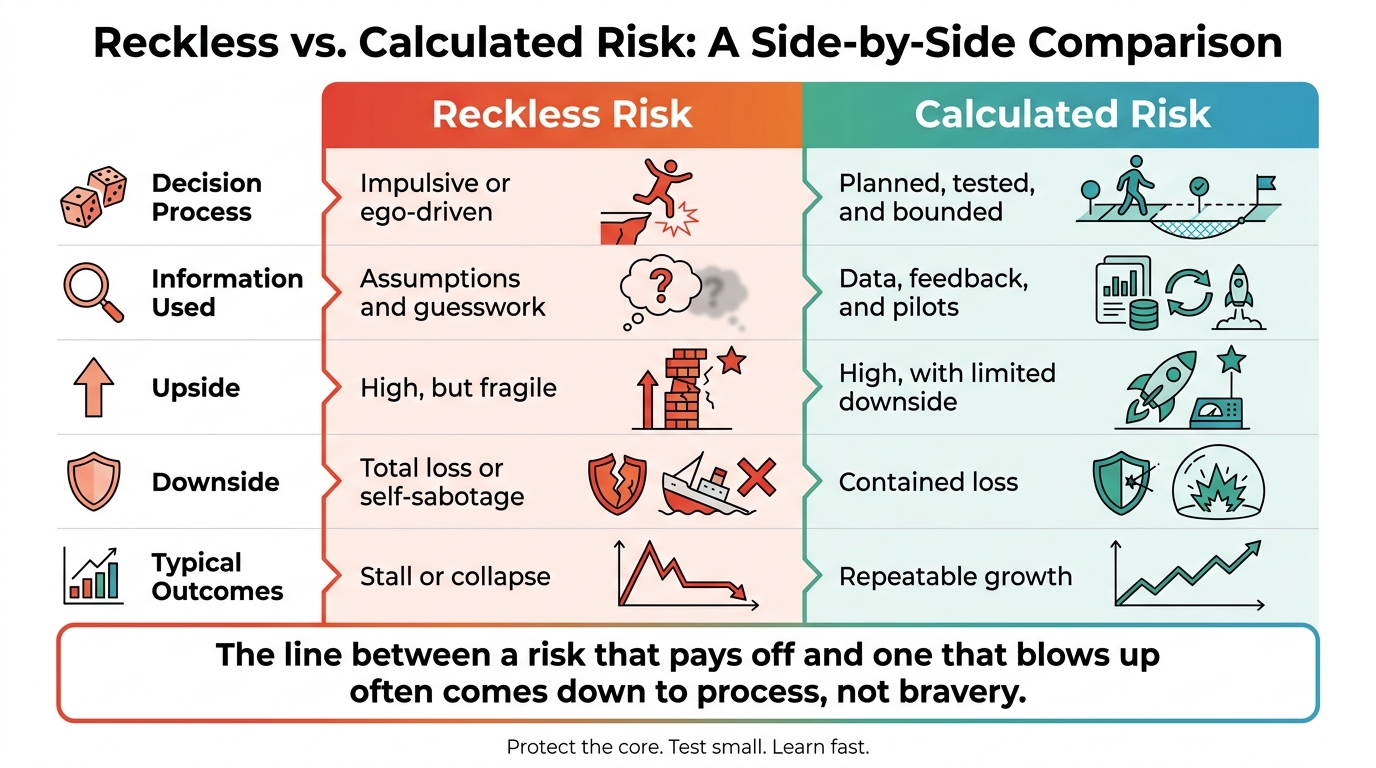
Reckless vs. Calculated Risk: A Side-by-Side Comparison
The line between a risk that pays off and one that blows up often comes down to process, not bravery.
Not every risk deserves the same label. The best bets protect the core business while still leaving room for upside.
Use this comparison to tell smart moves from expensive mistakes.
Here’s the fast comparison:
| Reckless Risk | Calculated Risk | |
|---|---|---|
| Decision Process | Impulsive or ego-driven | Planned, tested, and bounded |
| Information Used | Assumptions and guesswork | Data, feedback, and pilots |
| Upside | High, but fragile | High, with limited downside |
| Downside | Total loss or self-sabotage | Contained loss |
| Typical Outcomes | Stall or collapse | Repeatable growth |
Think of it as a quick gut check before your next decision.
In practice, a calculated risk puts limits on the test and protects the core. Netflix shows how that works at scale. Netflix is a clear example: it protected its DVD business long enough to build streaming.
How to Keep Risk-Taking Going Over Time
If you want risk to keep paying off, each tactic needs to become part of a repeatable system. The idea is simple: take small risks, set fixed limits, review fast, and do it again.
Start with a small wild-card budget for each test so your core resources stay safe. A budget cap does more than limit spend – it keeps a test from spilling into work that matters more. And it works even better when each test also has a firm stop date.
Set a fixed end date, like 30 or 90 days, and use that point to decide whether to scale, adjust, or stop. That deadline matters. Without it, tests have a way of hanging around, quietly eating up time and money long after they’ve stopped being useful.
When something misses the mark, log it in a failure resume: what failed, why it failed, and what changes next. That way, a bad result doesn’t just sting for a week and vanish. It becomes a lesson you can use again.
After the budget, deadline, and lesson log, there’s one more guardrail: protect the person making the calls. Mental resilience matters. Block off the first 90 minutes of your day for focused work so your decision-making stays sharp.
| Safeguard | Tool | Purpose |
|---|---|---|
| Financial | Wild-card budget | Protect core resources. |
| Temporal | 30- or 90-day window | Force a clear stop date. |
| Analytical | Failure resume | Turn each miss into a reusable lesson. |
| Mental | 90-minute morning block | Keep decision-making sharp. |
Conclusion
Opportunity almost never shows up without some risk attached. The edge comes from choosing that uncertainty on purpose, protecting your core, and testing ideas in a controlled way. That’s the thinking behind the four strategies in this article.
Don’t avoid risk. Choose it on purpose. Treat risk like a system: protect your core, test small, learn fast, and reach out boldly. When risk has structure, it stops feeling like a threat and starts working like a tool.
Start small, stay disciplined, and let repeated smart bets compound.
FAQs
How do I decide what belongs in the 10% test bucket?
Put high-risk, high-reward experiments in your 10% test bucket. These are the bets that can teach you a lot, fast, without putting your main resources on the line.
Use this bucket for pilot programs or prototypes built to test a clear hypothesis. The point is simple: fail fast, fail cheap, protect the other 90%, and learn enough to make your next move smarter.
What signs show a small experiment is worth scaling?
A small experiment is worth scaling when the upside is much bigger than the cost to keep going. In plain English: if you can test the idea with very few resources and the early results suggest a small input could lead to a strong payoff, it’s probably worth a closer look.
A few other signs matter too. Look for steady value over time, feedback you can actually use to improve the idea, and surprising second-order effects that make the result even better than you first expected. It also helps when the experiment lines up tightly with your goals, because even a promising test can become a distraction if it pulls you in the wrong direction.
How can I take relationship risks without feeling pushy?
Focus on trust, mutual gain, and service. Don’t chase the fast win. Put your energy into helping other people get where they want to go and giving them something useful first.
Be honest, even when the conversation feels a little awkward. Reach out to make things better, not to corner anyone or force an outcome. And when it is time to ask for something, treat it like a skill. The more you practice, the less heavy it feels.
Related Blog Posts
- Checklist for Building a Positive Stress Mindset
- Why Entrepreneurs Need Accountability Systems
- Entrepreneurs vs. Pressure: Decision-Making Tactics
- Mindful Decision-Making: A Step-by-Step Guide
About The Author