Meet the Indigenous Medicine Keepers of the Amazon Rainforest
There are moments in life that quietly change the way you see the world. For me, one of those moments didn’t happen deep in the Amazon rainforest. It happened thousands of miles away in the United States after meeting Haru Kuntanawa and Dr. Hayra Kuntanawa, cultural ambassadors of the Kuntanawa Tribe.
I arrived expecting to learn about an Indigenous culture. I left feeling connected to an entirely different way of understanding our relationship with nature.
The evening wasn’t simply about ceremonies or traditions. It was about community, music, storytelling, language, and a profound respect for the natural world. It reminded me that indigenous medicine is far more than the use of rainforest plants—it’s a philosophy of living in harmony with the Earth.
The Amazon: Nature’s Greatest Living Library
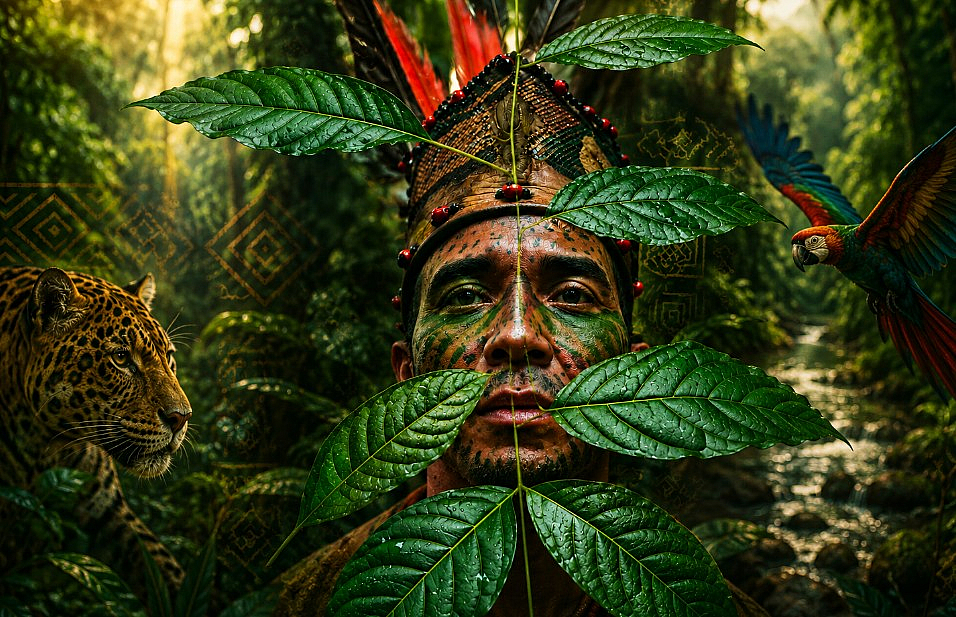
Stretching across nine South American countries, the Amazon rainforest is the largest tropical rainforest on Earth and one of the planet’s most important ecosystems. It produces enormous amounts of oxygen, stores vast quantities of carbon, regulates global weather patterns, and contains an estimated ten percent of all known species on Earth.
Yet perhaps its greatest treasure isn’t simply its biodiversity—it’s the people who have called it home for thousands of years.
Long before modern medicine began studying rainforest plants, Indigenous communities developed an extraordinary understanding of the forest through careful observation and generations of experience. Their knowledge wasn’t recorded in textbooks but passed from elders to children through stories, songs, ceremonies, and daily life.
This living tradition is what many people refer to today as indigenous medicine.
The Story of the Kuntanawa
Among the many Indigenous nations of the Amazon are the Kuntanawa, whose homeland lies in the Brazilian state of Acre.
Like countless Indigenous peoples throughout the Amazon, the Kuntanawa endured tremendous hardship during the rubber boom of the late nineteenth and early twentieth centuries. Violence, displacement, disease, and forced assimilation nearly erased their language, customs, and identity.
Despite these challenges, the Kuntanawa never disappeared.
Instead, they began the difficult work of reclaiming their culture. Elders preserved songs and traditions. Families revived ceremonies and language. Younger generations embraced their heritage with renewed pride while continuing to protect the rainforest that has sustained their people for centuries.
Today, the Kuntanawa stand as an inspiring example of cultural resilience and renewal.
Meeting Haru and Dr. Hayra
Meeting Haru and Dr. Hayra Kuntanawa made this history feel deeply personal.
Rather than presenting themselves as spiritual celebrities, they shared their culture with remarkable humility. Through music, traditional songs, stories, art, and conversation, they invited everyone present into a worldview centered on gratitude, reciprocity, and respect for nature.
It never felt like a performance.
It felt like an invitation to listen.
Throughout the gathering there was a recurring message: the forest is not something we own. It is something we belong to.
That simple idea has stayed with me ever since.
Indigenous Medicine Is a Way of Life
Many people hear the phrase indigenous medicine and immediately think of plants or ceremonies.
While plants certainly play an important role, Indigenous medicine is much broader than that.
It encompasses relationships—with family, community, ancestors, animals, rivers, forests, and future generations. It teaches that health isn’t simply the absence of illness but living in balance with ourselves, each other, and the natural world.
Within many Amazonian traditions, plants are viewed with deep reverence and used in carefully preserved cultural and ceremonial contexts that have been passed down over generations.
One example is hapé, a traditional sacred tobacco preparation used ceremonially by many Indigenous peoples of the Amazon. Different tribes have their own unique preparations and customs surrounding its use. These practices are rooted in cultural tradition and spiritual significance and should be understood within that context rather than as modern wellness trends or substitutes for medical care.
For the Kuntanawa, these traditions represent generations of accumulated knowledge and an enduring relationship with the rainforest itself.
Guardians of the Forest
One of the most inspiring things I learned is that Indigenous communities aren’t simply living in the rainforest—they’re actively protecting it.
Research has consistently shown that Indigenous-managed territories often remain among the healthiest and most biodiverse ecosystems anywhere on Earth. Their traditional knowledge has helped preserve these forests for countless generations.
Protecting Indigenous cultures and protecting the Amazon are inseparable.
When a culture disappears, so too can generations of ecological knowledge that may never be recovered.
Supporting Indigenous communities means supporting the future of one of Earth’s greatest natural treasures.
Bringing the Amazon to America
What impressed me most about Haru and Dr. Hayra is their commitment to cultural exchange.
Rather than asking people to travel thousands of miles into the rainforest, they’re bringing the heart of the Amazon to communities throughout the United States through educational gatherings, music, storytelling, traditional arts, and cultural experiences.
These events create opportunities for people to learn directly from Indigenous voices instead of secondhand interpretations.
In a world where authentic cultural connections have become increasingly rare, that feels incredibly valuable.
A New Perspective
I still haven’t visited the Amazon rainforest.
But after meeting the Kuntanawa, I feel as though I’ve caught a glimpse of its soul.
I left with a deeper appreciation not only for indigenous medicine, but for a culture built upon resilience, stewardship, gratitude, and respect for the living world.
In many ways, the greatest lesson wasn’t about the plants at all.
It was about remembering that humanity is part of nature—not separate from it.
Final Thoughts
The story of the Kuntanawa Tribe is ultimately one of hope.
Despite generations of hardship, they continue preserving their language, music, ceremonies, and ancestral knowledge while inspiring people around the world to reconnect with nature and appreciate the wisdom of Indigenous cultures.
Meeting Haru Kuntanawa and Dr. Hayra Kuntanawa reminded me that travel isn’t always measured by miles. Sometimes the most meaningful journeys happen through the people we meet and the stories we’re willing to hear.
Whether or not I ever reach the Amazon itself, I’ll always remember the evening when a small piece of one of the world’s oldest living cultures found its way into my life.
And perhaps that’s the greatest gift indigenous medicine has to offer—not simply knowledge of the forest, but a renewed appreciation for our place within it.
About The Author