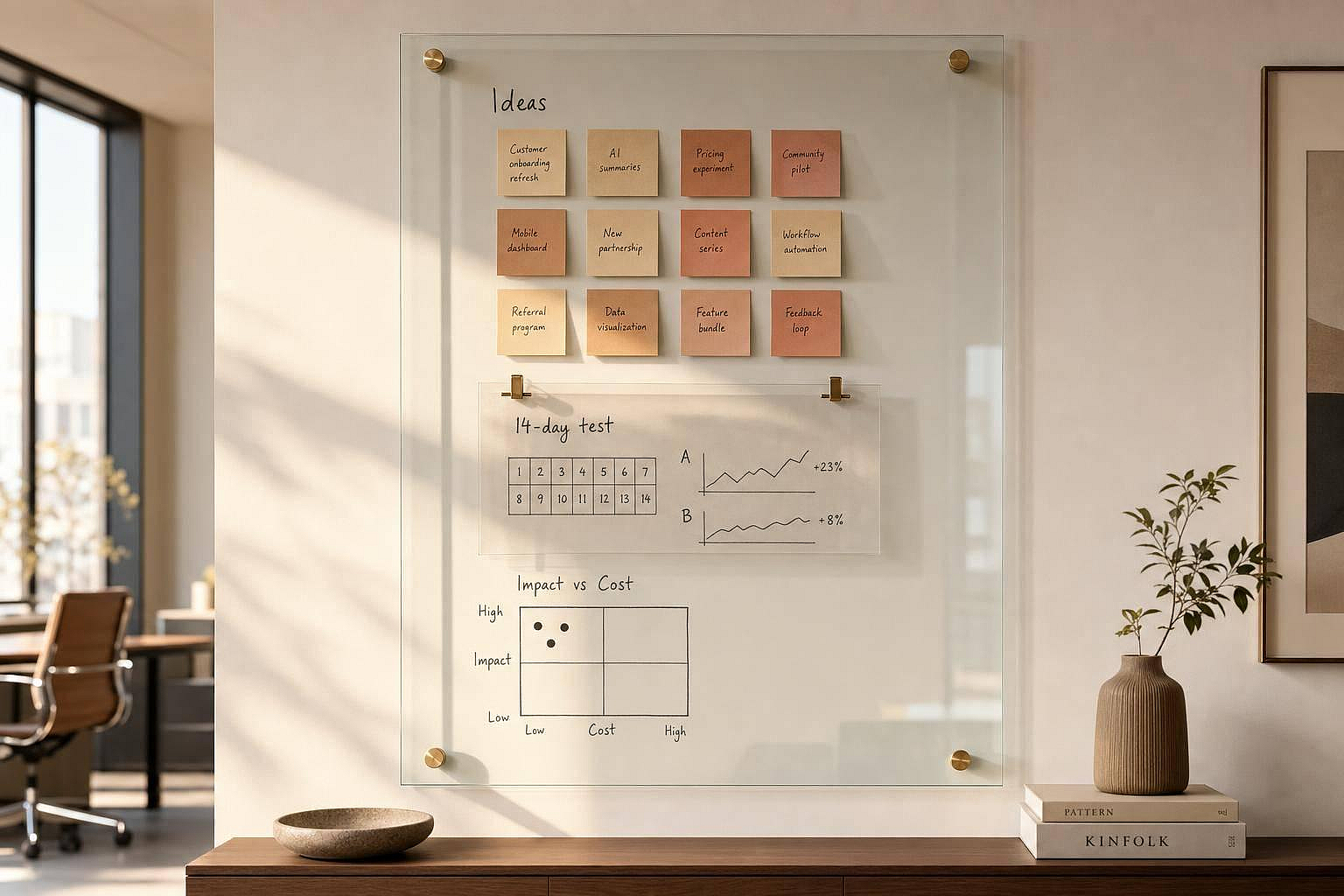
Better business choices come from mixing new ideas with proof. If I only look at past numbers, I may miss a better path. If I only chase ideas, I may waste time and money. The fix is simple: come up with more options, test the best one on a small scale, and then decide with facts.
Here’s the short version:
- I start with two thinking modes: open up options, then narrow them down.
- I use a clear process to move from a problem to a test.
- I test ideas with small bets before spending more.
- I look at customer behavior, not just internal goals.
- I use simple scoring to compare choices on impact, cost, fit, time, and effort.
- I check for bias before I commit.
- I turn all of this into a weekly habit.
A few numbers make the point clear:
- Design-led companies beat the S&P by 228% over 10 years.
- One test cited in the article used $15,000 in ads and led to $120,000 in added first-month revenue.
- A good rule is a 14-day test window for customer-facing changes.
- For idea generation, I should aim for 10 to 20 options before cutting the list.
What this means for me: if I’m deciding on pricing, hiring, marketing, product changes, or funding, I don’t need to guess. I can use a simple system:
- Define the problem in plain English.
- List many possible moves.
- Pick the best one with a scorecard.
- Test it with a small budget or rough prototype.
- Review the result and either move forward, change course, or stop.
Quick Comparison
| Approach | Main use | What I look at | Best when |
|---|---|---|---|
| Idea-generation process | Find more possible answers | options, patterns, fit | the problem is still open |
| Lean test | Check one key assumption | clicks, replies, sign-ups, feedback | I want proof before spending more |
| Design thinking | Focus on the customer problem | pain points, journey, user response | I may be solving the wrong problem |
| Cost-benefit review | Compare money in vs. money out | ROI, costs, tradeoffs | choices are clear and measurable |
The core idea is simple: think wide first, test small, and decide with discipline.
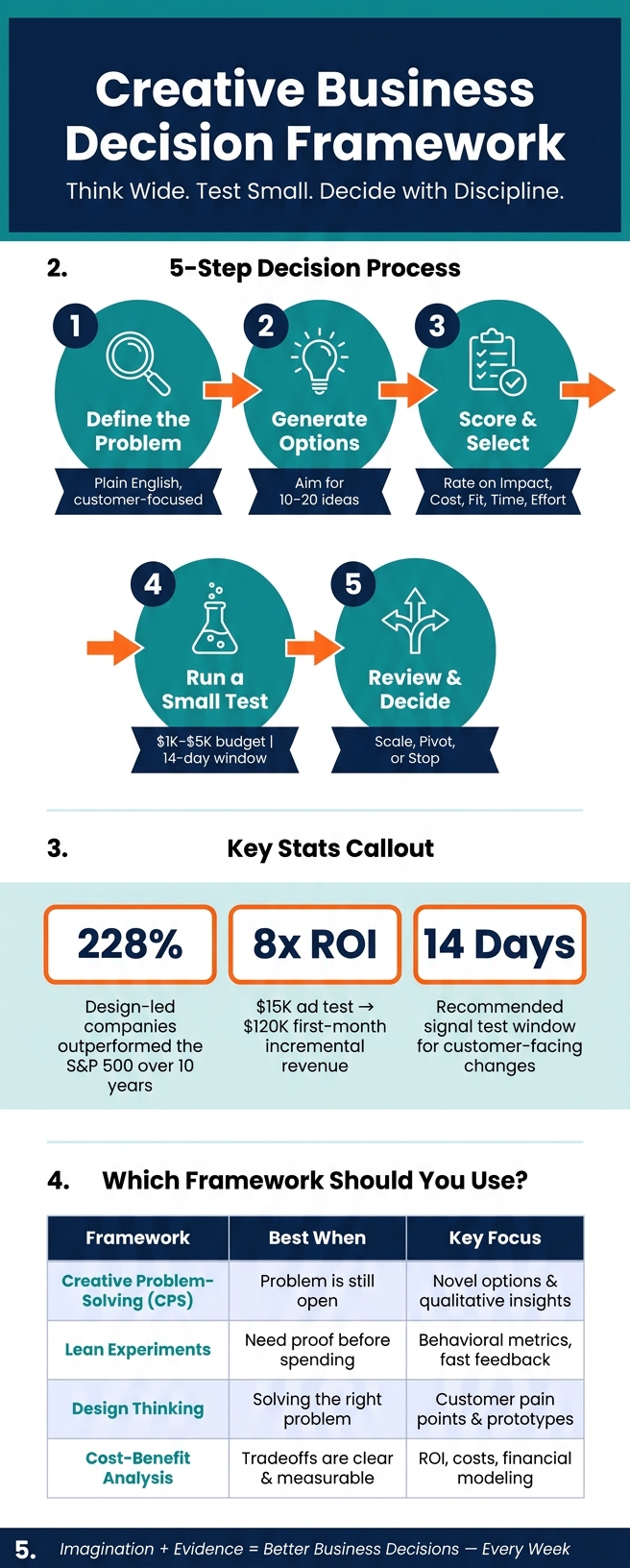
Creative Business Decision Framework: Think Wide, Test Small, Decide with Data
Creative Problem Solving and Decision Making Training
sbb-itb-fc951a8
Frameworks That Turn Ideas into Usable Business Decisions
Once those thinking modes are in place, the next move is simple: turn ideas into tests.
Raw ideas don’t turn into smart decisions by themselves. They need a process. For entrepreneurs and small business owners who need to move fast without wasting money, two frameworks stand out: Creative Problem-Solving (CPS) and lean experimentation. Used together, they cover the whole path from early idea to validated action.
Use the Creative Problem-Solving Process
CPS follows a clear sequence: clarify the problem, generate options, develop the strongest ideas, implement, and review results.
This is where divergent and convergent thinking work side by side. First, you open things up and generate a lot of options. Then you narrow the field, rank what stands out, and cut what doesn’t.
One handy tool inside this process is the Disney Strategy. It moves through idea generation, objective review, practical planning, and risk testing. In plain English, it helps you keep big ideas and hard reality in the same conversation without letting either one take over too soon.
Run Lean Experiments Before Making Large Commitments
After CPS brings the best option to the surface, lean experiments help you test it without taking a big financial swing.
Before making a large commitment, test the core assumption with a small slice of the budget. The point isn’t to prove your idea was right all along. The point is to learn fast and keep the cost low.
Example: AdVenture Media Group tested a humor-led brand line with a $15,000 ad budget and generated $120,000 in first-month incremental revenue.
That’s the big takeaway: test the hypothesis before you go all in.
A practical rule of thumb is to run a 2-week signal test for any customer-facing change. If it doesn’t produce measurable engagement or feedback within 14 days, iterate or pause. That keeps momentum up and stops a weak idea from quietly eating time and money.
Comparison Table: CPS vs. Lean Experiments vs. Standard Business Evaluation
Use the table below to match the framework to the decision.
| Framework | Goal | Speed | Data Needed | Cost Exposure | Risk Level | Best Use Cases |
|---|---|---|---|---|---|---|
| Creative Problem-Solving (CPS) | Generate novel, usable solutions | Moderate | Qualitative insights & observations | Low (mostly time/labor) | Low | Product design, operational bottlenecks |
| Lean Experiments | Validate assumptions with proof | Fast | Behavioral metrics & feedback | Low ($1,000–$5,000) | Controlled | Market fit, new feature launches |
| Standard Business Evaluation | Ensure financial/operational efficiency | Slow | Historical & quantitative data | High (analysis/consulting) | High (if data is outdated) | Funding, scaling, M&A |
Standard business evaluation works best when benchmarks already exist. CPS and lean experiments help you create new information much earlier.
How Design Thinking Improves Strategic Choices
If CPS and lean experiments help you test ideas, design thinking helps you make sure you’re solving the right problem first. It starts with the customer, not an internal hunch. Then it builds strategy around what people actually need.
Start with Customer Behavior, Not Internal Assumptions
Design thinking moves through five stages: empathize, define, ideate, prototype, and test. The first two stages matter a lot because that’s where teams reframe the problem around customer behavior. Instead of starting with a revenue target, start with the pain people feel. That shift can change everything that comes next.
Disney did exactly that. The company reframed a revenue goal around guest pain points, which led to MagicBand and stronger satisfaction and revenue.
To see if a change is working, map the customer journey and track signals like NPS, CES, and simple operating metrics.
Once the real problem is clear, the next step is to test the direction with the smallest workable prototype.
Use Prototypes to Lower Risk in Strategic Decisions
After you define the real problem, test a direction cheaply before you commit to a full rollout.
A prototype doesn’t need to look polished. It can be a one-page mockup, a sample offer, or a two-minute demo video. The point is simple: get feedback before you spend serious money.
James Dyson built 5,127 prototypes before launching his bagless vacuum. The rule here is plain: build the smallest version that answers the biggest question, then measure the response before you scale.
Comparison Table: Design Thinking vs. Cost-Benefit Analysis
Use design thinking when the opportunity is still fuzzy. Use cost-benefit analysis when the tradeoff is already clear.
| Feature | Design Thinking | Cost-Benefit Analysis |
|---|---|---|
| Primary Focus | Customer empathy and behavior | Financial ROI and internal efficiency |
| Methodology | Iterative prototyping and testing | Financial modeling and forecasting |
| Risk Management | Low-cost tests to limit downside | Probability and impact estimation |
| Certainty Level | Best for unknowns | Best for known tradeoffs |
| Best Used For | New or uncertain situations | Clear financial tradeoffs |
Use design thinking to find the right opportunity. Use cost-benefit analysis to check the financial case.
Balance Bold Ideas with Data, Financial Discipline, and Bias Control
After you’ve generated and tested ideas, the next step is simple: decide which ones deserve more money and attention.
That’s where a decision filter helps. Without one, a promising idea can quietly eat up budget, pull the team in three directions, and turn into a distraction. The aim isn’t to kill bold thinking. It’s to make bold ideas easier to defend.
Score Ideas with a Simple Decision Matrix
A simple decision matrix gives you a quick, honest way to compare options side by side. Score each idea against a few clear criteria, such as feasibility, expected impact, implementation time, strategic fit, and cost. Then line up the results and see which option gives you the best mix of upside and resource use.
This works well when you’re deciding on marketing spend, product changes, or team investments – cases where the stakes are real, but the right answer isn’t obvious. For product decisions, RICE (Reach, Impact, Confidence, Effort) gives you a compact way to rank ideas. Use the score to weigh upside against time, cost, and risk.
Spot Biases That Weaken Business Decisions
Once you’ve ranked the options, take a second look. Bias can still bend the outcome.
Common traps include first-answer bias, habit lock-in, group pressure, and winner-only thinking. These often sink strong ideas during review – not because the ideas were poor, but because the evaluation process went sideways.
One practical fix is to split idea generation from idea evaluation. Research shows that independent idea generation, followed by pooling the results, produces twice as many ideas as group brainstorming. Have people score options on their own before the discussion starts. Another solid checkpoint is a pre-mortem: before you commit funds, act as if the project has already failed and write down the most likely reasons why. That simple exercise helps surface risks before they turn into expensive mistakes.
Pros-and-Cons Table: Low-Analysis Ideas vs. Low-Innovation Analysis
Neither extreme leads to strong business results. Here’s how they compare:
| Factor | Low-Analysis Ideas | Low-Innovation Analysis |
|---|---|---|
| Upside | High potential, but largely untested | Predictable, but limited ceiling |
| Failure Risk | High – guardrails are missing | Moderate – risks are known, but solutions are narrow |
| Speed | Fast to generate, slow to recover from mistakes | Slower to decide, but execution is more predictable |
| Flexibility | High early on, fragile under pressure | Low – hard to pivot once committed |
| Long-Term Growth | Inconsistent without structure to scale wins | Can stagnate without fresh thinking to drive differentiation |
A better approach is to start with open idea generation, then add budget caps, pilot data, and pre-mortems before scaling. That gives you room to think big without letting one-off ideas turn into a messy weekly habit.
Build a Repeatable Decision System and Take Next Steps
Create a Weekly Decision Workflow
Once you’ve scored your ideas, make the process part of your weekly routine. These frameworks only help if you use them on a regular basis. A simple weekly rhythm keeps your thinking tied to business results without eating up your calendar.
Start with one decision that matters this week. Pick a specific business problem, not a fuzzy goal. Think: “Why is our email open rate dropping?” or “Which of these two pricing models fits our customers better?” Then generate enough options to create actual choice and narrow them down fast. Idea volume is the first sign that you’re looking well, so aim for 10 to 20 options before you cut the list.
Next, choose one option to test this week and review it at the end of the week. Track what happens, set a decision deadline, and commit to the next move based on the data. Keep one running idea log for every idea, draft, and test result. A lot of strong ideas don’t show up all at once – they appear after people start writing them down.
Apply This Framework to Funding, Growth, and Lifestyle Decisions
Use the same process, but match the depth of your analysis to the size of the choice. Reversibility is the main filter. Creativity gives you options, analysis trims them, and reversibility tells you how far to go before you act.
For funding decisions, the stakes are high enough to justify a 12- to 18-month trade-off review. Don’t stop at the cash in front of you. Look at what limits, obligations, or trade-offs may come with that money later.
For daily operations and lifestyle choices, automate low-stakes defaults. Preselecting things like your wardrobe, meals, or morning routine saves mental bandwidth for choices that can move the business forward.
Conclusion: The Strongest Business Decisions Combine Originality with Proof
That pattern is the point of the guide.
“Data is important, but it is not the entire story… the vision, heart, and soul stem from the creative talent.” – Anna Wintour, Editor in Chief, Vogue
The goal is a repeatable system, not a perfect one. You want imagination and evidence working side by side, week after week, until better decisions become the default.
FAQs
How do I balance creativity with data?
Balance instinct and data by treating them as a team, not a tug-of-war.
Use intuition, storytelling, and emotional intelligence to shape your direction and big-picture ideas. Then use data, testing, and optimization to steer execution, scale what works, and track results.
Prototyping helps bridge that gap. It gives you a way to test creative ideas in real situations before you roll them out in full.
What should I test first before spending more?
Start with small, reversible experiments – two-way door decisions. Think pilot programs, short-term pricing tests, or small-scale prototypes. They let you gather data and feedback without putting your core business on the line.
Test early, then review the results within 7 to 30 days. After that, adjust based on what the evidence says, not on hunches. This small bets approach cuts the downside and gives you room to try new ideas that might work.
How can I avoid bias when choosing ideas?
Separate brainstorming from evaluation so you don’t kill ideas before they have a chance to grow. A simple way to do this is to split the process into three clear roles: first the dreamer, then the realist, and then the critic.
Start by letting ideas flow without judging them. That’s the dreamer’s job. After that, switch into realist mode and figure out what could work in practice. Then bring in the critic to look for weak spots, risks, and missing pieces. Doing these steps in order helps you think more clearly and keeps early doubt from shutting things down.
It also helps to get input from people who won’t just nod along. Talk to people who will push back on your assumptions and point out what you may be missing. At the same time, watch for blind spots driven by ego or fear. Those can quietly steer decisions more than most people realize.
To put ideas to the test, use pre-mortems and prototypes. A pre-mortem asks you to imagine the idea failed and work backward to figure out why. Prototyping lets you test the idea in a small, low-risk way before going all in. That way, you’re not relying on gut instinct alone – you’re checking the idea against evidence.
Related Blog Posts
- 5 Habits That Kill Your Creative Flow
- Entrepreneurs vs. Pressure: Decision-Making Tactics
- Mindful Decision-Making: A Step-by-Step Guide
- 4 Ways To Create Opportunities Through Risks
About The Author