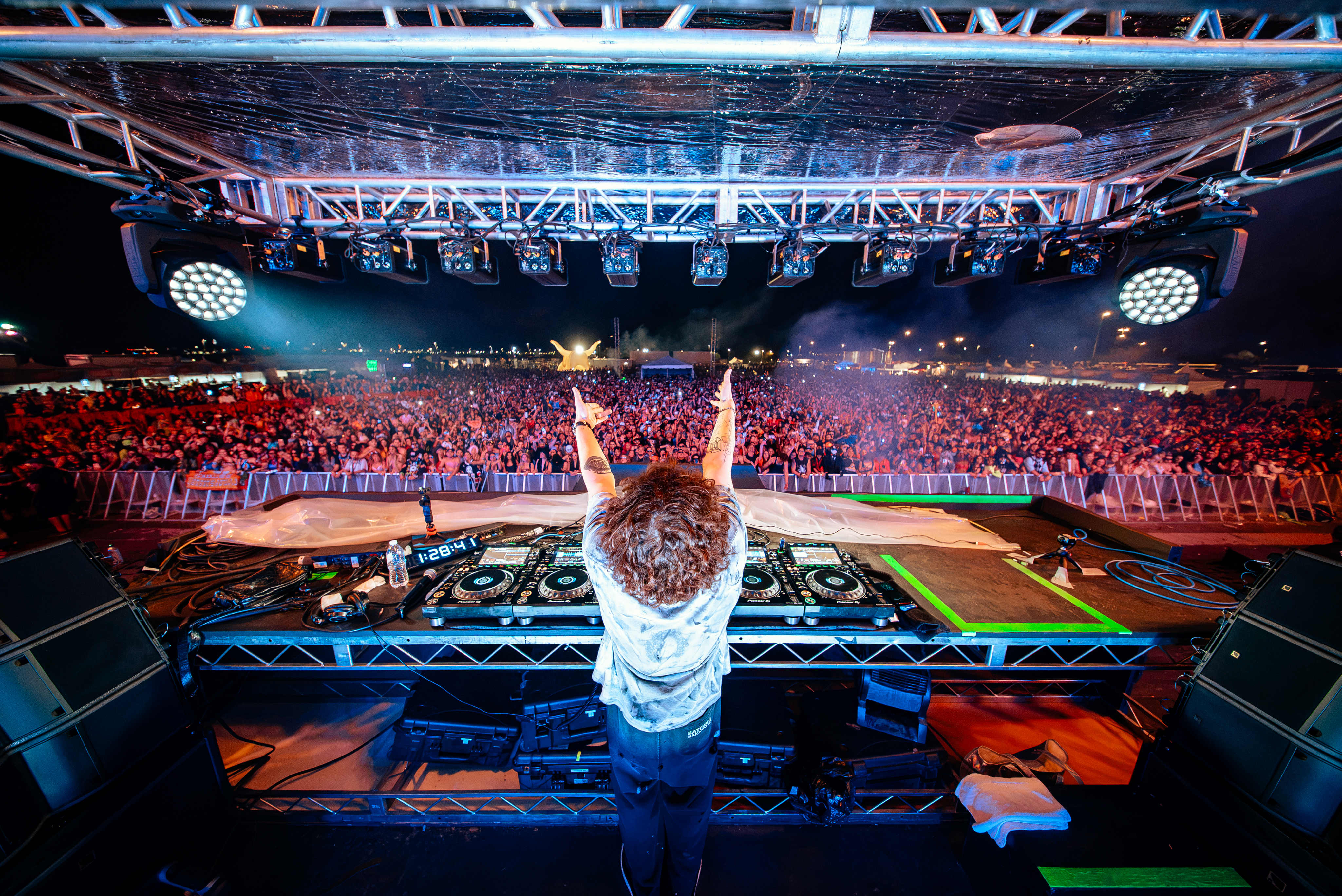
Rain, lasers, heavyweight bookings, and a purpose-built stage gave Relentless Beats’ inaugural Halloween bass ritual an identity all its own.
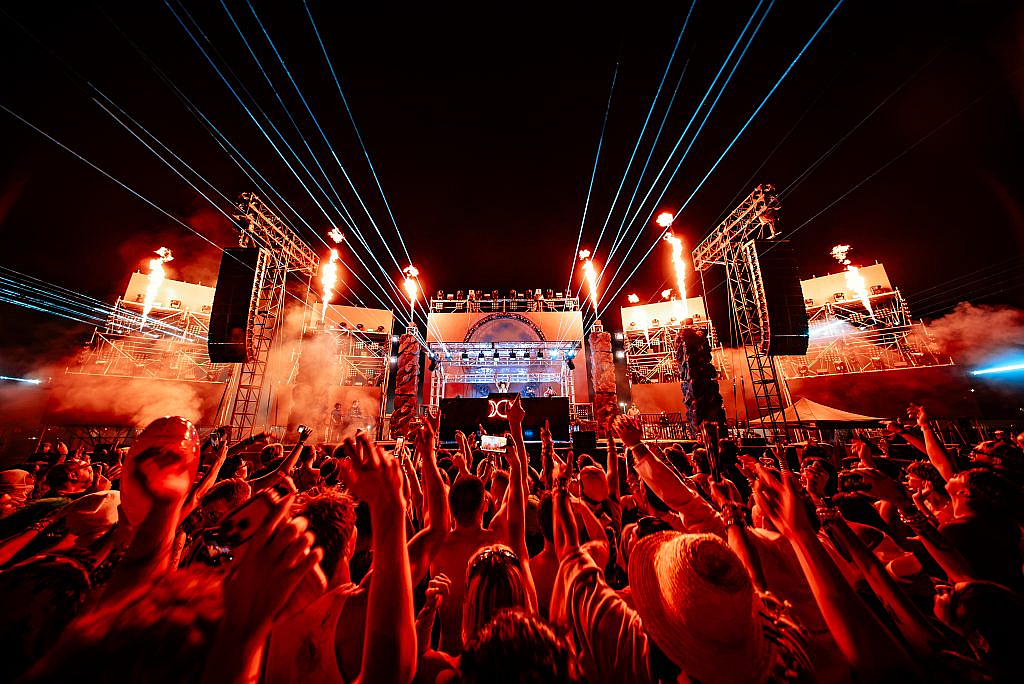
There was no past edition to compare it to, no familiar stage design to expect, no previous crowd size to measure against, and no established traditions waiting for attendees when they walked through the gates.
HEX Music Festival entered Rawhide Festival Grounds on October 30 and 31 as a completely new experiment for Relentless Beats and its bass-focused Aftershock brand: build an entire Halloween weekend around the heavier side of electronic music and see just how far Arizona’s appetite for bass could stretch.
Then the weather decided to test the idea almost immediately.
Rain interrupted the first night and absolutely soaked the second, yet somewhere between Friday’s evacuation, Saturday’s mud, flames shooting above the stage, and lasers cutting through thousands of falling raindrops, HEX managed to find an identity. For a festival celebrating its inaugural year, that may have been its biggest success.
HEX Knew Exactly Who It Was For
Calling HEX simply another Halloween EDM festival undersells what Relentless Beats attempted. This was a bass-first, dubstep-centered festival from top to bottom, and the headliners alone established the caliber of the weekend.
Subtronics, Excision, INZO and ATLiens each carry enough weight to occupy major slots on considerably larger multi-genre festivals, yet HEX placed all four inside one highly concentrated weekend.
That philosophy extended well beyond the names at the top. Friday brought LAYZ, Dennett, Inaktiv, Izzy Vadim, Nikademis, Onara, Sora and more before INZO and Subtronics took over the later hours. Saturday dug even deeper into the heavier corners of bass music with Hurtbox, Modal Nodes, Riot Ten B2B PhaseOne, YVM3, Xaebor, Decimate, Softest Hard, Proxxxy and others leading into ATLiens and Excision.
Rather than attempting to satisfy every corner of electronic music, HEX committed to one audience and went deep. Riddim, tearout, experimental bass, festival dubstep, and heavy sound design were all represented across the weekend.
If you came to Rawhide looking for house music, you were probably at the wrong festival. If you came looking for bass, you had two days built specifically for you.
That distinction matters because Arizona’s bass community has repeatedly demonstrated its strength whenever heavier artists appear on mixed-genre festival lineups. In 2026, however, Relentless Beats has begun giving that audience something more specific. System Overload launched earlier this year as another bass-focused festival experience, and HEX gave that same community an entirely separate Halloween destination.
The demand was visible beyond Arizona as well. Over the weekend, we crossed paths with attendees who had traveled from places including Portland and even Florida specifically for HEX. For a first-year festival, that kind of pull says a lot about the lineup Relentless Beats assembled.
An Undercard That Refused to Feel Like an Undercard
It would have been easy for HEX to sell itself almost entirely on its four headliners, but some of the weekend’s most interesting moments happened much earlier.
Hurtbox used his Saturday performance to acknowledge that he was playing his first festival main-stage set, thanking the crowd for embracing him as he reached the milestone. What made the moment even more notable was the treatment his performance received from the production team.
Lasers were already being incorporated into his set well before the final headlining hours, giving Hurtbox production treatment often reserved for artists much higher on festival billing. It made the performance feel intentional rather than like an opening artist playing beneath a dormant stage while everyone waited for the bigger names to arrive.
[IMAGE — Hurtbox on the Altar stage. Ideally a shot showing lasers or the scale of the stage. Credit supplied Day Two photographer.]
Elsewhere, Modal Nodes brought one of modern riddim’s rapidly developing cult followings into Arizona, while Riot Ten B2B PhaseOne delivered the world-premiere pairing of two artists already capable of carrying aggressive festival sets individually.
Then there was YVM3, whose masked tearout project delivered one of the most violent sets of the weekend. Mosh pits opened throughout the crowd as the music pushed further into the darker, more punishing end of bass music.
Even artists buried deeper into the lineup found room to make an impression. Xaebor, in particular, delivered one of those sets that rewards people who actually arrive at festivals early instead of treating everything before the headliners as background music.
That depth is what separated HEX from an oversized concert. The headliners sold the event, but the undercard gave it credibility.
INZO Put the Stage on Display
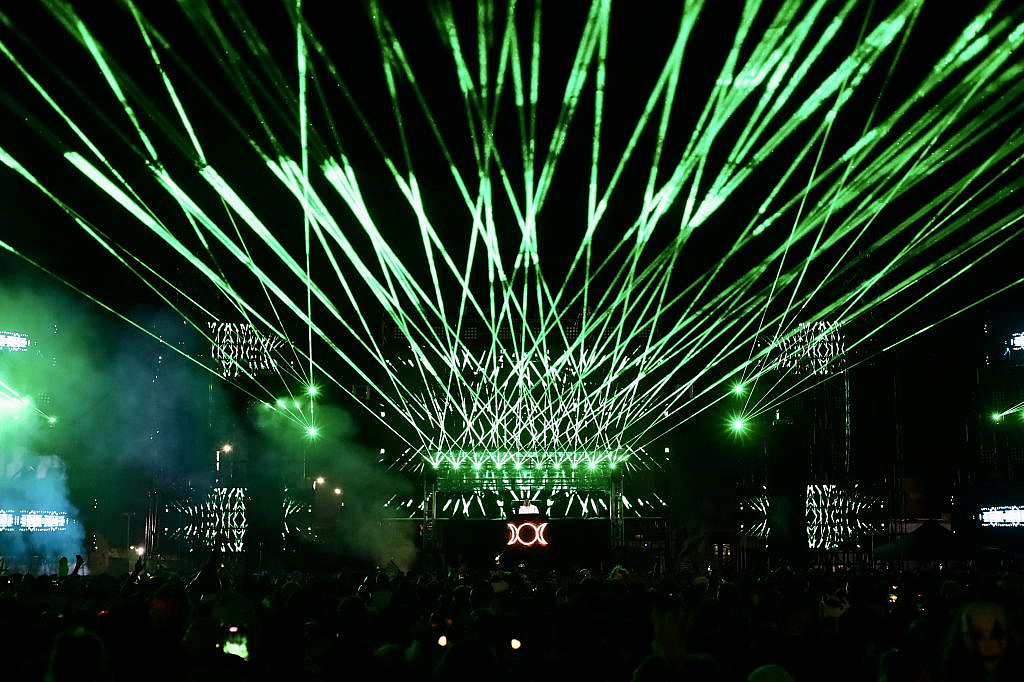
Friday night provided one of the clearest looks at what the Altar stage was capable of, particularly once INZO stepped behind the decks.
His approach to bass music is already unusually atmospheric. Moments of spirituality, spoken-word elements, and emotional tension can suddenly dissolve into enormous low-end passages and experimental sound design, and HEX gave that contrast plenty of room to breathe.
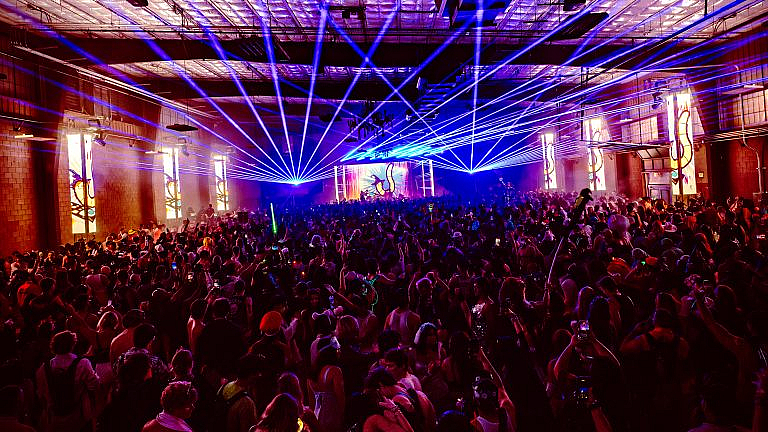
As darkness settled over Rawhide, the lighting and laser package became increasingly prominent, transforming the stage around him and creating some of the strongest visual moments of the first night.
INZO has never needed nonstop aggression to command a bass crowd. His performances operate more like journeys, moving between vulnerability, serenity, and absolute weight. Against the darkened Halloween environment of HEX, that style worked especially well.
It also gave attendees an early look at how serious Relentless Beats had been when designing the festival’s primary stage.
The Altar Was an Impressive First Swing
When a festival launches for the first time, its stage can reveal a lot about the organizer’s ambitions. HEX did not arrive with something that felt temporary.
The Altar carried its Halloween identity directly into the physical design. Dark, brick-like structures rose around the performance area almost like industrial chimneys, with flame units positioned above them. A glowing lunar-eclipse-inspired HEX emblem sat prominently near the artist position, tying the festival branding into the stage itself rather than simply placing another logo across an LED wall.
Then came the lasers.
A central array of roughly 10 laser units sat above the artist, supplemented by additional laser positions throughout the stage. Once fully activated, those fixtures stretched across the Rawhide sky and dramatically expanded the apparent scale of the build.
The advantage of an outdoor festival became obvious here. There was room for flames, room for smoke, and plenty of open sky to paint with lasers.
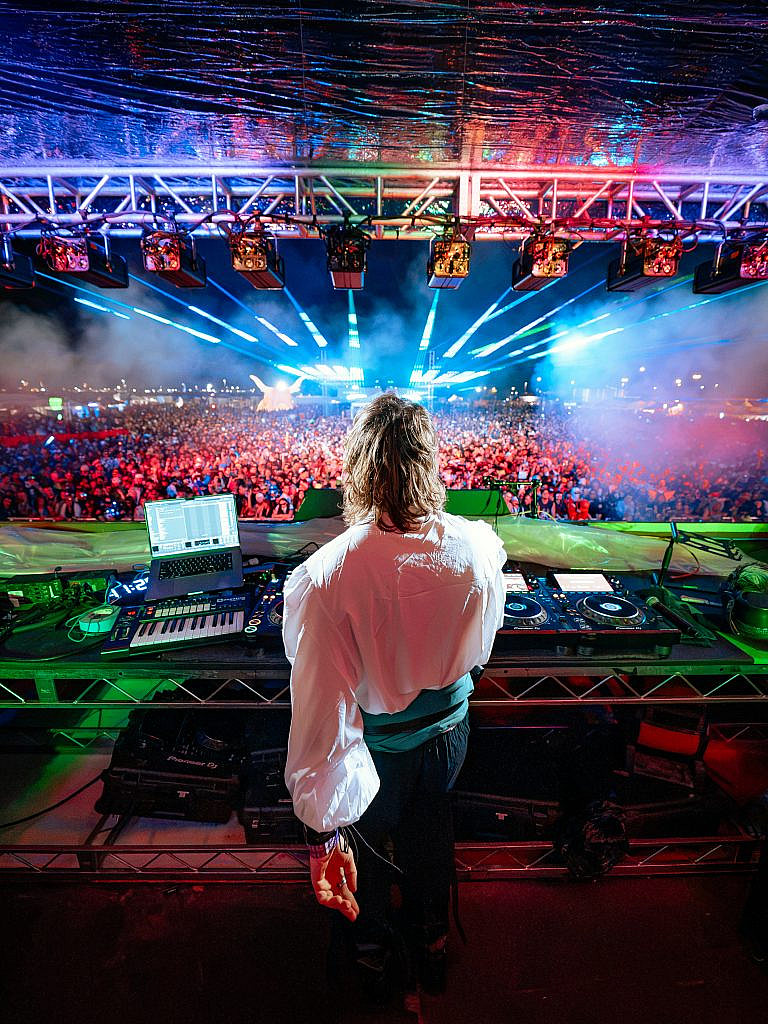
The stage never felt disconnected from the festival around it. The darker architecture, lunar imagery, flames, and surrounding Halloween elements all contributed to the same visual language.
Large themed inflatables placed throughout the grounds extended that identity beyond the stage and gave attendees plenty of Halloween-focused photo opportunities, but the Altar remained the centerpiece. For a first-year event, it was an ambitious foundation.
Arizona’s Festival Competition Is Raising the Standard
There is also a larger story unfolding around HEX.
For years, Relentless Beats has maintained an enormous presence within Arizona electronic music, but in 2026 Insomniac’s Arizona footprint has become increasingly visible. That became impossible to ignore on Halloween weekend.
While HEX took over Rawhide, BOO! Arizona operated simultaneously at WestWorld of Scottsdale, placing two major Halloween dance-music events in the same market on the same nights. Insomniac has continued adding Arizona programming beyond BOO!, signaling that competition for the state’s electronic audience is becoming much more serious.
That competition creates pressure, but for attendees, that pressure can be a very good thing. Production has to improve, bookings have to matter, festival identities need to become clearer, and promoters have to give fans a reason to choose one experience over another.
HEX felt like Relentless Beats answering that challenge in its own language.
Instead of attempting to mimic an Insomniac experience, Aftershock leaned directly into one of Relentless Beats’ strongest existing communities and built something specifically for Arizona bass fans. If that competition contributed at all to the scale of HEX’s first-year production, then everyone in the market should welcome more of it.
Sound Built for the Music
Visual production only works if the audio underneath it can carry the same weight, and for most of the weekend the Altar delivered clear, physical low end appropriate for a lineup built almost entirely around bass music.
The sheer volume felt somewhat more restrained than System Overload earlier this year, an event that set an unusually high benchmark for Relentless Beats main-stage sound. That comparison is less criticism than context, because System Overload was one of those rare productions where the sound itself became part of the event’s reputation.
HEX did not quite reach that same overwhelming level of physical output, but clarity remained strong, and the system handled radically different styles of bass without losing the detail necessary for artists such as INZO, Subtronics, YVM3, or Excision.
For a festival built around sound design, that matters.
Then Mother Nature Joined the Lineup
No recap of the inaugural HEX could ignore the rain, and Friday brought the first real test.
During Dennett’s set, festival screens switched to an evacuation message as lightning entered the area. House lights came on, audio stopped, and attendees were directed toward shelter.
For a brand-new festival, suddenly evacuating the grounds during its first night is about as difficult a scenario as organizers could have requested. Still, the interruption did not end HEX.
After the weather cleared, attendees were allowed back inside and the schedule resumed. LAYZ, INZO, and the remainder of Friday’s lineup still received their sets, while the evening was ultimately extended beyond its originally planned ending to compensate for time lost during the interruption.
That extension created an unexpected reward.
By the end of Subtronics’ closing performance, the night had become increasingly loose. He acknowledged from the stage that the curfew had some flexibility, and the closing stretch began to feel less like a tightly timed festival slot and more like Subtronics being given room to simply keep going.
For fans who survived the evacuation and returned to the grounds, it was a fitting payoff.
Rain Made Night Two Even More Absurd
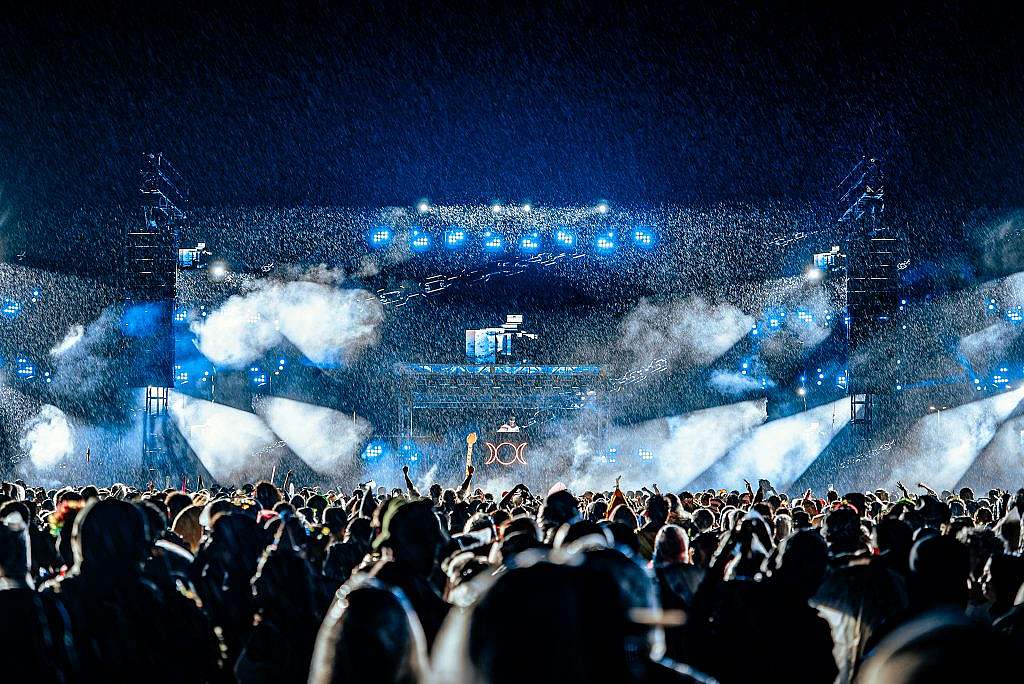
There was no brief shower on Halloween night. It poured, and the rain stayed part of the experience from early performances through Excision’s closing set.
The difference was preparation.
By Day Two, ponchos were everywhere, boots had replaced questionable festival footwear, and attendees knew exactly what they were walking into. As long as lightning stayed away, the show continued.
Strangely enough, the rain became one of the most visually memorable elements of the festival.
Lasers are already designed to expose particles in the air, but add thousands of rain droplets falling through those beams and the entire sky begins to sparkle. Every laser path suddenly had texture, and every sweep across the audience became visible in a completely different way.
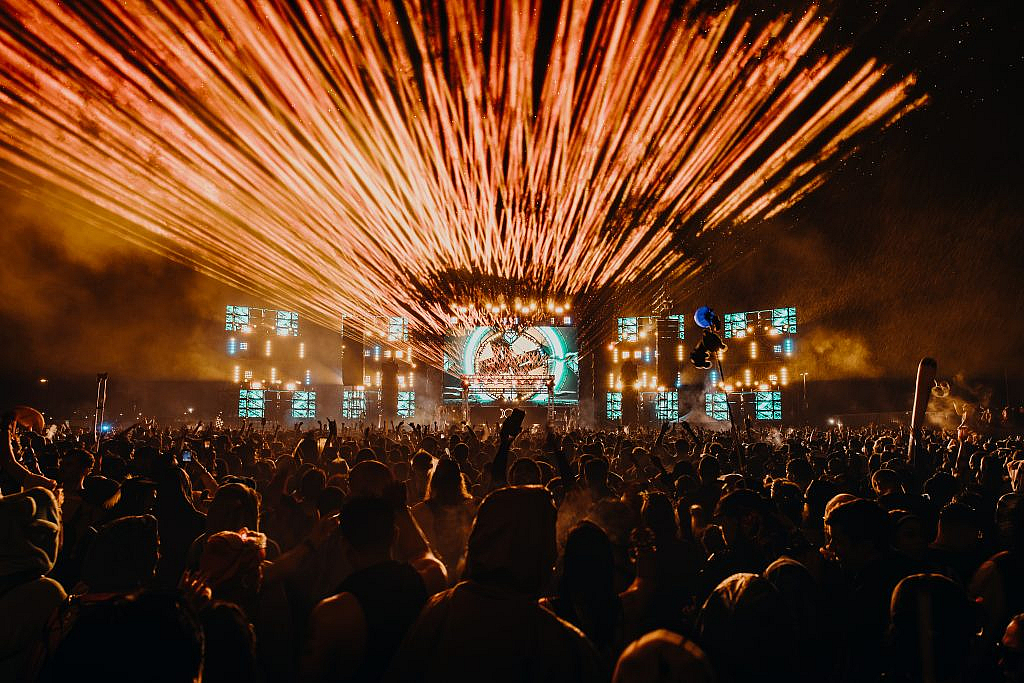
It should have been miserable, and at moments it probably was, but visually it was undeniably beautiful.
More importantly, the production kept running. The artists kept playing, and the crowd kept moving.
By the time Excision closed HEX, the festival looked less like a polished Halloween event and more like a massive bass gathering surviving the elements together. For this particular crowd, that almost made the weekend feel more fitting.
Year One Did What It Needed to Do
HEX did not receive an easy first year. Its opening night was interrupted by lightning, its second night was soaked almost from beginning to end, and mud, ponchos, and weather alerts became as much a part of the weekend as costumes and lasers.
Yet none of that exposed a festival without an identity. If anything, it revealed how strong that identity already was.
HEX knew its audience and booked specifically for them. It gave emerging artists meaningful stage opportunities, brought in four headliners capable of anchoring significantly larger festivals, and built an Altar stage that felt appropriately large, thematic, and technically ambitious for the artists standing on it.
That is an impressive place to begin.
There will undoubtedly be lessons from Year One. Every inaugural festival finds things to refine once thousands of people actually move through a concept that previously existed only on production plans. But the fundamental question has already been answered: Does Arizona have room for another bass festival?
After System Overload and now HEX, the answer looks increasingly obvious.
Arizona bass fans suddenly have multiple Relentless Beats experiences built specifically around them rather than simply receiving a bass stage inside somebody else’s festival. For dubstep fans across Phoenix and the greater Southwest, that is an enormous win.
And if this was only the first summoning, Year Two has one hell of a foundation to build from.
About The Author