Screenshot
Jeff Bezos and Leonardo DiCaprio Commit $200 Million to Protect Earth’s Most Endangered Species
The Phoenix Species Project could help protect rainforests, strengthen Indigenous stewardship and remind modern society what ancestral cultures have understood for generations
There are moments when money becomes more than money. It becomes a vote for the kind of world that should remain after its owners are gone.
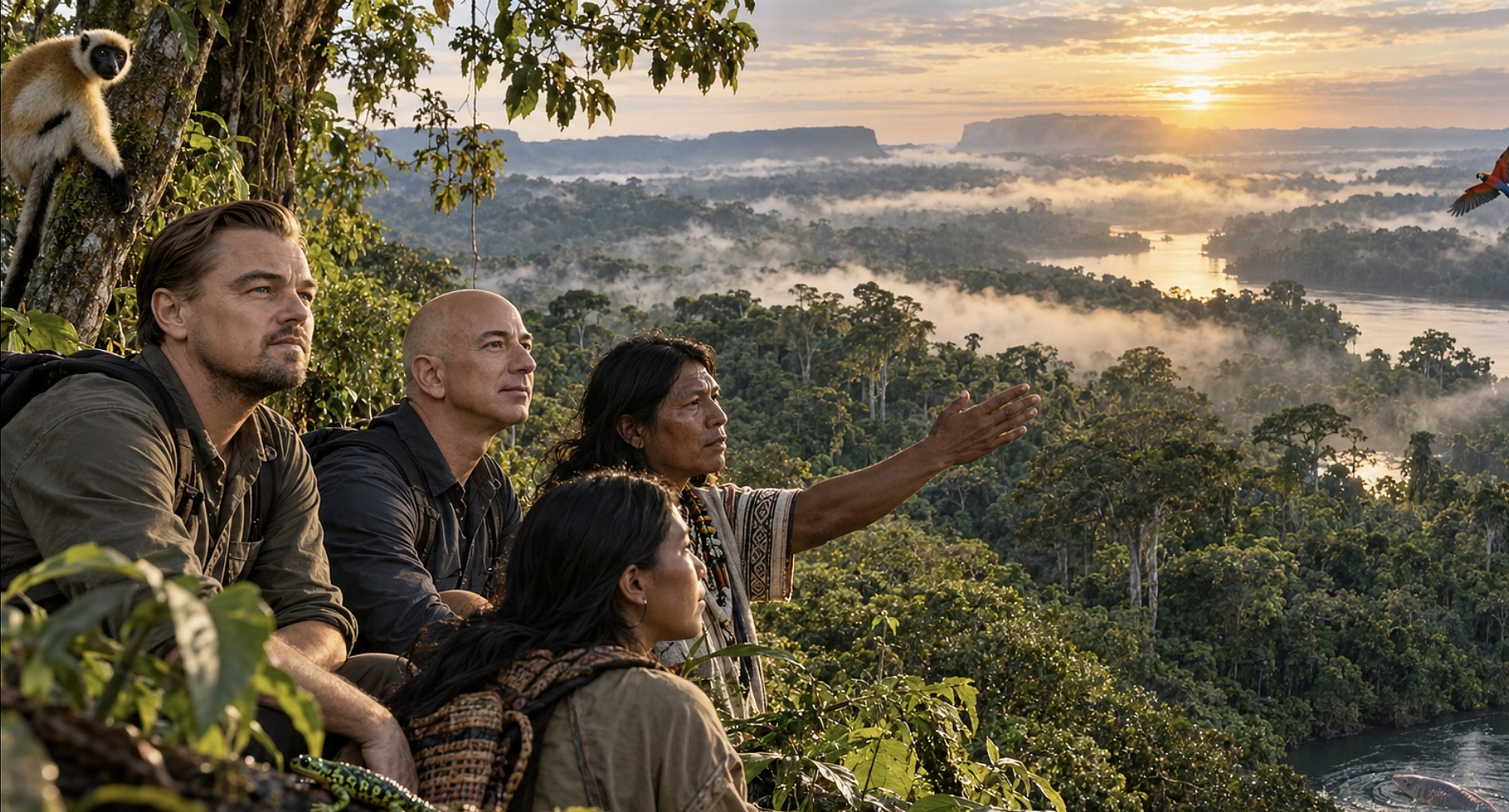
In August 2026, Amazon founder Jeff Bezos and actor-environmentalist Leonardo DiCaprio joined forces behind a $200 million initiative intended to recover 100 of the planet’s most endangered species. Known as the Phoenix Species Project, the effort is being led by DiCaprio’s conservation organization Re:wild and the Bezos Earth Fund.
The funding includes $100 million from Re:wild and $100 million from the Bezos Earth Fund, with additional support from Age of Union and the Todd Graves Family Foundation. Organizers describe it as the largest philanthropic initiative ever dedicated exclusively to recovering critically endangered species across different countries, ecosystems and biological groups.
Although frequently described as a rainforest campaign, the Phoenix Species Project is global. Its work will extend across 30 countries and include rainforests, wetlands, oceans, deserts, freshwater environments, grasslands and volcanic plains. Yet its relationship to rainforest protection remains profound because an endangered species can rarely be saved without protecting the entire living system surrounding it.
The initiative also arrives with a deeper lesson—one familiar to the Huni Kuin and other ancestral cultures of the Amazon. Human beings cannot separate their survival from the survival of the natural world. We may imagine ourselves standing above nature, but we remain inside it.
Beyond Slowing Extinction
For decades, conservation organizations have been forced to operate in emergency mode. They receive a limited grant, protect a fragment of habitat, conduct a short study and then return to fundraising before the work has had time to mature.
The Phoenix Species Project is intended to change that pattern.
Rather than merely slowing the decline of endangered wildlife, it is structured around measurable recovery. Each participating species is expected to receive approximately five years of sustained support. The goal is not simply to keep a disappearing animal or plant alive on paper. It is to rebuild populations, reduce threats, restore habitats and eventually return each species to its ecological role.
More than 100 organizations, Indigenous communities, governments, scientists and conservation groups will lead work on the ground. Recovery strategies may include habitat restoration, conservation breeding, reintroduction, disease management, population relocation and invasive-species control. The International Union for Conservation of Nature’s Species Survival Commission will serve as a scientific knowledge partner.
This emphasis on sustained recovery reflects something ancestral societies have long understood: healing is not an isolated event. It is a relationship maintained over time.
A forest does not recover because someone plants a tree for a photograph. A species does not recover because its decline temporarily slows. A community does not heal through a single ceremony, policy or donation. Recovery requires patience, repetition, responsibility and continued attention.
What the Huni Kuin Can Teach the Modern World
The Huni Kuin, whose communities live primarily in the Brazilian state of Acre and neighboring Peru, have maintained a cultural relationship with the Amazon that differs fundamentally from the extractive logic governing much of the modern economy.
The forest is not simply scenery or a warehouse of raw materials. It is home, pharmacy, teacher, food system, spiritual inheritance and living community. Knowledge is carried through language, stories, songs, art, family relationships, plant traditions and direct observation of the natural world.
This does not mean that Indigenous communities should be romanticized as symbols of a perfect past. The Huni Kuin are contemporary people navigating modern pressures, political struggles and economic realities. Their cultures continue to change, adapt and reclaim traditions after generations of displacement and exploitation.
The lesson is not that modern society should imitate Indigenous life from a distance. It is that we should recognize the intelligence contained within cultures that have learned to survive without destroying the biological foundation beneath them.
One of the most important Huni Kuin lessons is reciprocity. Life is not understood solely as a collection of resources available for personal accumulation. Receiving creates responsibility. If the forest provides food, medicine, water and shelter, human beings acquire an obligation to protect the forest in return.
Modern consumer culture has largely removed that sense of relationship. We purchase food without seeing the soil, order products without knowing where their materials were extracted and use technology without considering the mines, forests, factories and energy systems behind it. The transaction ends at the cash register, but its ecological consequences continue somewhere beyond our sight.
Ancestral thinking restores the missing half of the transaction. It asks not only, “What can I receive?” but also, “What must I protect, replenish or return?”
From Individualism to Interdependence
Another lesson is the recognition that survival is collective.
Modern culture often glorifies radical individualism. Success is presented as personal conquest: more money, more property, more attention and more influence. Social media offers the appearance of community while frequently rewarding competition, performance and self-promotion. People collect followers but struggle to find trustworthy relationships.
An ancestral community operates from a different center. Identity exists within relationships—to family, elders, children, territory, ancestors and future generations. A person’s choices affect the health of the larger group.
This does not erase individuality. It gives individuality a purpose beyond itself.
The Phoenix Species Project applies the same principle to ecology. A salamander, lemur, fish or plant cannot be separated from its environment. Every species exists within a network of relationships. Animals spread seeds, pollinate plants, regulate other populations and move nutrients through landscapes. When one species disappears, the consequences may travel through the ecosystem in ways we do not immediately recognize.
The same is true of human society. Loneliness, addiction, environmental destruction and social fragmentation cannot always be solved by telling individuals to work harder. They frequently reveal a damaged network of relationships.
A healthy culture, like a healthy forest, depends upon connection, diversity, reciprocity and cooperation.
Indigenous Stewardship Is Not Symbolic
Indigenous involvement in conservation must extend beyond imagery, acknowledgments and invitations to public events. Communities need decision-making authority, secure territorial rights, direct funding and meaningful ownership of the work.
The evidence for this approach is substantial. Indigenous and tribal peoples govern between 320 million and 380 million hectares of forest worldwide. Approximately 45 percent of the Amazon Basin’s remaining intact forests are located within Indigenous territories, while Indigenous lands generally experience lower deforestation rates than comparable forests.
Brazilian Indigenous territories also contain more species of mammals, birds, reptiles and amphibians than all of the country’s protected areas outside those territories.
These figures challenge the assumption that rainforest communities must be taught conservation by the industrial world. In many cases, they have already been performing the work while governments and corporations debated what should be done.
The Phoenix Species Project promises to collaborate with Indigenous peoples and locally led organizations. Whether that collaboration produces genuine authority will be one of the project’s most important tests. Communities should not be treated as temporary contractors hired to execute a strategy designed elsewhere. They should help define the strategy, control appropriate funding and determine what responsible conservation looks like in their territories.
Protecting Species Means Protecting Relationships
Among the species selected for the initiative is Madagascar’s golden-crowned sifaka. Protecting this lemur also requires protecting the forest that provides water, food and livelihoods to surrounding communities.
The program will also support the bowmouth guitarfish, threatened partly by the international fin trade; Australia’s elusive night parrot; the Hickory Nut Gorge green salamander of North Carolina; and the Charco Azul pupfish, which became extinct in the wild after drought and agricultural water extraction destroyed its natural spring.
Their stories illustrate a simple truth: extinction rarely begins with the final animal dying. It begins when relationships are broken.
A river is diverted. A forest is fragmented. A breeding ground is polluted. An invasive species is introduced. A traditional territory is taken from the people who protected it. Eventually the animal disappears, but its final disappearance is only the last visible stage of a much longer process.
Ancestral knowledge encourages us to examine the entire relationship rather than addressing only its final symptom.
This principle can help modern culture far beyond conservation. We often wait until a person is severely ill before addressing diet, stress and environmental exposure. We wait until relationships collapse before examining years of neglect. We wait until communities fracture before noticing the disappearance of trust, accountability and shared purpose.
The forest teaches prevention. It teaches us to recognize imbalance before collapse.
A Separate Commitment to the Amazon
The Phoenix Species Project should not be confused with another $200 million initiative announced in 2023 by the Protecting Our Planet Challenge, a coalition that includes Re:wild and the Bezos Earth Fund.
That earlier commitment was developed with the Brazilian government and directed specifically toward the Amazon. Its stated purpose was to expand and manage protected areas and Indigenous territories over four years.
Together, the two initiatives represent complementary approaches. The Amazon commitment protects large territories, while the Phoenix Species Project concentrates resources on recovering individual species. One defends the home; the other helps restore the lives within it.
Neither approach can succeed without the people who know those landscapes intimately.
Lessons for Our Culture Today
The deepest value of ancestral wisdom is not found in costumes, borrowed ceremonies or fashionable spiritual language. It is found in a different orientation toward life.
Modern society can learn to replace extraction with reciprocity, isolation with community and endless consumption with stewardship. We can begin evaluating success through the health of our bodies, relationships, communities and ecosystems—not merely through wealth, possessions or influence.
We can restore respect for elders without rejecting innovation. We can use technology while remembering the Earth from which every device is made. We can create businesses that generate prosperity without treating people, animals and landscapes as expendable inputs. We can recover the understanding that freedom without responsibility eventually becomes exploitation.
The Huni Kuin and other ancestral peoples also remind us that knowledge must be lived. It is not enough to post about protecting nature while maintaining habits built upon careless consumption. It is not enough to celebrate Indigenous wisdom while ignoring Indigenous rights. Respect becomes real through conduct.
The question is not whether modern people should abandon civilization and return to the forest. The question is whether civilization can recover enough humility to recognize that the forest contains knowledge we still need.
A $200 Million Beginning
The Phoenix Species Project will not save the natural world by itself. No philanthropic fund can neutralize deforestation, pollution, illegal mining, wildlife trafficking, climate change and the conversion of living landscapes into disposable commodities.
It can, however, give 100 species something extraordinarily rare: time.
It can help a lemur continue moving seeds through a forest. It can restore a freshwater habitat for a fish that currently survives only in human care. It can allow Indigenous guardians and local conservationists to work with resources closer to the scale of the challenges they face.
Its greatest contribution could be proving that extinction is not inevitable. It is often the result of accumulated choices—neglect, extraction, disconnection and indifference. Recovery is also a choice.
The Huni Kuin worldview adds an essential dimension to that choice. Saving the rainforest is not charity offered by humanity to nature. It is an act of reciprocity toward the living system that has sustained humanity all along.
Jeff Bezos and Leonardo DiCaprio have placed a $200 million bet on recovery. Its ultimate success will not be measured by the size of the announcement or the celebrity of its supporters. It will be measured years from now in forests, rivers and communities—when species once expected to disappear are still alive, Indigenous guardians possess greater control over their ancestral territories and modern society has finally begun to remember that protecting life is inseparable from protecting ourselves.
About The Author