
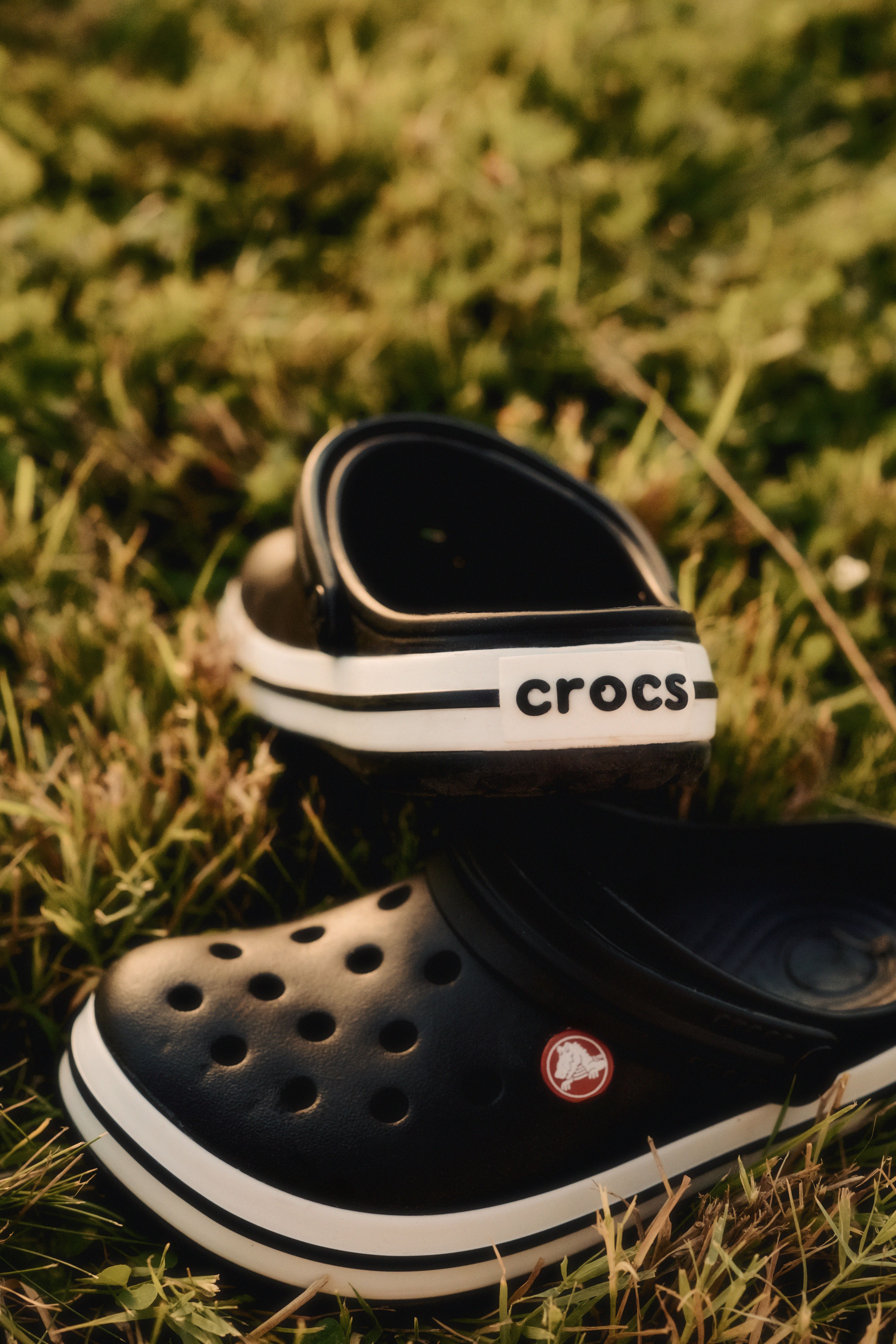
Crocs Health Risk: They Aren’t Just Bad Fashion—They’re Bad for Your Health and the Environment
There is something almost admirable about the Croc. It is unapologetically hideous, aggressively synthetic and engineered with all the visual sophistication of a hospital bedpan. It has conquered beaches, airports, restaurant kitchens, suburban shopping centers and school hallways through the brute-force promise of convenience. Slide your feet into two perforated chunks of foam and stop thinking about footwear altogether.
Unfortunately, that same bargain—cheap comfort without questions—is precisely where the trouble begins.
Crocs and the endless army of imitation foam clogs surrounding them belong to a much larger experiment in plastic living. We eat from plastic, sleep on plastic, dress in plastic and now spend hours sweating directly into plastic shoes. The Crocs health risk is more complicated than viral videos suggest, but the environmental verdict is considerably clearer: these shoes are fossil-derived products that generate emissions, shed plastic particles and resist decomposition long after their owners are gone.
Is the Crocs Health Risk Real?
The internet’s most alarming version of the story claims that Crocs contain lead, cadmium and hormone-disrupting phthalates that pass directly through sweaty feet. That conclusion goes further than the available evidence.
A widely cited 2024 investigation commissioned by Environmental Defence Canada tested 13 flexible PVC products. Every product contained phthalates, while approximately 46 percent contained lead or cadmium. One set of inexpensive cartoon shoe charms advertised for use with Crocs reportedly contained 13.2 percent DEHP—a reproductive-toxic phthalate—and 1 percent lead by weight.
Those are not trace amounts. They are disturbing concentrations in a product likely to be handled by children.
There is, however, a detail often buried beneath the panic: authentic Crocs were not tested. The contaminated items were third-party charms made by an unrelated seller and marketed to fit inside Crocs. The original report explicitly acknowledges this distinction. Environmental Defence’s plastic-product investigation
The honest conclusion is not that laboratory testing proved all Crocs contain lead. It is that some cheap, poorly regulated plastic accessories attached to children’s shoes contain chemicals that should never be there. Any responsible assessment of the Crocs health risk must distinguish authentic Croslite footwear from imitation clogs and third-party charms.
That is still a serious problem—just a more precise one.
What Are Crocs Made Of—and Why Does It Matter?
Authentic Crocs are primarily made from Croslite, a proprietary closed-cell polymer resin generally understood to be related to ethylene-vinyl acetate, or EVA foam. It is not ordinary rubber, and it is not the same material as the heavily plasticized PVC examined in the 2024 investigation.
This matters because PVC is naturally rigid and frequently requires chemical plasticizers such as phthalates to make it soft. EVA is already flexible and does not ordinarily require the same high concentrations of phthalate plasticizers.
But “proprietary” is a convenient word. It means the public does not receive the complete recipe.
Consumers are not given a comprehensive inventory of Croslite’s pigments, catalysts, stabilizers, antioxidants, cross-linking chemicals, blowing agents or processing residues. Crocs publishes extensive information about carbon emissions and bio-circular materials, but not enough ingredient-level information for independent scientists to evaluate every chemical used across every color, model and production facility.
That does not prove Croslite is poisonous. It proves that consumers are being asked to accept a black box of polymer chemistry on trust. The lack of complete ingredient transparency does not establish a Crocs health risk by itself, but it makes sweeping claims of absolute safety difficult to independently verify.
Crocs Health Risk: Can Chemicals Be Absorbed Through Your Feet?
Human skin is not an impenetrable raincoat. Certain substances can penetrate it, and heat, moisture, friction and prolonged contact may increase chemical migration from a material. Research has demonstrated that phthalates can migrate between components of PVC footwear, particularly under warmer and more humid conditions. Peer-reviewed research on phthalate migration in PVC footwear
But sweaty feet are not magical chemical express lanes into the bloodstream. The soles contain numerous sweat glands, but those glands are not open drinking straws pulling exterior substances into the body. The thick outer skin of the foot remains a substantial biological barrier.
To establish that authentic Crocs create a meaningful systemic health risk, researchers would need to test the actual shoes, determine which chemicals migrate under realistic conditions and measure how much enters the wearer’s body. The studies circulating online generally do not do that. For now, claims that toxins are flooding through the feet of ordinary Crocs users go beyond the available evidence.
This is where social-media health reporting often goes off the rails. It identifies a genuinely dangerous chemical, points toward an object made of plastic and allows fear to bridge the gap where exposure data should be.
The Greatest Crocs Health Risk May Be Hanging from the Shoe
The strongest chemical case behind the Crocs health risk concerns imitation clogs and anonymous third-party charms rather than verified Crocs footwear.
Young children remove charms, trade them, carry them and sometimes put them in their mouths. Lead and phthalates transferred from a contaminated charm to a child’s hands—and then from hands to food or mouth—represent a far more credible exposure pathway than toxins silently flooding through the bottom of an adult’s foot.
A 2025 Danish investigation tested 16 pairs of shoes for hazardous chemicals. Nine contained illegal levels of substances such as phthalates and heavy metals. All nine came from the 11 pairs purchased through international online marketplaces including AliExpress, Shein and Temu. Some contained phthalate concentrations approaching 17 percent. The five shoes obtained from established Danish-market brands did not show the same pattern of illegal contamination. CHEM Trust’s summary of the footwear testing
The common denominator was not a particular shoe design. It was a murky supply chain in which the seller can disappear faster than the chemical smell coming out of the package.
If you are buying foam clogs or charms for children, the difference between an established manufacturer and a random marketplace seller is not elitism. It is traceability.
Crocs Health Risks for Feet, Joints and Balance
Even if we set chemical exposure aside, the more immediate Crocs health risk may involve foot mechanics, stability and using casual clogs for activities they were never designed to handle.
They are lightweight, washable and generously sized. Their wide toe box can accommodate swelling, bunions and hammer toes, while their cushioning may provide temporary relief for sensitive feet. Around a pool, in the garden or during a quick trip to the store, they perform their intended function reasonably well.
The problems begin when casual clogs become all-day performance footwear.
The loose heel can cause wearers to grip with their toes to keep the shoe in place. A poorly fitting or heavily worn pair may reduce stability, particularly during running, climbing or rapid changes in direction. Children, older adults and people with existing balance problems should be especially careful. The heel strap helps, but it does not transform a foam clog into an athletic or occupational-safety shoe.
Footwear also influences joint loading. One clinical study involving people with knee osteoarthritis found that clogs generated greater knee-adduction loading than flat walking shoes, flip-flops or barefoot walking. That does not mean Crocs inevitably destroy healthy knees, but it demonstrates that comfort and biomechanical performance are not the same thing. Study of footwear and knee-joint loading
Then there is the small ecosystem developing inside the shoe. Heat, moisture and friction can contribute to blisters, macerated skin, odor and fungal irritation. The ventilation holes help, as does the ability to wash the shoes, but spending an entire hot day barefoot inside synthetic foam is not exactly a spa treatment.
The Environmental Cost Behind the Crocs Health Risk
The strongest argument against Crocs has nothing to do with endocrine panic. It begins at the oil field and ends in a landfill.
Croslite is a polymer product. Manufacturing it requires raw materials, chemical processing, energy, molding and global transportation. Crocs previously calculated the carbon footprint of a Classic Clog at approximately 3.94 kilograms of carbon-dioxide equivalent per pair. The company has since reported a roughly 10 percent reduction from its 2021 emissions baseline.
That is an improvement, but lower-carbon plastic is still plastic.
Crocs now incorporates bio-circular feedstocks into Croslite. These materials can be derived from biological waste streams such as used cooking oil rather than entirely from newly extracted fossil resources. The company reported reaching 25 percent bio-circular content across its Croslite portfolio in 2024. Crocs’ bio-circular material announcement
It sounds greener than it is.
Bio-circular does not mean biodegradable. It does not mean a particular pair is made from 25 percent visible plant material. Crocs uses a certified mass-balance system that tracks qualifying feedstocks through a shared supply chain and allocates their proportional use across production. It can reduce fossil consumption and carbon emissions, but the finished polymer remains a persistent synthetic material.
A bio-circular Croc abandoned on a beach does not peacefully dissolve back into the coconut trees.
The Microplastics Beneath Our Feet
Crocs begin releasing material before anyone throws them away. Every step grinds the outsole against concrete, tile, asphalt, soil and sand. Some of that missing tread becomes plastic-rich abrasion debris, including particles small enough to qualify as microplastics.
Those particles enter street dust, stormwater, soil and waterways. They are diffuse, mobile and practically impossible to recover once released.
Research on synthetic shoe-sole fragments has found that the particles and their chemical leachates can alter soil conditions, produce oxidative stress and interfere with plant health. More recent abrasion experiments have directly documented microplastic release from shoe outsoles. Research on the ecological effects of shoe-sole fragments
There is no reliable public estimate of how much microplastic pollution comes specifically from Crocs. The problem applies to synthetic footwear generally. Nevertheless, Croslite’s undisclosed formulation makes it difficult to determine exactly what its worn particles contain or how they behave after entering soil and water.
The shoe does not disappear as the tread wears down. It merely changes address.
Crocs Don’t Die—They Accumulate
Durability is one of Crocs’ better qualities. A pair worn for several years can have a lower environmental cost per use than multiple pairs of disposable shoes.
But durability becomes a liability when the company sells long-lasting plastic as fast fashion. Limited editions, celebrity collaborations, collectible colors and endless shoe charms encourage consumers to accumulate far more pairs than they need. A product capable of lasting years becomes another seasonal impulse purchase.
When Crocs finally wear out, ordinary curbside recycling programs generally cannot process them. Foam density, contamination, chemical additives and cross-linked polymer structures complicate conventional recycling. Crocs operates a take-back program in participating stores, donating wearable shoes and directing damaged products toward recycling streams.
Reuse is valuable when it prevents another pair from being manufactured. But a truly circular system would publicly disclose how many shoes it collects, what percentage becomes new footwear, how much is downcycled and how much ultimately reaches a landfill or incinerator. Without that information, “take-back” remains a promise without a complete receipt.
Should You Throw Away Your Crocs?
Throwing a functional pair into the garbage because of a frightening Instagram reel would create an immediate environmental cost without producing a clearly demonstrated health benefit. Understanding the Crocs health risk means responding proportionately rather than replacing evidence with panic.
Keep existing authentic Crocs in service if they remain intact, fit correctly and do not cause irritation. Use them for casual, low-risk activities. Wash and dry them regularly. Replace them when the material becomes sticky, brittle, strongly odorous or structurally unstable.
Be more selective about what you buy next. Avoid anonymous imitation clogs and untraceable third-party charms, particularly for children. Do not allow children to chew or mouth shoe accessories. Choose secure footwear for sports, hiking, school activities, industrial environments and extended walking.
Most importantly, buy fewer pairs. The greenest Croc is probably the ugly old one already sitting by the door—not the new “sustainable” limited edition being shipped halfway around the world.
The Bottom Line on the Crocs Health Risk
Crocs have not been proven to pump lead and endocrine disruptors through people’s feet. The most alarming laboratory evidence involved unrelated PVC footwear and third-party charms, not authentic Croslite clogs. Any article that ignores that distinction is selling fear instead of science.
But Crocs still embody an uncomfortable truth about modern consumption. They are proprietary plastic objects produced at enormous scale, sold with incomplete chemical transparency and promoted as collectible fashion despite being designed to survive for years. They generate carbon emissions, shed synthetic particles and create a difficult waste problem at the end of their useful lives.
Crocs may not be the toxic emergency social media claims they are. The most defensible Crocs health risk involves questionable third-party charms, untraceable knockoffs, moisture and friction, limited stability during demanding activities and unanswered questions created by proprietary material formulations. Environmentally, the case is stronger: Crocs are another fossil-derived convenience product whose true cost has been pushed upstream to factory communities, downstream into soil and water, and forward in time to whoever inherits the landfill.
They are comfortable because someone else—and eventually somewhere else—absorbs the discomfort.
About The Author