

A clear brand story helps people remember you and trust what you do. If your LinkedIn profile says one thing, your website says another, and your in-person intro goes in a third direction, people get mixed signals fast.
Here’s the short version: use one main story everywhere, then change the length, format, and proof for each platform. Research in the article points to 90% of consumers saying this kind of honest brand message matters when they choose who to support.
If I wanted to fix my brand story fast, I’d focus on these 9 points:
- Define the core story: who I am, what I do, and why it matters
- Know the audience: shape the message around what they want and struggle with
- Write one repeatable line: a short statement I can use across channels
- Fit the platform: LinkedIn, Instagram, TikTok, X, and my site all need different delivery
- Use personal moments with a purpose: share stories that support the message
- Shorten it for networking: turn the story into a 30-second spoken intro
- Build it into my site and bio: keep the same message in longer and shorter formats
- Back it up with proof: use testimonials, numbers, and before-and-after results
- Keep it steady, but update it: don’t rewrite everything – just revise as my work changes
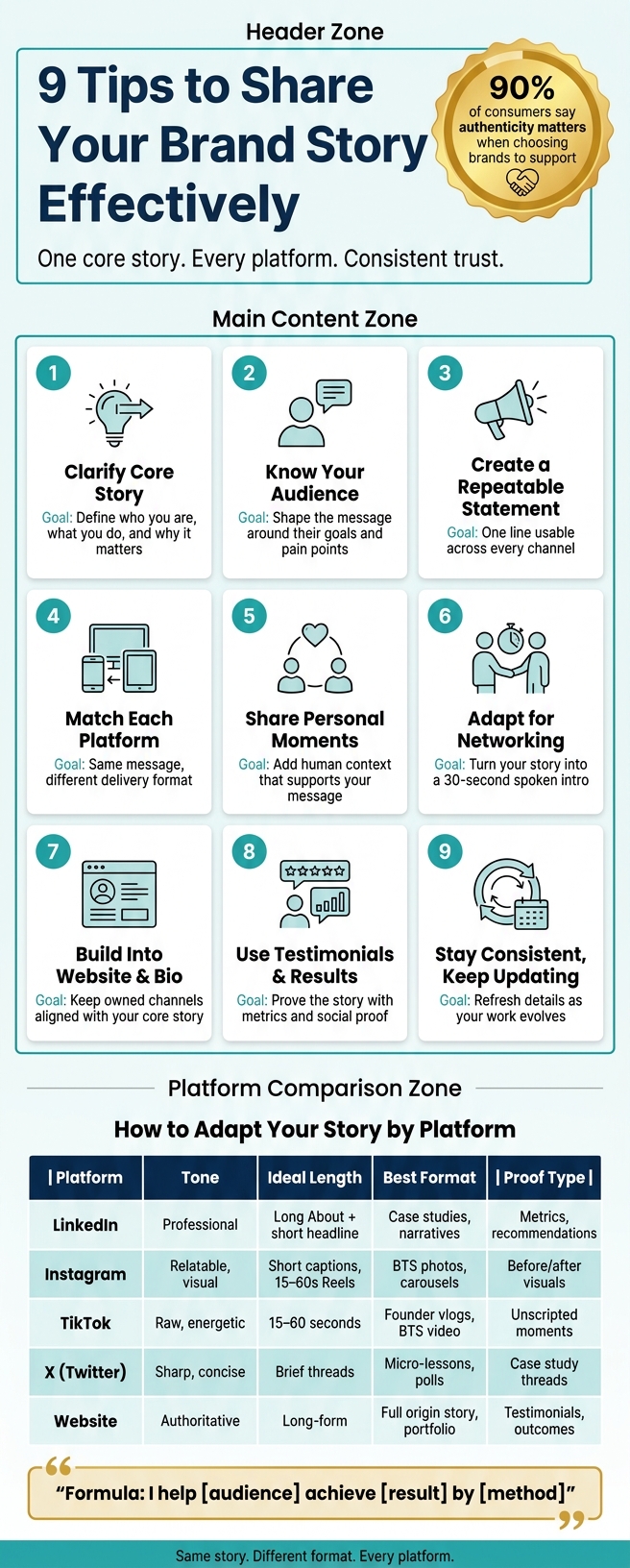
9 Brand Storytelling Tips: Platform-by-Platform Guide
How to Build a Personal Brand Through Storytelling
sbb-itb-fc951a8
Quick Comparison
| Tip | Main Goal | Best Use |
|---|---|---|
| 1. Clarify core story | Set the main message | All platforms |
| 2. Know your audience | Make the story fit the right people | Messaging and targeting |
| 3. Create a short statement | Make the story easy to repeat | Bios, intros, headlines |
| 4. Match each platform | Fit the channel without changing the message | Social and content platforms |
| 5. Share personal moments | Add human context | About pages, posts, interviews |
| 6. Adapt for networking | Make it easy to say out loud | Events, meetings, calls |
| 7. Build into website and bio | Keep owned channels aligned | Homepage, About page, profile bios |
| 8. Use testimonials and results | Prove the story with facts | Case studies, social proof, sales pages |
| 9. Stay consistent and update it | Keep the message current | Yearly reviews and milestone updates |
Bottom line: your story should sound like the same person everywhere, even when the format changes.
Why Brand Storytelling Works Across Platforms
Stories stick. People tend to remember how you made them feel long after they forget a list of credentials.
That matters because your audience runs into your brand in more than one place. They might see your LinkedIn profile, land on your About Page, scroll past an Instagram post, or meet you in person. Each channel has its own style, but your core message should stay the same.
A 30-second pitch won’t sound like a long LinkedIn article. And it shouldn’t. The format changes. The heart of the story doesn’t.
Think of your brand story as a filter for every bio, post, and intro. If a piece of content supports that story, it helps people recognize you. If it doesn’t, it creates mixed signals.
Inconsistent messaging creates doubt. Consistent messaging builds trust before you even meet.
| Platform | Story Format | What to Emphasize |
|---|---|---|
| Professional narratives, case studies | Achievements, thought leadership | |
| Visual stories, photos/videos | Behind-the-scenes moments, values | |
| About Page | Detailed written journey | Origin story, mission |
| In-Person | 30-second pitch | Personal anecdotes, emotional connection |
Once the message is clear, the next step is shaping it for each touchpoint and each channel. Start by defining the core story you’ll repeat everywhere.
1. Clarify Your Core Brand Story
Your core brand story is simple: who you are, what you do, and why it matters.
Think of who you are as your identity – your values, passions, and skills shaped by the path that brought you here. What you do is the specific problem you solve for a clear audience. So instead of saying, “I’m a marketer”, say something like, “I help early-stage SaaS founders double their sales pipeline through data-driven content.”
Why it matters is your purpose – the change you help make happen. Frame that story around your audience’s goals, not your résumé. Your job is to guide them, not stand in the spotlight. And when you can, support the story with results instead of just saying you’re good at what you do.
Once your core story is clear, the next step is making it matter to the people you want to reach.
2. Know Your Audience Before You Share
Once your core story is clear, the next step is simple: figure out who needs to hear it. The same story can land in very different ways depending on the person reading it. So shape what you highlight around your audience’s goals, pain points, and values. Then adjust that same story for each channel.
Audience Fit
Start with your audience’s biggest pain points. The more clearly you see what they’re dealing with, the easier it becomes to show why your story matters to them.
According to a Stakla survey, 90% of consumers say authenticity is an important factor when deciding what brands they like and support.
That matters because people don’t just want polished messaging. They want something that feels honest and relevant to their lives.
Platform Adaptation
Match your tone, length, and proof points to each platform. That helps you keep the message consistent without making every platform sound identical.
Each platform rewards something a little different. A LinkedIn post may do better with clear results and a direct point. A short video or social post may need a lighter tone and a faster hook. Same story, different delivery.
Authenticity Signals
Audiences can tell when something feels forced versus genuine. That’s why it helps to share real setbacks that support your point.
A small mistake, a slow start, or a lesson learned the hard way can make a story feel more human. Used well, those details make the story easier to believe and easier to trust.
Proof of Credibility
Lead with specific outcomes, testimonials, and results. Concrete proof builds trust faster than self-promotion.
If you helped cut costs, say by how much. If a client got a result, include the detail. If someone praised your work, use the testimonial. Clear proof does more work than broad claims. When the message is clear and backed up, it’s ready to be shaped into a line people can repeat.
Knowing your audience isn’t a one-time exercise. It’s a habit. Track which posts get shared, which stories spark replies, and which angles fall flat. Let that feedback shape how you tell your story over time.
Once you know who you’re speaking to, distill the message into a short line they can repeat.
3. Create a Short, Repeatable Story Statement
Once you know who you’re talking to, turn that insight into a line you can use again and again. Think of it as your core one-line story. It should stay the same whether you’re writing a LinkedIn bio, updating your website, or introducing yourself at a networking event.
A simple formula works well here: “I help [specific audience] achieve [specific result] by [unique method or skill].” The more specific you are, the more believable the line feels. Name a clear audience instead of a broad industry label. For example: “I help early-stage SaaS founders double their sales pipeline through data-driven content.” That line spells out who you help, what they get, and how you do it.
Keep one main statement, then adjust the length based on where you’re using it.
| Platform | How to Use Your Statement |
|---|---|
| Short headline + full version in “About” section | |
| Website Bio | Full narrative opening |
| Networking | 30-second verbal pitch focused on the result you create |
| Social Media | Short profile line or post hook |
Your line also needs proof behind it. Use one clear result instead of a fuzzy claim. Rather than saying you “improve marketing”, point to a metric or outcome, such as “helped a B2B team grow pipeline by 40% in six months”. Then check and update your statement at least once a year, or after a major milestone, so it still matches where you are now.
Use this line as the starting point for every platform-specific version.
4. Match Your Story Format to Each Social Platform
Keep your main story the same. Then shape it to fit how each platform works. Take the one-line story from Tip 3 and turn it into the format people expect on each channel.
On LinkedIn, start with professional proof. Use a strong headline and a summary that opens with your core brand statement. Then support it with industry-specific case studies and results.
On Instagram, lean into behind-the-scenes Reels, journey-based Highlights, and carousel posts that show change over time. People don’t just want the polished ending. They want to see how things moved from point A to point B.
TikTok tends to reward raw, less scripted posts. Founder-led “day-in-the-life” videos and behind-the-scenes storytelling drives 40% higher engagement than traditional branded video on Instagram and TikTok.
On X (formerly Twitter), keep it short and sharp. Brief threads and quick lessons tend to work well.
Don’t hide the messy parts. Share early struggles, pivots, and failed attempts. Add proof where you can, like metrics, testimonials, or before-and-after visuals.
| Platform | Best Story Format | Strongest Proof Type |
|---|---|---|
| Professional narrative + case studies | Recommendations, metrics, articles | |
| Reels, BTS snapshots, Story Highlights | Customer journey visuals, before/after | |
| TikTok | Raw founder vlogs, behind-the-scenes video | Unscripted moments, behind-the-scenes footage |
| X (Twitter) | Threaded brief lessons, polls | Case study threads, daily insights |
Use the same core message in networking and owned channels too. Just change the format to match the space.
5. Share Personal Moments That Support Your Message
Share personal moments only when they back up your message. The goal isn’t to tell every story from your life. It’s to pick the ones that prove your values, show where you came from, or explain why people should believe you.
Not every personal story belongs in your brand story. Use the moments that tie straight to the problem you solve or the reason you do this work. That might be an origin story, a values-based choice, or a hard season that shows why your brand exists. Those moments aren’t just nice extras. They’re often the reason people trust you.
A good rule: match the moment to what your audience is dealing with right now. If they’re stuck, share a moment when you were stuck. If they’re afraid to make a call, share the time you had to make one under pressure. That’s what makes the story feel personal without wandering off track.
Keep the format simple:
- Use the longer version in articles, podcast interviews, or your About page
- Use the short version in social posts or quick intros
- Drop the polished wording and tell the messy part too
- End with one clear result, decision, or lesson
Don’t just share the neat ending. Share the part that cost you something. That’s usually the part people connect with.
Next, shorten that same moment for networking conversations.
6. Adapt Your Story for Networking Events
Take the personal moment from Tip 5 and trim it into a natural, in-person intro. Networking uses the same core story, just in a shorter, more conversational way. A live intro should sound spoken, not pasted in from your website. The aim isn’t to memorize a script. It’s to sound clear, human, and easy to remember.
Audience Fit
Know who you’re talking to. Shape your story around the person in front of you, not just your general brand message. Put their goals first, and let your brand show how you help.
If you’re talking with early-stage founders, start with the problem you solve. If you’re meeting leaders focused on growth, efficiency, or retention, tie your story to those results.
Keep Your Introduction Short and Repeatable
Use your one-line story as your live intro. It should be short enough that someone can hear it once and repeat it back later.
Authenticity Signals
Share the moment that made your brand matter. Lean on your core values and strengths to keep the message grounded. Pick the detail that shows why you care about this work.
Proof of Credibility
Add one specific number, timeframe, or result. Specific results build trust faster than credentials alone. You’re giving proof, not rattling off a résumé.
Use that same one-line version in your website bio so your in-person intro matches what people see online.
7. Build Your Story Into Your Website and Bio
Take that same core story and carry it into your website and bio.
Your website should be the main place people learn who you are and why your work matters. Let your homepage speak to the visitor’s problem. Then use your About page to show the full arc: where you started, what wasn’t working, and what changed.
Website Story
Keep your website detailed, especially the About page. That’s where the full story belongs. Walk people through your starting point, the struggle, and the shift that led to better results.
Write in plain English. Say what wasn’t working. Skip the jargon. A specific, honest story does more than a polished list of credentials ever could.
Just as important, show what your work led to. Put the result front and center. Use a timeframe, a number, or a clear outcome instead of vague claims.
“I grew email signups by 42% in 90 days” lands a lot better than “I improved audience engagement.”
Then take that same message and tighten it down for places where space is limited.
Bio Version
Your bio should be one line, built around the same promise from Tip 3: “I help [audience] achieve [result] by [method].” That format works well on LinkedIn and other platforms.
If your bio still sounds like a job title, rewrite it.
For example: “I help B2B brands grow with data-driven content.”
The more specific you are, the easier your story is to remember – and believe.
8. Use Testimonials and Results as Proof
Start with the promise in your core story. Then prove it.
Support your brand story with testimonials, results, and before-and-after examples. That way, people don’t just hear what you say happened. They can see it.
Audience Fit and Proof of Credibility
Pick proof that lines up with your audience’s main pain point. The best examples show three things: a person, a number, and an outcome.
That mix matters. A person makes the story feel concrete. A number gives it weight. An outcome shows what changed.
The closer your example matches what your audience is going through, the more believable your story feels.
Platform Adaptation
Different platforms call for different proof formats.
| Platform | Best Proof Format |
|---|---|
| In-depth case studies, professional narratives | |
| Visual stories, short video clips, client quotes | |
| X (Twitter) | Concise threaded stories, micro-lessons |
| YouTube | Long-form transformation stories, vlogs |
Authenticity Signals
Perfect success stories can feel staged. People tend to trust stories more when they include a setback and what changed after it.
In plain English, a polished win can sound a little too neat. A bump in the road makes the result feel more human.
Use the same proof points wherever you tell the story.
9. Keep Your Story Consistent but Let It Grow
After you prove your value, keep your story up to date as your results grow. Stick with the same core promise, but refresh the details as your work changes. When your milestones, offers, or focus shift, your story should shift with them.
The key is simple: treat it like an update, not a rewrite.
That way, people still recognize what you stand for, while also seeing that your work is moving forward. And when you make updates, swap vague claims for specific proof. Use a number, a timeframe, or a clear outcome. That kind of detail shows progress. It shows your story isn’t just repeating itself.
Once the core story is current, adjust the length and proof for each channel.
How to Frame Your Story on Each Platform
Now it’s time to shape that core story for each channel without changing what you stand for.
Here’s the key idea: keep one main story. Then adjust the format, length, and how you show proof based on where you’re sharing it. The message stays the same. The packaging changes.
Think of it like this: same song, different speakers. A LinkedIn profile, an Instagram Reel, and an in-person intro shouldn’t sound identical. But they should still feel like they came from the same person.
Use this table to line up each platform’s tone, length, and support:
| Platform | Tone | Ideal Length | Visual Support | Call to Action |
|---|---|---|---|---|
| Professional, authoritative | Short headline; long About section | Professional headshot, infographics | Connect, Follow, Read Article | |
| Relatable, visual, authentic | Short captions; 15–60 second Reels | High-quality photos, Reels, Stories | Link in bio, DM for info | |
| Community-focused, conversational | Medium-length posts | Live video, group discussions, polls | Join group, Sign up for webinar | |
| Short-form Video | Energetic, fast-paced | 15–60 seconds | Short tutorials, quick tips, or process clips | Follow, Like, Check link |
| Personal Website | Comprehensive, authoritative | Long-form | Portfolio, blog content, testimonials | Contact form, Book a call, Hire me |
| In-person | Confident, conversational | 30-second elevator pitch | Body language, business cards | Exchange info, Schedule a follow-up |
For example, your LinkedIn About section might spell out your background, results, and point of view in detail. That same story on Instagram may show up as a short Reel, a few sharp captions, and a clear visual style. In person, it may shrink down to a 30-second intro that gets to the point fast.
What changes is delivery. What should not change is the heart of the message.
Next, watch for mistakes that weaken that consistency.
Brand Story Mistakes to Avoid
As you shape your story for each channel, steer clear of these four mistakes.
Leading with your résumé can make the story sound like self-promotion. Start with the audience’s problem, not your background. A simple gut check helps: does your story show how you help someone, or does it mostly list what you’ve done?
Overpolished delivery can feel fake. If every line sounds scripted and nothing ever went wrong, people can sense it. A smooth story is fine. But if it feels too polished, add a real setback or a lesson you learned.
Skipping proof weakens credibility. Big claims don’t do much on their own. Back them up with metrics, outcomes, or testimonials so people have something solid to hold on to.
Inconsistent messaging across platforms erodes trust. Different formats are fine. Different messages are not. If your LinkedIn bio, website, and social profiles tell different stories, people will notice. Keep the same core message, tone, and values across every platform.
These checks help keep your story clear as you move into the final takeaway.
Conclusion
A strong brand story is clear, consistent, and credible. Start with one core story, then shape the length and format for each platform without changing what it says. As your brand changes, your story should change with it.
Your story affects how people see your brand. So don’t rewrite it from scratch every time. Keep the core intact, and give it a refresh at least once a year or after major results.
Pick one tip, use it, and build from there.
FAQs
How do I find my core brand story?
Start with some honest self-reflection. Look at the values, experiences, and traits that shape who you are. Then get clear on your why: your core purpose, and the problems you’re in a strong position to solve.
Next, take stock of your strengths, your skills, and the gaps you can fill for other people. From there, build a story around your path, including the hard parts and the wins, so your brand feels human, relatable, and grounded.
How often should I update my brand story?
Updating your brand story isn’t a one-and-done task. It should shift as your career grows, your work changes, and the market moves around you.
Set aside time to review and refine it quarterly. And when a major shift happens, like a new role, a big win, a setback, or a change in your personal life, update it then too.
What proof makes a brand story more credible?
Make your brand story more believable by pairing emotion with hard proof. Back up your claims with data people can check, stats, research, and clear results.
You can also build trust by pointing to specific wins, testimonials, and a track record that shows you’ve done this before. When your story lines up with your core values and includes concrete numbers, people are more likely to believe it and see what your brand actually delivers.
Related Blog Posts
- Ultimate Guide to Personal Branding Online
- Authenticity vs. Perfection in Storytelling
- Personal Stories vs. Data: What Builds More Trust?
- Storytelling in Leadership: Resolving Team Conflicts
About The Author