
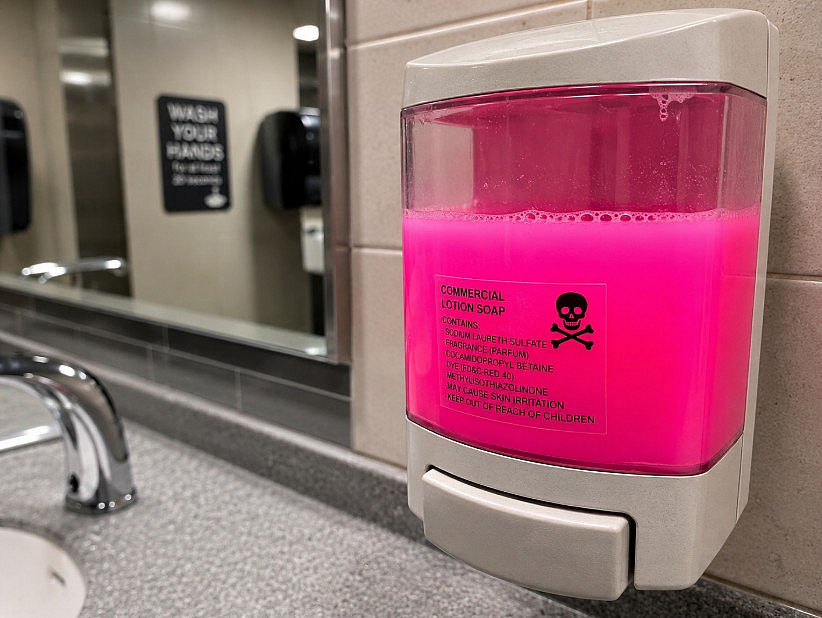
What the hell is this neon Pink Gas Station Soap? A pervasive and strange chemical cocktail that took over America’s Public Restrooms …
It has become one of the most familiar products in America, yet almost nobody knows its name. Walk into a gas station in Nevada, a truck stop in Oklahoma, a highway rest area in Florida, an airport in New York, or a fast-food restaurant almost anywhere in between, and chances are you’ll find the same fluorescent pink liquid waiting beside the sink. It pours with the consistency of syrup, smells vaguely floral with an unmistakably synthetic edge, and has become so commonplace that most people never stop to wonder how it managed to conquer virtually every public restroom in the country.
For something used by hundreds of millions of people every year, America’s neon pink soap has remained surprisingly anonymous. There are no television commercials, no celebrity endorsements, no flashy branding campaigns competing for consumer loyalty. Yet somehow it became the default soap for schools, office buildings, airports, hospitals, restaurants, truck stops, stadiums, and gas stations alike. The story behind that humble dispenser reveals a hidden industry driven not by consumer choice, but by chemical engineering, procurement contracts, and one relentless goal: delivering the lowest possible cost per hand wash.
The Pink Soap Empire Nobody Talks About
Contrary to popular belief, there isn’t one company manufacturing America’s ubiquitous pink soap. Instead, an entire commercial chemical industry quietly produces nearly interchangeable versions under different names. Companies such as Gojo Industries, Spartan Chemical, Kutol Products Company, Nyco Products, Detco, Boardwalk, Genuine Joe, Claire Manufacturing, and dozens of regional chemical suppliers all compete for the same customers. Those customers aren’t shoppers browsing supermarket aisles. They’re janitorial distributors, maintenance contractors, school districts, restaurant chains, municipalities, hospitals, airports, and large corporations responsible for maintaining thousands of public restrooms.
Unlike consumer brands, these manufacturers compete almost entirely behind closed doors. Procurement departments compare cost per gallon, dispenser compatibility, shipping efficiency, shelf life, and supply reliability. The winning formula is rarely the one with the finest ingredients. It’s the one that cleans adequately, stores easily, flows consistently through automatic dispensers, and costs the least. Over decades, that purchasing model has quietly transformed bright pink lotion soap into one of the most successful industrial products most Americans have never heard of.
Why Is It Always Pink?
One of the strangest aspects of commercial restroom soap is that nearly every manufacturer settled on the same unmistakable color. Despite its almost radioactive appearance, the bright pink dye serves no cleaning function whatsoever. It exists largely because history made it familiar. Decades ago, manufacturers began tinting hand soap pink to distinguish it from industrial degreasers, disinfectants, and heavy-duty cleaning chemicals. The vibrant color was also easy for custodial staff to see through translucent dispensers, making refills simpler to manage.
Over time, pink stopped being a design choice and became an expectation. Purchasing managers grew accustomed to seeing it, maintenance workers expected it, and users unconsciously associated the color with cleanliness. The irony is difficult to ignore. One of the least natural-looking substances in a public restroom became synonymous with hygiene simply because enough people repeated the pattern for long enough.
What’s Really Inside the Dispenser?
The cheerful color hides a formula built almost entirely around industrial practicality. Most commercial pink soaps rely on synthetic surfactants such as sodium laureth sulfate, sodium lauryl sulfate, cocamidopropyl betaine, or similar detergent compounds that lift oils and dirt from the skin so they can be rinsed away with water. Thickening agents create the familiar lotion-like consistency, preservatives prevent bacterial growth inside bulk storage containers, and artificial fragrances produce the generic “clean” scent that has become part of the public restroom experience.
None of these ingredients are particularly exotic, but neither are they chosen because they represent the most luxurious or skin-friendly option available. They are selected because they perform reliably, remain stable for long periods, survive transportation, and can be manufactured inexpensively at enormous scale. Artificial dyes complete the recipe, not because they improve cleaning performance, but because they reinforce a visual identity that has become deeply embedded in institutional purchasing.
Does It Actually Clean Your Hands?
Despite its uninspiring reputation, commercial pink soap generally performs the task it was designed to do. Soap works by surrounding oils, dirt, and microorganisms so they can be rinsed away with running water rather than by sterilizing the skin. In that sense, even inexpensive institutional soap can effectively clean hands when people wash thoroughly for at least twenty seconds.
The bigger question isn’t whether it works. It does. The question is whether the industry could do better. Higher-quality commercial formulations already exist using gentler surfactants, fragrance-free recipes, biodegradable ingredients, and fewer unnecessary additives. Yet many institutions continue purchasing the cheapest acceptable option because procurement departments are rewarded for reducing costs rather than improving user experience or minimizing chemical exposure.
Why Your Hands Feel Like Sandpaper
Anyone who spends long days traveling has probably noticed the same pattern. After several stops at airports, restaurants, and gas stations, hands often begin to feel unusually dry. While frequent washing itself contributes to that sensation, commercial soap formulations can amplify the effect. Strong detergents remove not only dirt and contaminants but also many of the natural oils that protect the skin’s outer barrier. For people working in healthcare, education, food service, or hospitality, where dozens of hand washes each day are routine, repeated exposure can leave skin dry, irritated, or prone to cracking.
Artificial fragrances and dyes present another consideration. Although generally considered safe for the overwhelming majority of users, these ingredients contribute nothing to cleaning performance and can trigger irritation or allergic reactions in individuals with sensitive skin. Dermatologists commonly recommend fragrance-free cleansers for patients managing eczema or chronic dermatitis, raising an obvious question: if the fragrance and bright pink dye serve no hygienic purpose, why are they still so common?
Following the Chemical Trail
The environmental story begins long before someone presses the dispenser. Every gallon of commercial soap requires petrochemical feedstocks, manufacturing energy, transportation, plastic containers, warehousing, and eventually wastewater treatment after use. Most modern surfactants break down far more effectively than earlier generations of industrial detergents, and wastewater treatment plants remove much of the remaining material before releasing treated water. Even so, billions of hand washes every year introduce synthetic fragrances, preservatives, dyes, and detergent compounds into municipal treatment systems that were never originally designed with today’s enormous chemical throughput in mind.
Manufacturers have made meaningful improvements over the past two decades by developing biodegradable surfactants, refill systems that reduce plastic waste, and phosphate-free formulations. Yet the industry remains largely driven by price, leaving many environmentally preferable alternatives competing against products that continue to win simply because they cost a fraction less per refill.
The Lowest Bidder Usually Wins
The dominance of neon pink soap says less about chemistry than it does about economics. Large institutions purchase hand soap much the same way they purchase paper towels or garbage bags. The decision often comes down to price, logistics, storage efficiency, and compatibility with existing dispensers. Saving only a few cents per refill may seem insignificant, but across thousands of restrooms and millions of annual hand washes, those pennies become substantial budget savings.
This procurement model leaves little room for premium ingredients, naturally derived fragrances, or more sustainable formulations unless buyers specifically demand them. Manufacturers simply respond to the incentives placed before them. If institutional purchasers overwhelmingly prioritize the lowest cost, the market inevitably rewards companies capable of delivering soap at the lowest possible price while still meeting minimum performance standards.
There Are Better Options
The good news is that alternatives already exist. A growing number of commercial manufacturers now offer fragrance-free, dye-free, plant-based, biodegradable hand soaps formulated specifically for schools, healthcare facilities, offices, and public buildings. Many clean just as effectively while reducing unnecessary additives and improving the experience for people with sensitive skin. Concentrated refill systems have also reduced packaging waste and transportation emissions, demonstrating that cost and sustainability no longer have to exist at opposite ends of the conversation.
The challenge is not technological. It is cultural. Public institutions rarely change purchasing habits unless budgets, regulations, or consumer expectations force the conversation. As long as fluorescent pink soap remains the accepted default, few procurement departments have much incentive to question whether something better is available.
The Real Mystery Isn’t the Soap
After tracing the path from anonymous restroom dispensers to chemical manufacturers and institutional purchasing departments, the biggest revelation isn’t discovering a hidden conspiracy. It is discovering how quietly ordinary products become permanent fixtures in everyday life simply because no one ever asks whether they should.
The fluorescent pink soap that has occupied America’s public restrooms for decades did not earn its place because it was the healthiest, most sustainable, or most thoughtfully formulated product on the market. It earned its place because it was inexpensive, dependable, widely available, and good enough. Over time, “good enough” became the standard.
Perhaps that is the real lesson hiding behind every pump of neon pink soap. The products we encounter most often are not always the result of careful consumer choice or superior design. Sometimes they are simply the winners of an invisible competition fought in procurement offices and supply warehouses, where the lowest bid often carries more weight than the highest quality.
The next time you step into a gas station restroom and reach automatically for that unmistakable neon pink liquid, it may be worth pausing for just a moment. Not because the soap is uniquely dangerous, but because it represents something far more common—and perhaps more unsettling. It is a reminder that many of the products shaping our daily lives arrived there not through informed public demand, but through decades of quiet decisions made by people most of us will never meet.
About The Author