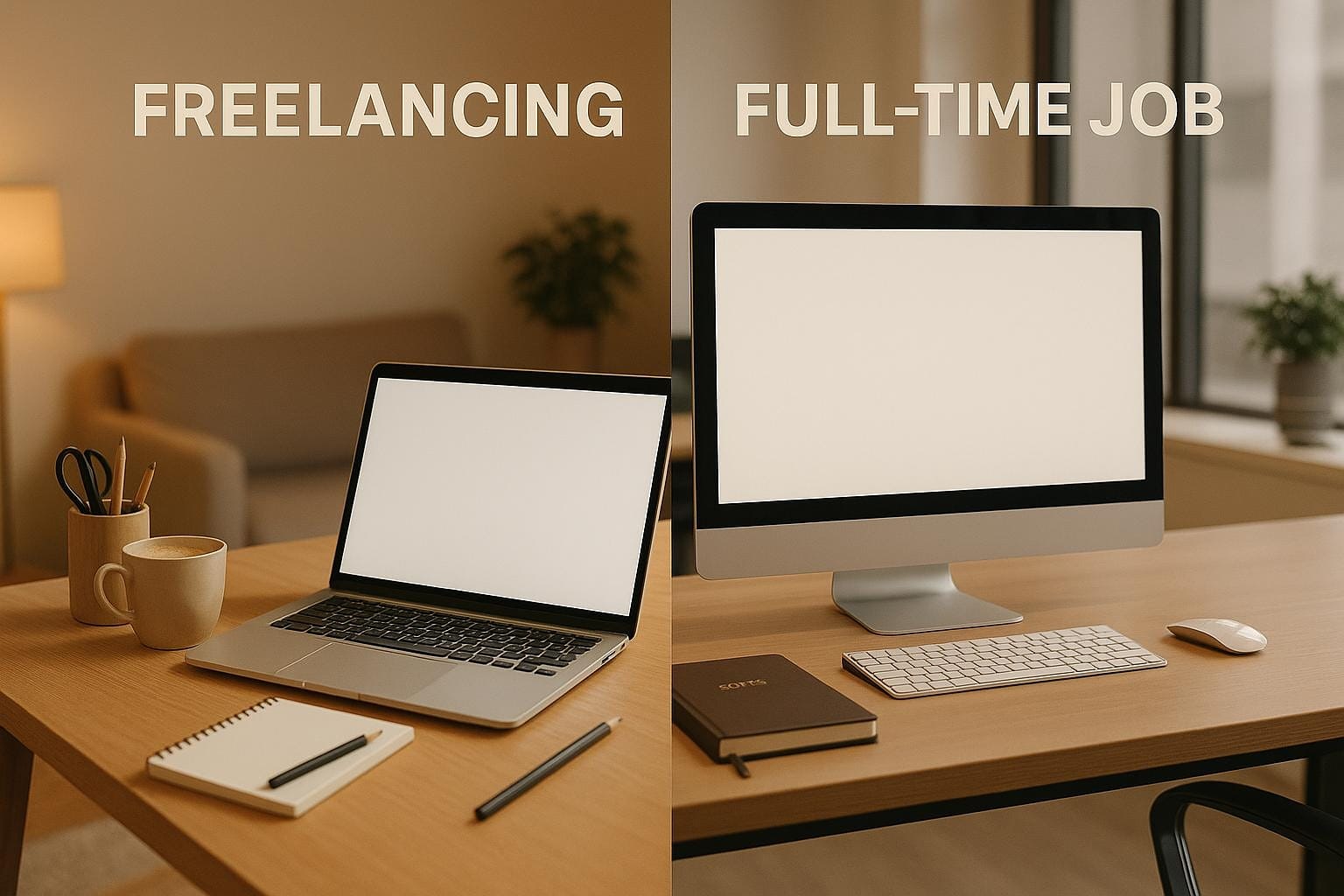
Freelancing and full-time jobs each offer unique benefits and challenges. Here’s the bottom line:
- Freelancing gives you control over your schedule, choice of projects, and the potential for higher earnings. But it comes with income fluctuations, no employer-provided benefits, and the need to manage taxes and finances independently.
- Full-time jobs provide steady paychecks, employer-sponsored benefits like health insurance and retirement plans, and structured growth opportunities. However, they often lack flexibility in schedules and project selection.
Quick Overview:
- Freelancing: Flexible schedule, self-managed benefits, variable income, and independence.
- Full-Time Job: Stable income, employer-provided benefits, fixed schedule, and structured career growth.
Both paths can lead to success, but the right choice depends on your financial goals, work preferences, and long-term aspirations.
Freelance or Full-time Employee – Which is Right for You?
Work Structure and Lifestyle Differences
How you organize your workday – and the ripple effects on time management and daily routines – varies greatly between freelancing and full-time employment. Recognizing these differences can provide clarity when evaluating financial stability and long-term career goals.
Schedule Freedom and Control
Freelancers have unmatched control over their schedules. You decide when to work, which projects to take on, and how to organize your day. Maybe you dive into an intense project for a few weeks and then take a well-earned week off. Prefer early mornings? Late nights? You get to choose what works best for you.
This flexibility also extends to project selection. Freelancers can say no to work that doesn’t align with their values, interests, or availability. For example, if you’re passionate about eco-conscious initiatives, you can focus solely on collaborating with sustainable businesses. Additionally, freelancers can tailor their workload to match their stress tolerance or personal goals.
On the other hand, full-time employees follow structured schedules set by their employers. Most stick to traditional hours, though some companies now offer flexible options. While you might have some input into the projects you work on, tasks are usually assigned based on business priorities rather than personal preferences.
That said, this structure brings predictability and boundaries. Knowing when your workday starts and ends can make it easier to balance professional and personal responsibilities.
Work-Life Balance
Freelancing offers unparalleled flexibility, but it comes with the challenge of setting boundaries. You can attend your kid’s soccer game on a weekday afternoon and make up the work later that evening. Want to take a three-week trip to Europe? No problem, as long as you coordinate with client deadlines. Freelancers also enjoy the freedom to work from nearly anywhere – whether it’s a home office, a favorite coffee shop, or a co-working space halfway across the globe.
The downside? Separating work from personal life can be tricky. When your home doubles as your office, it’s easy to blur the lines – checking emails late at night or working weekends to meet a deadline. Some freelancers even find themselves putting in more hours than traditional employees because there’s always another client or opportunity waiting.
Full-time employees, by contrast, often benefit from clearer work-life boundaries. In most states, employers can’t legally require you to work beyond 40 hours a week without paying overtime. Plus, you get paid time off – usually 10-15 vacation days per year, along with sick leave and holidays. When you’re off, you’re truly off, as colleagues typically step in to cover your responsibilities.
The trade-off? Less flexibility for personal needs. Time off requires prior approval, and stepping away during business hours for personal errands or emergencies isn’t as simple. If your child gets sick, you’ll likely need to dip into your sick leave or vacation time instead of just adjusting your schedule.
Daily routines also differ significantly. Freelancers often craft varied schedules around project demands and personal preferences, while full-time employees follow more consistent routines, including regular meetings and team collaborations. The table below highlights these lifestyle contrasts.
Comparison Table: Lifestyle Factors
| Factor | Freelancing | Full-Time Job |
|---|---|---|
| Schedule Control | Total freedom over hours and days worked | Set hours, typically 40 hours/week |
| Workplace Location | Anywhere – home, coffee shops, co-working spaces | Office-based, with some remote options |
| Project Choice | Pick clients and projects that match your interests | Tasks assigned based on business needs |
| Time Off | Unlimited but unpaid; must plan around deadlines | Paid vacation, sick leave, and holidays |
| Work-Life Boundaries | Flexible but requires self-discipline | Clear separation between work and personal life |
| Daily Structure | Varies by project and personal preference | Consistent routine with meetings and tasks |
| Income Predictability | Fluctuates with project availability | Regular bi-weekly or monthly paychecks |
| Benefits Management | Self-funded health insurance, retirement, etc. | Employer-provided benefits like health, dental, and retirement plans |
Money and Financial Stability
Deciding between freelancing and full-time employment often comes down to understanding the financial trade-offs. Each path comes with its own set of challenges and rewards, especially when it comes to income, benefits, and taxes.
Income Stability and Earning Potential
One of the biggest differences lies in how income is earned. Full-time employees enjoy the predictability of steady paychecks, making it easier to budget and plan for the future. Raises and promotions usually follow a set structure, based on company policies.
Freelancers, on the other hand, face a more unpredictable income stream. Some months may bring in significant earnings, while others could be slower. This variability can be daunting, but it also opens the door to higher earning potential. Freelancers can adjust their rates, take on more clients, or expand their services to boost income. However, managing an inconsistent cash flow requires careful planning, especially during leaner periods.
Benefits and Perks
Full-time jobs often come with a package of benefits that can include health insurance, retirement plans, and paid time off. These perks provide financial security by covering major expenses like healthcare and retirement savings, along with offering paid leave for vacations or sick days.
Freelancers, however, need to handle these areas on their own. This means purchasing individual health insurance plans, setting up and contributing to retirement accounts like a SEP-IRA or Solo 401(k), and planning ahead for unpaid time off. Freelancers must also budget for these additional costs and factor them into their rates. Beyond benefits, another key consideration is tax management, which differs significantly from traditional employment.
Taxes and Financial Planning
Taxes are simpler for full-time employees, as their employer automatically withholds federal and state income taxes, along with Social Security and Medicare contributions. Employers even cover half of the Social Security and Medicare taxes, a total of about 7.65% of wages.
Freelancers, however, are responsible for handling their own tax obligations. This includes paying both income tax and the self-employment tax, which is 15.3% of net profits. To stay compliant, freelancers often need to make quarterly estimated tax payments. This requires meticulous record-keeping, disciplined budgeting, and a solid understanding of cash flow. Managing taxes as a freelancer can be complex, but it’s crucial to avoid penalties and ensure financial stability.
Comparison Table: Financial Pros and Cons
| Financial Factor | Freelancing | Full-Time Job |
|---|---|---|
| Income Stability | Variable; earnings can fluctuate significantly | Regular, scheduled paychecks |
| Earning Potential | Opportunity to increase earnings by adjusting rates and client base | Typically follows a structured, incremental path |
| Health Insurance | Must be purchased independently | Often provided or subsidized by the employer |
| Retirement Benefits | Self-funded retirement plans (e.g., SEP-IRA, Solo 401(k)) | Employer-sponsored plans, often with matching funds |
| Paid Time Off | Unpaid time off; income stops during leave | Includes paid vacation, sick days, and holidays |
| Tax Obligations | Responsible for quarterly estimated payments and a 15.3% self-employment tax | Taxes are automatically withheld; employer covers part of payroll taxes |
| Business Deductions | Eligible to deduct qualified business expenses | Limited to unreimbursed work-related expenses |
| Financial Planning | Requires detailed budgeting and a robust emergency fund | More straightforward due to predictable income |
Freelancing and full-time employment each come with unique financial dynamics. While full-time roles offer stability and benefits, freelancing provides flexibility and the chance to grow earnings – but with greater financial responsibility.
sbb-itb-fc951a8
Career Growth and Skill Building
Freelancing and full-time employment carve out distinct routes for building skills, expanding networks, and planning long-term growth.
Skill Building and Learning Opportunities
When it comes to career growth, freelancing and traditional employment offer very different experiences.
In a full-time role, learning often comes structured and supported. Companies commonly invest in their employees through formal training programs, mentorship opportunities, and access to certifications or industry conferences. Working alongside seasoned colleagues provides a steady stream of feedback and collaboration, which helps employees grow their skill sets in a systematic way.
For freelancers, skill development takes a more self-driven approach. Staying competitive means actively seeking out new knowledge, whether through online courses, workshops, or hands-on experimentation. Beyond technical skills, freelancers also need to master business essentials like client management and marketing. While this independence demands initiative, it also allows freelancers to decide what to learn and when, tailoring their growth to their interests and market demands. Staying current with emerging technologies and industry trends is often a top priority for those working independently.
Networking and Community Support
Networking looks quite different depending on the career path you choose.
Traditional employment naturally includes opportunities to build relationships. Office interactions, team projects, and company-sponsored events often lead to valuable connections. Colleagues can become mentors, collaborators, or even future employers, and the company’s network often opens doors to industry contacts.
Freelancers, on the other hand, need to be more proactive. Building a strong network requires attending industry meetups, joining professional associations, and engaging in online communities. Platforms like LinkedIn and industry-specific forums are essential for staying visible and connected. Many freelancers also turn to coworking spaces or peer groups, where they can share insights and find support from others who understand the unique challenges of independent work. These intentional efforts often result in meaningful professional relationships that fuel long-term success.
Job Security and Long-Term Growth
The stability and growth opportunities in freelancing and full-time roles differ significantly.
In traditional employment, there’s a clear framework for advancement. Regular performance reviews, defined promotion paths, and structured feedback make long-term planning more predictable. However, job security can still be influenced by larger economic shifts or company decisions.
Freelancers face a different kind of uncertainty but often counterbalance it by diversifying their income streams. Working with multiple clients across various industries helps reduce the impact of economic downturns. Freelancers also have the flexibility to scale their businesses by expanding services or subcontracting work, creating opportunities for growth that might not exist in a traditional job setting.
Both freelancing and full-time roles offer viable paths to success, but each requires a different mindset and approach. Understanding these differences can help you align your career choice with your personal goals and preferred way of working.
How to Choose the Right Career Path
Deciding between freelancing and full-time work isn’t just about the job itself – it’s about aligning your career with your personality, financial situation, and long-term aspirations.
Evaluating Personal Fit
The best career choice starts with understanding who you are and what you need from your professional life.
Are you comfortable with risk? Freelancing often comes with income ups and downs. If you’re okay with that uncertainty and enjoy the challenge of finding new clients, freelancing might be your thing. On the other hand, if you prefer the stability of a steady paycheck and benefits, full-time work offers more security. Think about your financial responsibilities when weighing these options.
How do you like to work? Some people thrive when they have complete control over their schedule and projects, while others do better with clear guidance and regular feedback from a manager. Reflect on when you’ve felt most productive – was it when you had creative freedom, or when you worked within a structured system and collaborated with a team?
Personality plays a big role. Freelancers often need to juggle multiple roles, from managing projects to handling finances and marketing themselves. If you’re organized, disciplined, and enjoy wearing many hats, freelancing could be a good fit. But if you prefer focusing on one specialty and value mentorship and teamwork, traditional employment might be a better match.
Your long-term goals also matter. If you dream of building a personal brand or scaling your own business, freelancing offers that opportunity. But if your goal is to climb the corporate ladder or contribute to large-scale projects, a full-time job might provide a clearer path forward.
Once you’ve assessed your personal fit, think about how each career option can adapt to your goals as they evolve.
Switching Between Career Types
It’s common for professionals to switch between freelancing and full-time roles throughout their careers. With the right planning, these transitions can be smooth.
From full-time to freelancing: Preparation is key. Start by building a financial cushion – three to six months’ worth of expenses is a good goal. While still employed, take on small freelance projects to gain experience, build a client base, and learn essential skills like invoicing and time management. Tools for tracking productivity and managing projects can make the transition easier. Also, creating a dedicated workspace at home, even if it’s just a corner, can help you establish boundaries and stay focused.
From freelancing to full-time work: Highlight your freelance achievements when applying for jobs. Show potential employers how your skills in self-management, client relations, and adaptability can benefit their team. Be ready to explain how you’ll adjust to a structured schedule and team environment during interviews.
Both transitions require a mindset shift – one toward stability, the other toward independence.
Legendary Life Media Resources

Legendary Life Media offers a variety of resources to help you navigate career changes.
- Business funding programs: These programs provide freelancers and entrepreneurs with access to capital for things like equipment, marketing, or expanding their businesses. You’ll also find guidance on preparing funding applications and connecting with investors who understand the needs of independent professionals.
- Community events and workshops: Monthly seminars cover topics like tax planning for freelancers, strategies for finding clients, and scaling service-based businesses. These events also offer networking opportunities with others who are facing similar career decisions.
- Mentorship program: This program pairs experienced professionals with those making career transitions. Whether you’re moving from corporate life to freelancing or vice versa, mentors provide personalized advice based on their own experiences.
- Digital resources: Access templates for contracts, proposals, and business plans, along with industry-specific salary and rate benchmarking data. These tools can help freelancers set competitive rates and employees negotiate fair compensation.
These resources are designed to support you through career transitions. Remember, your career path doesn’t have to be set in stone. Many professionals switch between freelancing and traditional employment as their priorities and circumstances change, finding the right fit for each stage of their lives.
Conclusion: Key Takeaways
Pick the work style that matches your goals, lifestyle, and financial situation.
Summary of Key Differences
Freelancing offers the freedom to set your schedule and rates, along with the chance to grow across various industries. However, it comes with challenges like unpredictable income and the need to handle taxes, benefits, and business details on your own. This path suits those who value independence and variety but requires strong self-management and business skills.
Full-time employment provides stability with steady paychecks, employer-sponsored benefits, and defined career paths. You’ll work within established structures, often with mentorship and teamwork opportunities. On the flip side, you’ll have less control over your schedule and projects, and your earning potential is often tied to company budgets and salary limits.
Financially, the two paths differ significantly. Freelancers need to account for health insurance, retirement savings, business expenses, and irregular income when setting their rates. Meanwhile, full-time employees enjoy predictable income and employer-supported benefits but may face slower income growth compared to freelancers.
Career development also varies. Freelancers gain diverse skills and experience across industries while honing their business expertise. Full-time employees, on the other hand, often deepen their knowledge in a specific field through structured training and mentorship programs.
Understanding these differences is key to making the choice that works for you.
Making Your Decision
Reflect on these differences and think about what aligns with your current priorities.
Consider your risk tolerance, financial situation, and preferred work style. If you value steady income and predictable benefits, full-time employment might be the better fit. If you’re comfortable managing income fluctuations and have a financial cushion, freelancing offers flexibility and potentially higher earnings.
Think about how you like to work. Do you thrive with clear guidance and regular feedback, or do you prefer setting your own goals and deadlines? Do you enjoy variety and new challenges, or are you more fulfilled by focusing deeply on specialized tasks within a team?
Ultimately, align your choice with your long-term goals – whether that’s establishing a personal brand or advancing within an organization.
Remember, these paths aren’t set in stone. Many professionals move between freelancing and full-time roles throughout their careers as their priorities and circumstances shift. The key is making a choice that fits where you are right now and where you want to go in the coming years.
No matter which path you choose, success comes from continuous learning, building meaningful professional relationships, and staying flexible as industries and work environments evolve.
FAQs
What financial factors should I consider when choosing between freelancing and a full-time job?
When choosing between freelancing and a full-time job, it’s crucial to think about the financial implications of each path.
Freelancing offers flexibility but comes with an unpredictable income. To navigate this uncertainty, it’s a smart move to have a financial safety net – ideally, about six months’ worth of living expenses saved. Keep in mind that freelancers are responsible for handling their own taxes, securing health insurance, and setting aside money for retirement. These extra responsibilities can take a noticeable bite out of your earnings.
In contrast, full-time jobs provide a steady paycheck and often come with employer-sponsored perks like health insurance, retirement plans, and paid time off. However, your earning potential might be more limited compared to freelancing, where your income can grow based on how much work you take on, your skillset, and the rates you charge.
Ultimately, your choice should align with your financial priorities, comfort with risk, and how disciplined you are with managing your money.
What’s the best way to transition from a full-time job to freelancing, and how can I prepare for it?
Transitioning from a full-time job to freelancing takes thoughtful preparation. Begin by pinpointing your strongest skills and researching how they align with what clients are looking for in the freelance market. A solid portfolio is essential – it’s your chance to show potential clients what you bring to the table. On top of that, it’s wise to have a financial cushion, like an emergency fund, to cover any gaps in income during the early stages.
To ease into freelancing, you might want to start small by taking on part-time projects while still working your full-time job. This approach lets you gain experience, build a network of clients, and see how well you can juggle freelance work alongside other responsibilities. As you get closer to making the leap, put systems in place: create a work schedule, set clear boundaries, and figure out how to handle finances, taxes, and healthcare. These steps can make the transition smoother and set you up for a thriving freelance career.
How can freelancers maintain a healthy work-life balance and avoid burnout while managing a flexible schedule?
Freelancers can achieve a better balance between work and personal life by establishing firm boundaries. For example, setting specific work hours and clearly communicating them to both clients and family can help keep work from creeping into personal time. This kind of structure is essential for maintaining a sense of order.
Mastering time management is another key piece of the puzzle. Techniques like time blocking, prioritizing tasks, and scheduling regular breaks can make a big difference. Beyond that, carving out time for self-care, hobbies, and relaxation is essential for staying mentally and physically refreshed.
And don’t underestimate the power of saying ‘no’ when needed. Taking on too many projects can quickly lead to burnout. Focus on work that aligns with your goals and workload capacity. By knowing your limits and keeping balance in mind, you can enjoy the perks of freelancing without compromising your well-being.
Related Blog Posts
- Travel Budget Checklist for Digital Nomads
- Best Productivity Apps for Entrepreneurs
- Checklist for Building a Positive Stress Mindset
- SMART Goals for Entrepreneurs: Step-by-Step Guide
About The Author